Concrete & Brick Calculator Guide: How to Accurately Estimate Materials and Costs for Any Building Project | CalculatorLoop | Calculator Loop
construction
Verified Guide
Concrete & Brick Calculator Guide: How to Accurately Estimate Materials and Costs for Any Building Project
Comprehensive construction guide: nominal concrete mix ratios (M15, M20, M25), dry-to-wet 1.54 expansion factor, brickwork mortar math, and wastage buffers.
🏗️
CalculatorLoop Construction & Engineering Team
Civil Engineers
Reviewed by Structural & Site Engineers
6 min read
Calculate This Instantly
Test your numbers directly with our free, real-time calculator.
Table of Contents
Concrete & Brick Calculator Guide: How to Accurately Estimate Materials and Costs for Any Building Project
Whether you are pouring a concrete patio slab, erecting a perimeter boundary wall, laying the foundation for a residential home, or managing a multi-story commercial development, material estimation errors are among the most expensive mistakes in construction.
Underestimating quantities leads to catastrophic "cold joints" when concrete runs out mid-pour, emergency delivery surcharges, and costly project delays. Conversely, overestimating leaves piles of hardened spoiled cement bags, shattered bricks, and thousands of dollars in wasted capital.
This professional construction engineering guide breaks down the exact volumetric equations for concrete, details the dry-to-wet volume expansion ratio, demystifies nominal mix specifications (M15, M20, M25), calculates exact brick and mortar requirements per cubic meter, and outlines contractor-approved wastage safety factors.
Concrete is not a single material; it is a composite artificial stone formed through the chemical hydration reaction between Portland Cement, Fine Aggregate (River Sand or M-Sand), Coarse Aggregate (Crushed Stone/Gravel), and Water.
The structural strength of hardened concrete is designated by its Grade (M-Grade), representing its characteristic 28-day compressive strength in megapascals (N/mm²).
The CalculatorLoop Construction & Engineering Team consists of structural engineers and seasoned quantity surveyors specializing in concrete estimation, masonry math, and building material optimization.
Put this knowledge to use with our free financial calculators
construction
Verified Guide
Concrete & Brick Calculator Guide: How to Accurately Estimate Materials and Costs for Any Building Project
Comprehensive construction guide: nominal concrete mix ratios (M15, M20, M25), dry-to-wet 1.54 expansion factor, brickwork mortar math, and wastage buffers.
🏗️
CalculatorLoop Construction & Engineering Team
Civil Engineers
Reviewed by Structural & Site Engineers
6 min read
Calculate This Instantly
Test your numbers directly with our free, real-time calculator.
Table of Contents
Concrete & Brick Calculator Guide: How to Accurately Estimate Materials and Costs for Any Building Project
Whether you are pouring a concrete patio slab, erecting a perimeter boundary wall, laying the foundation for a residential home, or managing a multi-story commercial development, material estimation errors are among the most expensive mistakes in construction.
Underestimating quantities leads to catastrophic "cold joints" when concrete runs out mid-pour, emergency delivery surcharges, and costly project delays. Conversely, overestimating leaves piles of hardened spoiled cement bags, shattered bricks, and thousands of dollars in wasted capital.
This professional construction engineering guide breaks down the exact volumetric equations for concrete, details the dry-to-wet volume expansion ratio, demystifies nominal mix specifications (M15, M20, M25), calculates exact brick and mortar requirements per cubic meter, and outlines contractor-approved wastage safety factors.
Concrete is not a single material; it is a composite artificial stone formed through the chemical hydration reaction between Portland Cement, Fine Aggregate (River Sand or M-Sand), Coarse Aggregate (Crushed Stone/Gravel), and Water.
The structural strength of hardened concrete is designated by its Grade (M-Grade), representing its characteristic 28-day compressive strength in megapascals (N/mm²).
The CalculatorLoop Construction & Engineering Team consists of structural engineers and seasoned quantity surveyors specializing in concrete estimation, masonry math, and building material optimization.
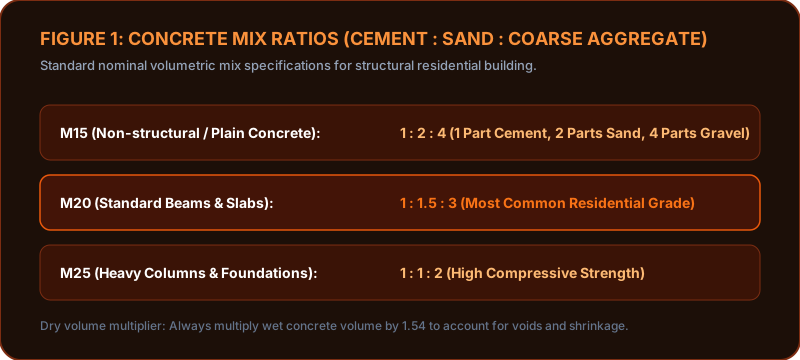
Standard Residential Grade: Beams, slabs, columns, stairs
M25
1 : 1 : 2
25 N/mm²
Heavy foundation footings, water-retaining structures, high-load columns
2. The Golden Rule of Concrete Math: The 1.54 Dry-to-Wet Factor
One of the most widespread blunders committed by novice builders is calculating materials based strictly on the wet concrete volume.
When water is added to dry cement, sand, and gravel, the fine particles dissolve into the voids between the coarse stones. As air pockets collapse, dry materials shrink by approximately 30% to 35% when converted into wet paste.
Dry Volume of Concrete = Wet Finished Volume × 1.54
Engineering Rule: To produce 1 cubic meter (1 m³) of compacted wet concrete, you must purchase and blend 1.54 cubic meters (1.54 m³) of dry cement, sand, and gravel.
3. Step-by-Step Calculation: Materials for a 10 m³ Concrete Slab
Suppose you are pouring a 10 cubic meter (10 m³) reinforced concrete floor slab using standard residential M20 grade concrete (1 : 1.5 : 3).
Step 1: Calculate the Total Dry Volume
Dry Volume = 10 m³ × 1.54 = 15.4 m³
Step 2: Sum the Ratio Proportions
Sum of Ratios = 1 + 1.5 + 3 = 5.5
Step 3: Calculate Cement Quantity
Volume of Cement = (1 / 5.5) × 15.4 = 2.80 m³
Standard density of Portland cement = 1,440 kg/m³
Weight of Cement = 2.80 m³ × 1,440 kg/m³ = 4,032 kg
Standard weight of 1 bag of cement = 50 kg
Number of Cement Bags = (4,032 / 50) = 80.64 → 81 Bags
4. Brickwork Estimation: Standard Dimensions & Mortar Math
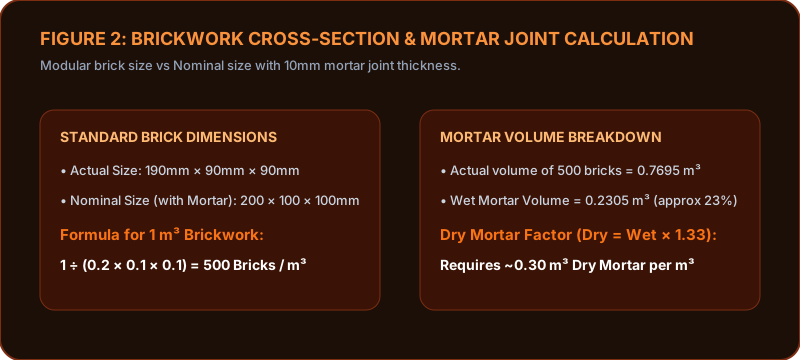
Estimating brick requirements requires accounting for both the actual dimensions of the brick unit and the mortar joint thickness (typically 10 mm / 0.4 inches).
Brickwork Cross-Section and Mortar Calculation
The Modular Brick Benchmark
Actual Size of 1 Modular Brick: 190 mm × 90 mm × 90 mm
Nominal Size with 10 mm Mortar Joint: 200 mm × 100 mm × 100 mm (0.20 m × 0.10 m × 0.10 m)
Calculating Number of Bricks per 1 Cubic Meter of Wall
5. Construction Wastage & Buffer Allowances: The Contractor's Safeguard
Never order the exact theoretical quantity calculated on paper. In the real world, materials suffer transit spillage, cutting breakage, formwork leakage, and uneven subgrade settlement.
Transit chipping, bats cutting for wall bond alignment
Ceramic / Vitrified Tiles
+10% (15% for diagonal)
Corner cuts around plumbing, edges, and patterned wastage
6. Frequently Asked Questions (FAQ)
Q1: How long must fresh concrete be cured?
Concrete reaches approximately 65% of its structural design strength at 7 days, 90% at 14 days, and 99% at 28 days. Water ponding, wet burlap, or chemical curing membranes must be maintained for a minimum of 7 to 14 days to prevent shrinkage cracking.
Q2: What is the optimal water-cement ratio?
For structural residential concrete, the water-cement ratio must stay between 0.45 and 0.55 (approx. 25 to 28 liters of clean water per 50 kg bag of cement). Adding excessive water weakens compressive strength drastically—every extra liter reduces concrete strength by up to 3%!
Q3: How do I calculate bricks for a 4.5-inch single-brick partition wall?
For a 4.5-inch (115 mm) half-brick partition wall, calculate area in square meters (m²) rather than volume. A single square meter requires approximately 50 modular bricks including 10 mm mortar joints.