Mastering Percentage Calculations: Formulas, Step-by-Step Tricks, and Practical Daily Applications
Complete guide to percentage calculations: the percentage formula triangle, % increase/decrease roadmap, reverse tax (GST/VAT) math, and mental math shortcuts.
📐
CalculatorLoop Mathematics Research Team
Math Specialists
Reviewed by Applied Mathematics Researchers
6 min read
Calculate This Instantly
Test your numbers directly with our free, real-time calculator.
Table of Contents
Mastering Percentage Calculations: Formulas, Step-by-Step Tricks, and Practical Daily Applications
From computing retail clearance discounts and calculating sales tax (GST/VAT) to analyzing investment returns, corporate dividend yields, and academic grading curves, percentages are the universal language of comparative mathematics.
Yet, despite being taught in middle school, percentage calculations remain one of the most common sources of computational errors for adults. Confusing percentage points with percentage change, botching reverse tax calculations, or miscalculating compounding increases can cost real money in everyday life.
This definitive mathematical masterclass provides the foundational formulas, introduces the intuitive percentage triangle method, solves step-by-step percentage increase and decrease problems, demystifies reverse tax math, and teaches high-speed mental math shortcuts.
1. What is a Percentage? The Core Concept
The word percentage originates from the Latin phrase per centum, meaning "by the hundred." A percentage is simply a mathematical fraction or ratio where the denominator is always fixed at 100.
1% = 1 part out of 100 = 1/100 = 0.01 (Decimal)
25% = 25 parts out of 100 = 25/100 = 0.25 (Decimal)
100% = 100 parts out of 100 = 100/100 = 1.00 (Whole)
2. The Percentage Formula Triangle: Never Forget the Equation
Every percentage calculation involves three fundamental variables:
The Whole (W): The baseline total or reference quantity (the base).
The CalculatorLoop Mathematics Research Team focuses on precision numerical methods, algorithmic algebra, geometry, and verified mathematical calculation tools.
Put this knowledge to use with our free financial calculators
math
Verified Guide
Mastering Percentage Calculations: Formulas, Step-by-Step Tricks, and Practical Daily Applications
Complete guide to percentage calculations: the percentage formula triangle, % increase/decrease roadmap, reverse tax (GST/VAT) math, and mental math shortcuts.
📐
CalculatorLoop Mathematics Research Team
Math Specialists
Reviewed by Applied Mathematics Researchers
6 min read
Calculate This Instantly
Test your numbers directly with our free, real-time calculator.
Table of Contents
Mastering Percentage Calculations: Formulas, Step-by-Step Tricks, and Practical Daily Applications
From computing retail clearance discounts and calculating sales tax (GST/VAT) to analyzing investment returns, corporate dividend yields, and academic grading curves, percentages are the universal language of comparative mathematics.
Yet, despite being taught in middle school, percentage calculations remain one of the most common sources of computational errors for adults. Confusing percentage points with percentage change, botching reverse tax calculations, or miscalculating compounding increases can cost real money in everyday life.
This definitive mathematical masterclass provides the foundational formulas, introduces the intuitive percentage triangle method, solves step-by-step percentage increase and decrease problems, demystifies reverse tax math, and teaches high-speed mental math shortcuts.
1. What is a Percentage? The Core Concept
The word percentage originates from the Latin phrase per centum, meaning "by the hundred." A percentage is simply a mathematical fraction or ratio where the denominator is always fixed at 100.
1% = 1 part out of 100 = 1/100 = 0.01 (Decimal)
25% = 25 parts out of 100 = 25/100 = 0.25 (Decimal)
100% = 100 parts out of 100 = 100/100 = 1.00 (Whole)
2. The Percentage Formula Triangle: Never Forget the Equation
Every percentage calculation involves three fundamental variables:
The Whole (W): The baseline total or reference quantity (the base).
The CalculatorLoop Mathematics Research Team focuses on precision numerical methods, algorithmic algebra, geometry, and verified mathematical calculation tools.
Put this knowledge to use with our free financial calculators
The Percentage (P%)
The Part (P): The portion of the whole represented by that percentage.
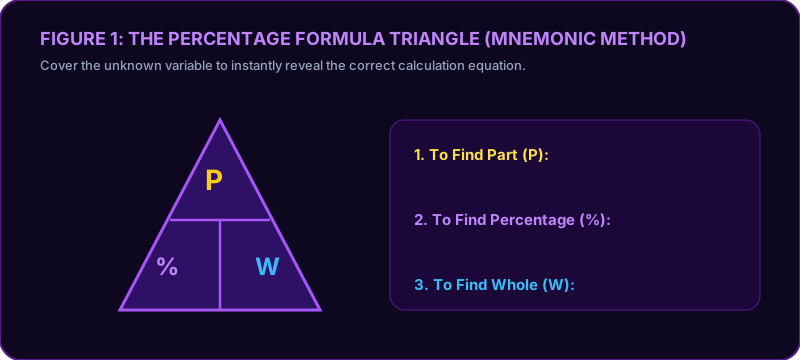
The Percentage Formula Triangle Mnemonic Method
The Three Master Formulas
By covering the unknown variable on the triangle with your finger, you instantly reveal the required mathematical operation:
To Find the Part (P):
Part = Whole × ( frac{Percentage}{100} )
Example: What is 15% of 240?\rightarrow 240 \times 0.15 = \mathbf{36}$.
To Find the Percentage (P%):
Percentage (%) = ( frac{Part}{Whole} ) × 100
Example: A student scores 68 marks out of 80. What is their percentage? → (68 ÷ 80) × 100 = 85%.
To Find the Whole (W):
Whole = frac{Part}{Percentage ÷ 100}
Example: If 45 represents 30% of a bill, what was the total bill?\rightarrow 45 \div 0.30 = \mathbf{\150}.
3. Percentage Increase and Decrease: The Golden Rule
Calculating percentage change measures how much a value has grown or shrunk relative to its original starting point.
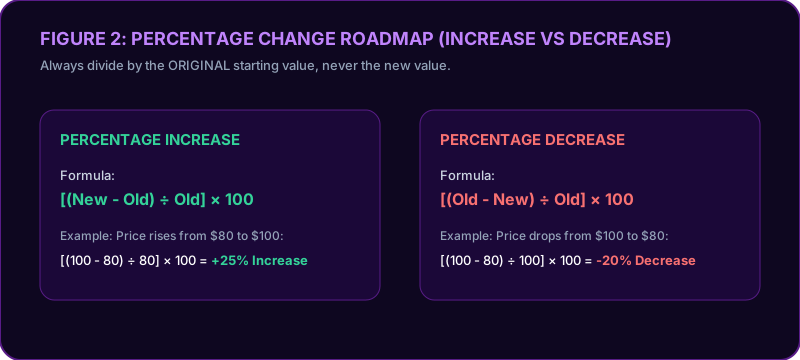
Percentage Change Roadmap: Increase vs Decrease
The Golden Rule of Percentage Change: Always divide the difference by the ORIGINAL (Old) value, never by the new or current value!
Percentage Change (%) = ( frac{New Value - Old Value}{Old Value} ) × 100
1. Worked Example: Percentage Increase
A company stock was priced at 80 in January and rose to 100 by June.
Difference = 100 - 80 = 20
Division by Original = (20 / 80) = 0.25
Percentage Increase = 0.25 × 100 = +25% Gain
2. Worked Example: Percentage Decrease (The Asymmetry Trap!)
Now, suppose the stock falls from 100 back down to 80. What was the percentage loss?
Difference = 80 - 100 = -20
Division by Original = (-20 / 100) = -0.20
Percentage Decrease = -0.20 × 100 = -20% Loss
The Asymmetry Insight:
Notice that gaining 25% from 80 brings you to100. But losing 25% from 100 brings you down to75! A 50% market drop requires a 100% gain just to break even.
4. Reverse Percentage Math: Finding Pre-Tax and Pre-Discount Prices
Retail stores, invoices, and accounting systems constantly present totals with sales tax (GST/VAT) already added, or show sale prices after a promotional discount has been applied.
How to Calculate Original Price Before Tax (Reverse Tax Math)
Suppose you purchase a smartphone for $1,180, which includes an 18% Value-Added Tax (VAT / GST). What was the actual pre-tax price?
The Common Mistake: Subtracting 18% of 1,180 (1,180 - 212.40 =967.60). This is completely wrong because the 18% tax was levied on the original base price, not on the total final amount!
The Correct Reverse Formula:
Pre-Tax Price = frac{Total Price with Tax}{1 + (Tax Rate ÷ 100)}
Pre-Tax Price = frac{1,180}{1 + 0.18} = \frac{\1,180}{1.18} = mathbf{1,000.00}$
The actual tax paid was exactly $180.00.
How to Calculate Original Price Before a Sale Discount
A jacket is on sale for $120 after a 25% promotional discount. What was the original retail price?
Original Price = frac{Sale Price}{1 - (Discount Rate ÷ 100)}
Original Price = frac{120}{1 - 0.25} = \frac{\120}{0.75} = mathbf{160.00}$
5. High-Speed Mental Math Shortcuts for Daily Life
You don't need a calculator to compute tips, discounts, or margins on the fly. Memorize these mental anchors:
The 10% Anchor Rule:
To find 10% of any number, move the decimal point one place to the left.
Example: 10% of 64.50 is 6.45.
The 1% Micro Rule:
To find 1% of any number, move the decimal point two places to the left.
Example: 1% of 3,200 is 32.
The 15% Tip Trick (10% + Half):
Calculate 10% (60 bill\rightarrow6.00). Take half of that (3.00). Add them together:\6.00 +3.00 = \mathbf{\9.00 Tip}.
The Commutative Swap Rule (x% of y = y% of x):
Need to calculate 16% of 50? That sounds hard in your head.
Swap the numbers: Calculate 50% of 16 instead!
50% of 16 is simply half of 16 = 8! Both equations equal 8.
6. Frequently Asked Questions (FAQ)
Q1: What is the difference between "Percentage" and "Percentage Points"?
A percentage represents a relative ratio, while a percentage point represents the direct arithmetic difference between two percentages. For example, if an interest rate increases from 4% to 5%:
It has increased by 1 percentage point.
But in relative terms, it has surged by 25 percent (1 ÷ 4 = 0.25)!
Q2: Can a percentage be greater than 100%?
Yes. A percentage exceeding 100% simply means the part is larger than the original reference whole. For example, if your income doubles from 50,000 to100,000, your new income is 200% of your old income, representing a 100% increase.