Understanding EMI: A Complete Guide to Equated Monthly Installments | CalculatorLoop | Calculator Loop
financial
Verified Guide
Understanding EMI: A Complete Guide to Equated Monthly Installments
Master EMI calculations, the loan amortization formula, reducing-balance vs flat rates, and proven strategies to slash total interest.
💼
CalculatorLoop Financial Expert Team
Financial Experts
Reviewed by Certified Financial Specialists
8 min read
Calculate This Instantly
Test your numbers directly with our free, real-time calculator.
Table of Contents
Understanding EMI: A Complete Guide to Equated Monthly Installments, Amortization, and Prepayment Strategies
Whether you are applying for a 30-year home mortgage, financing an electric vehicle, or taking out a personal loan, the term EMI (Equated Monthly Installment) dictates your monthly cash flow for years—or even decades. Yet, millions of borrowers commit to multi-year loans without understanding how interest is front-loaded, how amortization schedules work, or how simple prepayment adjustments can save tens of thousands of dollars.
This comprehensive guide breaks down the mathematics of EMI, examines the reducing-balance method versus the flat-rate trap, provides real-world calculation scenarios, and outlines battle-tested financial strategies to help you pay off your loans years ahead of schedule.
1. What is an Equated Monthly Installment (EMI)?
An Equated Monthly Installment (EMI) is a predetermined, fixed monthly payment made by a borrower to a bank or financial institution on a specific date each calendar month. The EMI is engineered to pay off both the loan principal and the accumulated interest over a specified tenure, ensuring the loan balance drops to exactly zero at the end of the term.
The Two Core Components of Every EMI
Every single EMI payment you make is split into two distinct parts:
Principal Component: The portion of money that directly reduces the outstanding loan balance.
Interest Component: The fee charged by the lender for borrowing their capital, calculated based on the outstanding principal balance.
Total Monthly EMI = Principal Repayment Portion + Monthly Interest Charge
2. The Amortization Paradox: Why You Pay Interest First
The CalculatorLoop Financial Expert Team brings together certified analysts, chartered financial modelers, and quantitative researchers to deliver transparent, institutional-grade calculation guides.
Put this knowledge to use with our free financial calculators
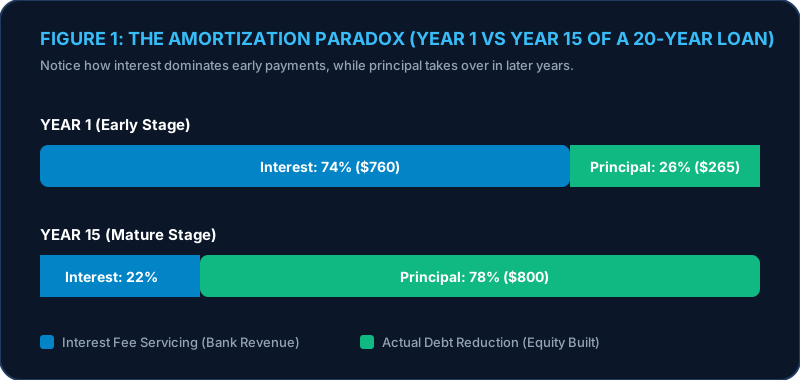
One of the biggest surprises for first-time borrowers is looking at their loan statement after three years of regular payments and discovering that the principal balance has barely moved. This phenomenon is caused by loan amortization.
During the initial years of any long-term loan (such as a 20-year or 30-year home mortgage), the outstanding principal is at its highest. Consequently, the monthly interest charge is also at its peak.
The Amortization Paradox: Year 1 vs Year 15 Split
Breakdown of the Amortization Stages
Early Stage (Years 1 to 5): Up to 70% to 80% of your monthly EMI goes exclusively toward servicing interest, while only 20% to 30% reduces the actual principal.
Mid Stage (Years 6 to 12): The split reaches parity (50% principal, 50% interest) as the principal balance gradually declines.
Late Stage (Final 5 Years): Over 80% to 90% of your EMI goes toward the principal, as the remaining interest charge has dropped to negligible amounts.
Loan Timeline Stage
Principal Portion of EMI
Interest Portion of EMI
Outstanding Principal Reduction Speed
Year 1 – 5
20% – 30% (Low)
70% – 80% (Heavy)
Very Slow
Year 6 – 12
45% – 55% (Moderate)
45% – 55% (Moderate)
Accelerating
Year 13 – 20
75% – 90% (Dominant)
10% – 25% (Minimal)
Maximum Velocity
3. The Mathematical EMI Formula Explained
Financial institutions across the world calculate monthly loan installments using the standard compound amortization equation:
EMI = P × r × ((1 + r)ⁿ / (1 + r)ⁿ - 1)
Where:
P (Principal Amount): The initial sum borrowed from the lender.
r (Monthly Interest Rate): The annual percentage interest rate divided by 12 months and expressed as a decimal (r = frac{Annual Rate}{12 × 100}).
n (Loan Tenure in Months): The total duration of the loan multiplied by 12 (n = Years × 12).
Step-by-Step Worked Mathematical Example
Let us calculate the exact EMI for a $100,000 home improvement loan with an annual interest rate of 9.0% over a tenure of 15 years (180 months).
Step 1: Convert Variables to Monthly Figures
P = 100,000
r = (9.0 / 12 × 100) = 0.0075 per month
n = 15 × 12 = 180 months
Step 2: Compute the Compounding Factor (1 + r)ⁿ
(1 + 0.0075)^{180} ≈ 3.838043
Step 3: Solve the Numerator and Denominator
Numerator: 100,000 × 0.0075 × 3.838043 = 2,878.53
Denominator: 3.838043 - 1 = 2.838043
Step 4: Final EMI Calculation
EMI = (2,878.53 / 2.838043) = mathbf{1,014.27 \text{ per month}}$
Over the course of 180 months:
Total Repayment Amount: 1,014.27 × 180 = mathbf{182,568.60}$
Total Interest Paid: 182,568.60 -100,000 = \mathbf{\82,568.60} (Over 82% of the borrowed amount!)
4. Reducing-Balance vs. Flat-Rate Interest: The Borrower Trap
One of the most dangerous marketing gimmicks employed by lenders—especially for consumer durable and automobile loans—is quoting a deceptively low "flat interest rate."
The Flat-Rate Calculation Trap
In a flat-rate loan, interest is calculated on the entire initial principal amount across the entire tenure, completely ignoring the fact that you are repaying principal every month.
Example: A $10,000 loan at a "5% flat rate" for 5 years:
Annual Interest = 10,000 × 5% =500$
Total Interest over 5 years = 500 \times 5 = $2,500$
In a reducing-balance loan, interest is calculated only on the remaining balance you actually owe at any given moment.
If you convert that identical $208.33$ monthly EMI back into an effective reducing-balance APR, the actual interest rate you are paying is 9.15% per annum—nearly double the advertised 5%!
Parameter
Flat Rate Loan
Reducing Balance Loan
Interest Calculation Base
Original Principal throughout
Outstanding Principal only
Advertised Rate
Looks deceptively low (e.g., 5%)
Reflects true APR (e.g., 9.15%)
Fairness to Borrower
Very poor (you pay interest on repaid debt)
Mathematically fair and transparent
Best Used For
Never (avoid whenever possible)
All institutional mortgages & loans
5. Proven Prepayment Strategies: Slicing Years Off Your Debt
You do not have to accept 15 to 30 years of interest servitude. By implementing strategic repayment techniques, you can eliminate debt years in advance.
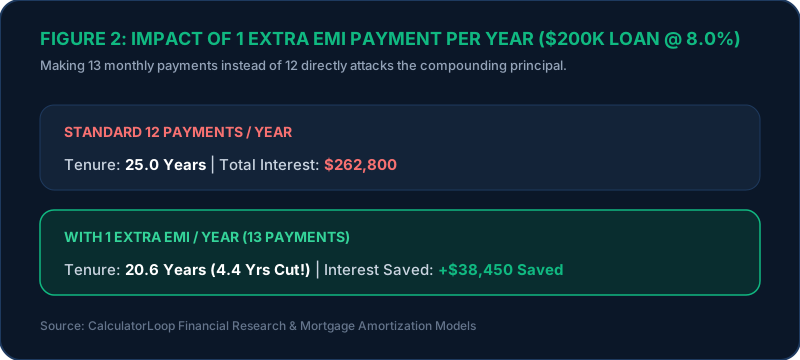
Impact of 1 Extra EMI Payment Per Year
Strategy 1: The "1 Extra EMI Per Year" Rule
By paying just one additional EMI payment every calendar year (13 payments instead of 12), you directly reduce the principal balance during the high-interest initial phase.
On a 25-year, 200,000 home loan at 8.0%, paying 1 extra EMI every year cuts your loan tenure by nearly 4.5 years and saves more than 38,000 in interest.
Strategy 2: Annual 5% to 10% Prepayment Step-Up
Whenever you receive an annual workplace bonus, tax refund, or salary raise, direct 5% of your outstanding loan balance toward a principal prepayment.
Because 100% of a prepayment subtracts from the principal balance, every future month's interest charge shrinks permanently.
Strategy 3: The 15-Year vs. 30-Year Mortgage Decision
30-Year Term (250,000 @ 7.5%): EMI =1,748| Total Interest = 379,300
15-Year Term (250,000 @ 7.5%): EMI =2,319| Total Interest = 167,400
Paying an extra 571 per month saves an astounding 211,900 in cold, hard cash!
6. Frequently Asked Questions (FAQ)
Q1: What happens if I miss an EMI payment?
Missing an EMI triggers late payment penalty charges (typically 2% to 4% per month on the overdue amount), damages your credit score significantly (often a 50 to 70 point drop), and flags your profile with credit rating agencies.
Q2: Does increasing tenure reduce total interest?
No, the opposite is true. Increasing tenure lowers your monthly payment because repayment is spread across more months, but it dramatically increases the total interest paid over the life of the loan.
Q3: Are there penalty fees for prepaying an EMI?
In many jurisdictions, regulatory bodies (such as the Reserve Bank of India or federal consumer credit protection bureaus) have abolished prepayment penalties on floating-rate home loans for individual borrowers. However, fixed-rate loans and personal loans may still carry prepayment fees between 1% and 3%. Always review your agreement.
Verify that the loan utilizes the reducing-balance method, not a flat-rate structure.
Aim for a Total Debt-to-Income (DTI) ratio below 35% to 40% of your net monthly income.
Commit to paying at least one extra installment or an annual 5% prepayment toward the principal.
One of the biggest surprises for first-time borrowers is looking at their loan statement after three years of regular payments and discovering that the principal balance has barely moved. This phenomenon is caused by loan amortization.
During the initial years of any long-term loan (such as a 20-year or 30-year home mortgage), the outstanding principal is at its highest. Consequently, the monthly interest charge is also at its peak.
The Amortization Paradox: Year 1 vs Year 15 Split
Breakdown of the Amortization Stages
Early Stage (Years 1 to 5): Up to 70% to 80% of your monthly EMI goes exclusively toward servicing interest, while only 20% to 30% reduces the actual principal.
Mid Stage (Years 6 to 12): The split reaches parity (50% principal, 50% interest) as the principal balance gradually declines.
Late Stage (Final 5 Years): Over 80% to 90% of your EMI goes toward the principal, as the remaining interest charge has dropped to negligible amounts.
Loan Timeline Stage
Principal Portion of EMI
Interest Portion of EMI
Outstanding Principal Reduction Speed
Year 1 – 5
20% – 30% (Low)
70% – 80% (Heavy)
Very Slow
Year 6 – 12
45% – 55% (Moderate)
45% – 55% (Moderate)
Accelerating
Year 13 – 20
75% – 90% (Dominant)
10% – 25% (Minimal)
Maximum Velocity
3. The Mathematical EMI Formula Explained
Financial institutions across the world calculate monthly loan installments using the standard compound amortization equation:
EMI = P × r × ((1 + r)ⁿ / (1 + r)ⁿ - 1)
Where:
P (Principal Amount): The initial sum borrowed from the lender.
r (Monthly Interest Rate): The annual percentage interest rate divided by 12 months and expressed as a decimal (r = frac{Annual Rate}{12 × 100}).
n (Loan Tenure in Months): The total duration of the loan multiplied by 12 (n = Years × 12).
Step-by-Step Worked Mathematical Example
Let us calculate the exact EMI for a $100,000 home improvement loan with an annual interest rate of 9.0% over a tenure of 15 years (180 months).
Step 1: Convert Variables to Monthly Figures
P = 100,000
r = (9.0 / 12 × 100) = 0.0075 per month
n = 15 × 12 = 180 months
Step 2: Compute the Compounding Factor (1 + r)ⁿ
(1 + 0.0075)^{180} ≈ 3.838043
Step 3: Solve the Numerator and Denominator
Numerator: 100,000 × 0.0075 × 3.838043 = 2,878.53
Denominator: 3.838043 - 1 = 2.838043
Step 4: Final EMI Calculation
EMI = (2,878.53 / 2.838043) = mathbf{1,014.27 \text{ per month}}$
Over the course of 180 months:
Total Repayment Amount: 1,014.27 × 180 = mathbf{182,568.60}$
Total Interest Paid: 182,568.60 -100,000 = \mathbf{\82,568.60} (Over 82% of the borrowed amount!)
4. Reducing-Balance vs. Flat-Rate Interest: The Borrower Trap
One of the most dangerous marketing gimmicks employed by lenders—especially for consumer durable and automobile loans—is quoting a deceptively low "flat interest rate."
The Flat-Rate Calculation Trap
In a flat-rate loan, interest is calculated on the entire initial principal amount across the entire tenure, completely ignoring the fact that you are repaying principal every month.
Example: A $10,000 loan at a "5% flat rate" for 5 years:
Annual Interest = 10,000 × 5% =500$
Total Interest over 5 years = 500 \times 5 = $2,500$
In a reducing-balance loan, interest is calculated only on the remaining balance you actually owe at any given moment.
If you convert that identical $208.33$ monthly EMI back into an effective reducing-balance APR, the actual interest rate you are paying is 9.15% per annum—nearly double the advertised 5%!
Parameter
Flat Rate Loan
Reducing Balance Loan
Interest Calculation Base
Original Principal throughout
Outstanding Principal only
Advertised Rate
Looks deceptively low (e.g., 5%)
Reflects true APR (e.g., 9.15%)
Fairness to Borrower
Very poor (you pay interest on repaid debt)
Mathematically fair and transparent
Best Used For
Never (avoid whenever possible)
All institutional mortgages & loans
5. Proven Prepayment Strategies: Slicing Years Off Your Debt
You do not have to accept 15 to 30 years of interest servitude. By implementing strategic repayment techniques, you can eliminate debt years in advance.
Impact of 1 Extra EMI Payment Per Year
Strategy 1: The "1 Extra EMI Per Year" Rule
By paying just one additional EMI payment every calendar year (13 payments instead of 12), you directly reduce the principal balance during the high-interest initial phase.
On a 25-year, 200,000 home loan at 8.0%, paying 1 extra EMI every year cuts your loan tenure by nearly 4.5 years and saves more than 38,000 in interest.
Strategy 2: Annual 5% to 10% Prepayment Step-Up
Whenever you receive an annual workplace bonus, tax refund, or salary raise, direct 5% of your outstanding loan balance toward a principal prepayment.
Because 100% of a prepayment subtracts from the principal balance, every future month's interest charge shrinks permanently.
Strategy 3: The 15-Year vs. 30-Year Mortgage Decision
30-Year Term (250,000 @ 7.5%): EMI =1,748| Total Interest = 379,300
15-Year Term (250,000 @ 7.5%): EMI =2,319| Total Interest = 167,400
Paying an extra 571 per month saves an astounding 211,900 in cold, hard cash!
6. Frequently Asked Questions (FAQ)
Q1: What happens if I miss an EMI payment?
Missing an EMI triggers late payment penalty charges (typically 2% to 4% per month on the overdue amount), damages your credit score significantly (often a 50 to 70 point drop), and flags your profile with credit rating agencies.
Q2: Does increasing tenure reduce total interest?
No, the opposite is true. Increasing tenure lowers your monthly payment because repayment is spread across more months, but it dramatically increases the total interest paid over the life of the loan.
Q3: Are there penalty fees for prepaying an EMI?
In many jurisdictions, regulatory bodies (such as the Reserve Bank of India or federal consumer credit protection bureaus) have abolished prepayment penalties on floating-rate home loans for individual borrowers. However, fixed-rate loans and personal loans may still carry prepayment fees between 1% and 3%. Always review your agreement.