Master GST calculations in India. Learn 4 tax slabs, CGST vs SGST vs IGST splitting, Input Tax Credit (ITC) optimization, RCM rules, and invoice formulas.
💼
CalculatorLoop Financial Expert Team
Financial Experts
Reviewed by Certified Financial Specialists
15 min read
Calculate This Instantly
Test your numbers directly with our free, real-time calculator.
Whether you are a startup founder drafting your first corporate invoice, an independent freelancer billing domestic and overseas clients, a retail merchant managing inventory, or a consumer scrutinizing a restaurant or electronics bill—Goods and Services Tax (GST) impacts every rupee of commerce you conduct in India.
Rolled out at the historic midnight session of Parliament on July 1, 2017, under the banner of "One Nation, One Tax," GST replaced 17 central and state levies—including Central Excise Duty, Service Tax, State VAT, Entry Tax, Luxury Tax, and Octroi. While GST dramatically simplified India's indirect tax landscape, calculating taxes accurately, determining the correct tax jurisdiction (CGST, SGST, IGST), understanding Input Tax Credit (ITC) eligibility, and staying compliant with dynamic e-invoicing mandates can still be daunting.
In this comprehensive, quantitative guide prepared by the CalculatorLoop Financial & Taxation Specialist Team, we dissect the entire architecture of India's GST regime. We explain the exact mathematical formulas for inclusive and exclusive price calculations, analyze current 2026 tax slabs, demystify the Input Tax Credit mechanism that saves businesses millions, detail Reverse Charge Mechanism (RCM) triggers, and provide a battle-tested compliance checklist to keep your business penalty-free.
1. What is GST? The Architecture of India's Unified Tax
Goods and Services Tax (GST) is a destination-based, multi-stage, comprehensive indirect tax levied on the manufacture, sale, and consumption of goods and services throughout India.
To understand why GST transformed Indian business, examine its three foundational pillars:
+--------------------------------------------------------------------------+
|                       THE THREE PILLARS OF GST                           |
+--------------------------------------------------------------------------+
| 1. DESTINATION-BASED : Tax accrues to the consuming state, not producer |
| 2. MULTI-STAGE       : Levied at every commercial transaction node       |
| 3. VALUE ADDITION    : Tax is paid ONLY on incremental value created     |
+--------------------------------------------------------------------------+
The CalculatorLoop Financial Expert Team brings together certified analysts, chartered financial modelers, and quantitative researchers to deliver transparent, institutional-grade calculation guides.
Destination-Based Principle: Unlike the pre-2017 origin-based manufacturing taxes (where producing states collected excise), GST follows the destination principle. The tax revenue ultimately accrues to the state where the product or service is actually consumed.
Multi-Stage Collection: GST is collected at every node of the supply chain—from the raw material supplier to the industrial manufacturer, distributor, wholesale merchant, retailer, and final customer.
Value Addition Taxation: At each intermediate stage, the business pays tax only on the incremental value it created, claiming a refund (Input Tax Credit) for the taxes already paid by earlier suppliers. This completely eliminates the devastating cascading effect (tax on tax) of earlier tax regimes.
2. Before GST vs. After GST: The Mathematics of the "Cascading Effect"
To appreciate how GST reduced consumer costs and improved supply chain efficiency, compare how a manufactured item was taxed before and after GST:
The Pre-GST Cascading Nightmare
Manufacturer produces goods at a base cost of ₹10,000.
Central Excise Duty (12.5%) added: ₹10,000 + ₹1,250 = ₹11,250.
State VAT (14.5%) was levied on the total ₹11,250 (charging tax on top of excise duty!): ₹11,250 + ₹1,631 = ₹12,881.
Inter-state Central Sales Tax (CST) of 2% was added with zero input credit available across state borders.
Result: Consumers routinely paid an effective tax burden of 30% to 35% on everyday manufactured goods due to taxes compounding on top of taxes.
The Unified GST Structure
Manufacturer produces goods at a base cost of ₹10,000.
Standard 18% GST applied: ₹1,800.
Total invoice: ₹11,800.
Wholesaler adds ₹2,000 in logistics, storage, and profit margin (total value: ₹12,000).
Wholesaler charges 18% GST on ₹12,000 = ₹2,160.
But via Input Tax Credit, the wholesaler takes credit for the ₹1,800 already paid, remitting only ₹360 (18% of their ₹2,000 added value) to the government!
3. GST Slabs in India (Current 2026 Schedule)
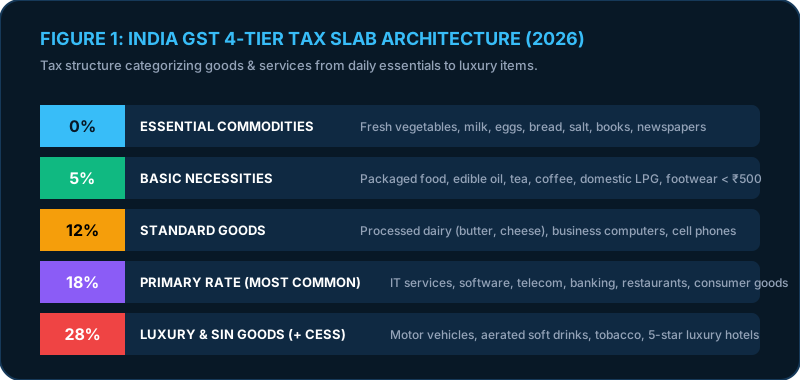
Figure 1: India GST 4-Tier Tax Slab Architecture
India employs a 4-tier rate structure (with special rates for precious metals and nil-rated essential commodities) designed to protect lower-income households while generating revenue from luxury and demerit goods:
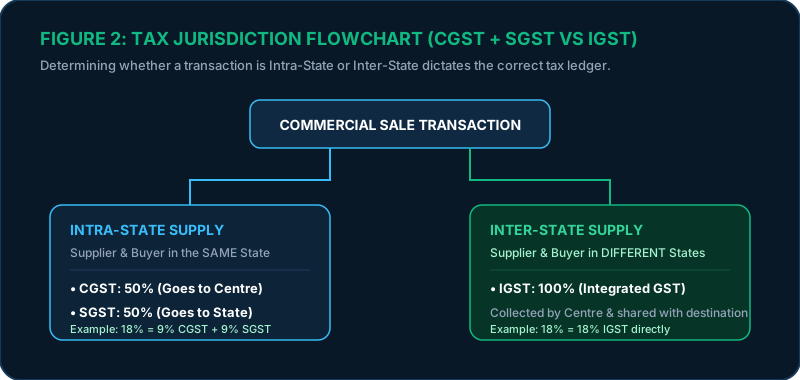
The most common source of invoice errors for new businesses is selecting the wrong tax ledger. GST in India is administered under a dual framework governed by whether a sale is Intra-State or Inter-State.
                           SUPPLY TRANSACTION
                                   |
         +-------------------------+-------------------------+
         |                                                   |
    INTRA-STATE                                         INTER-STATE
 (Within Same State)                                 (Across State Borders)
         |                                                   |
   SPLIT 50 / 50                                     100% TO SINGLE TAX
   - CGST (To Centre)                                 - IGST (To Centre)
   - SGST (To State)                                   (Shared with Destination)
1. Intra-State Supply (Buyer and Seller in the Same State)
When the supplier's location and the place of supply are in the same state:
The applicable GST rate is divided equally between the Central Government and the State Government.
CGST (Central GST): 50% of the total tax rate.
SGST (State GST): 50% of the total tax rate.
Example: A computer dealer in Bengaluru sells a laptop to a Bengaluru resident for ₹60,000 + 18% GST:
CGST (9%) = ₹5,400
SGST (9%) = ₹5,400
Total Invoice = ₹70,800
2. Inter-State Supply (Buyer and Seller in Different States)
When the supplier's location and the place of supply are in different states, or for international imports:
IGST (Integrated GST): Levied at the full tax rate (100%) by the Central Government, which subsequently apportions the destination state's share.
Example: A graphic designer in Pune (Maharashtra) invoices a corporate client in Gurgaon (Haryana) for ₹1,00,000 + 18% GST:
IGST (18%) = ₹18,000
Total Invoice = ₹1,18,000
3. UTGST (Union Territory GST)
For Union Territories without an elected state legislature (e.g., Andaman and Nicobar Islands, Chandigarh, Dadra and Nagar Haveli, Daman and Diu, Ladakh, Lakshadweep), UTGST replaces SGST. The tax is split as CGST + UTGST.
5. The Two Essential GST Mathematical Formulas
Calculating GST accurately is critical for bookkeeping, quoting client estimates, and filing monthly GSTR-3B returns.
Formula 1: Adding GST to a Base Amount (GST-Exclusive Price)
Use this formula when you know the pre-tax cost and need to calculate the tax and gross billing amount:
GST Amount = frac{Base Price × GST Rate}{100}
Total Invoice Price = Base Price + GST Amount = Base Price × (1 + frac{GST Rate}{100})
Worked Example:
A consulting firm quotes a professional fee of ₹1,50,000 at 18% GST:
Formula 2: Extracting GST from a Gross Price (GST-Inclusive Price)
Retail consumer goods, flight tickets, restaurant bills, and hotel room tariffs are frequently displayed as inclusive of taxes. To determine the true pre-tax value and the tax component:
You can calculate both inclusive and exclusive numbers instantaneously with zero math errors using our Free Online GST Calculator.
6. Input Tax Credit (ITC): The Engine of Corporate Tax Optimization
Input Tax Credit (ITC) is the single most valuable mechanism within the GST framework. It ensures that businesses are taxed strictly on their value additions rather than their gross transaction values.
The Mechanics of Claiming ITC
When a registered enterprise purchases inputs, capital equipment, or professional services for commercial operations, it pays GST to its vendors (Input Tax). When it delivers products or services to clients, it collects GST (Output Tax).
Net Tax Payable to Government = Output Tax Liability - Eligible Input Tax Credit
Real-World Commercial Illustration:
Consider an independent digital agency:
Monthly Revenue: Billed ₹10,00,000 in digital marketing services at 18% GST.
Instead of handing over the full ₹1,80,000, the agency legally saves ₹90,000 by claiming credit for legitimate business expenses!
Mandatory Statutory Conditions for Claiming ITC (Section 16)
To claim ITC legally without triggering tax notices or penalties:
The buyer must possess a valid Tax Invoice or Debit Note issued by a GST-registered vendor.
The goods or services must have been physically received.
The supplier must have uploaded the invoice in their GSTR-1, and it must reflect accurately in the buyer's auto-populated GSTR-2B statement.
The buyer must have paid the vendor within 180 days from the invoice date (if unpaid within 180 days, the claimed ITC must be reversed with 18% interest!).
Blocked Input Tax Credits: What You CANNOT Claim (Section 17(5))
The GST law explicitly forbids claiming ITC on certain expenses, even if incurred for business purposes:
Motor Vehicles: Passenger vehicles with seating capacity ≤ 13 persons (unless in the business of transportation, driving schools, or car dealerships).
Food, Beverages & Outdoor Catering: Meals, business dinners, corporate celebrations, and event catering.
Club Memberships & Health Fitness: Gym memberships, social clubs, health club passes.
Travel Benefits: Leave travel concessions (LTC) or personal holiday packages for employees.
Goods Lost, Stolen, Destroyed, or Written Off: Obsolete inventory or free marketing samples.
Personal Consumption: Any expense diverted for non-business or personal use.
7. Mandatory Registration Thresholds & The Composition Scheme
Not every small business is forced to register for GST immediately. The law provides clear annual turnover thresholds:
GST Registration Thresholds (2026)
Business Nature
Standard Indian States
Special Category States (NE, Hills)
Pure Goods Suppliers
₹40 Lakhs annual aggregate turnover
₹20 Lakhs annual aggregate turnover
Service Providers & Mixed
₹20 Lakhs annual aggregate turnover
₹10 Lakhs annual aggregate turnover
Inter-State E-Commerce
Compulsory registration (₹0 threshold)
Compulsory registration (₹0 threshold)
Inter-State Sellers
Compulsory registration (with exceptions)
Compulsory registration
Special Category States include: Arunachal Pradesh, Assam, Jammu & Kashmir, Manipur, Meghalaya, Mizoram, Nagaland, Sikkim, Tripura, Himachal Pradesh, and Uttarakhand.
The Composition Scheme: Simplified Compliance for MSMEs
For small enterprises overwhelmed by monthly invoicing and reconciliation, the government offers the Composition Scheme for businesses with turnover up to ₹1.5 Crore (₹50 Lakh for service providers):
Manufacturers & Traders: Pay a flat 1% GST on turnover (0.5% CGST + 0.5% SGST).
Restaurants (Non-alcohol): Pay a flat 5% GST on turnover.
Service Providers: Pay a flat 6% GST on turnover (under Section 10(2A)).
Trade-offs of Composition:
Cannot issue tax invoices or charge GST to customers.
Cannot claim Input Tax Credit on purchases.
Cannot engage in inter-state outward sales.
Only required to file one quarterly statement (CMP-08) and one annual return (GSTR-4).
8. Reverse Charge Mechanism (RCM): When Buyer Pays the Tax
Under ordinary GST mechanisms, the supplier collects tax from the buyer and deposits it with the treasury. Under the Reverse Charge Mechanism (RCM), the statutory obligation flips: the recipient/buyer must pay the tax directly to the government.
Key Transactions Subject to Mandatory RCM:
Goods Transport Agency (GTA): Freight charges paid to transporters (taxed at 5% RCM if GTA does not charge 12% forward rate).
Legal Services: Fees paid to advocates or senior legal counsels by a business entity.
Director Fees: Remuneration or sitting fees paid to non-executive company directors.
Sponsorship Services: Sponsorship fees paid to any individual or sports body.
Recovery Agents: Services provided by recovery agents to banking institutions.
[!NOTE]
Even though you pay RCM tax out of pocket, you can immediately claim 100% of it back as Input Tax Credit in the same month's GSTR-3B return, provided the underlying expense is an eligible business input!
9. GST Return Filing Calendar: Key Deadlines & Forms
Filing late attracts mandatory daily late fees (₹50/day; ₹20/day for nil returns) plus 18% per annum penal interest on outstanding tax liabilities.
Return Form
Target Population
Content Summary
Statutory Filing Deadline
GSTR-1
Regular registered taxpayers
Monthly details of all outward supplies (sales invoices)
11th of succeeding month
GSTR-3B
Regular registered taxpayers
Monthly self-declared summary of sales, ITC claims, and tax payments
20th of succeeding month
IFF (QRMP)
Small taxpayers (Turnover < ₹5 Cr)
Invoice Furnishing Facility under Quarterly Return Monthly Payment
13th of month following quarter
GSTR-4
Composition scheme dealers
Annual summary return for composition taxpayers
30th April following financial year
GSTR-9
Regular taxpayers
Comprehensive annual reconciliation return
31st December following financial year
10. Frequently Asked Questions (FAQ)
Q1. Can an unregistered freelancer charge GST to clients?
No. Charging GST without possessing a valid, active 15-digit GSTIN (Goods and Services Tax Identification Number) is a criminal offense under the CGST Act. If your annual service turnover is below ₹20 Lakhs, you issue standard non-GST commercial invoices without charging tax.
Q2. How do I verify if a vendor's GSTIN is active and genuine?
You can verify any vendor's GST registration in seconds through the official GST Portal (gst.gov.in) under "Search Taxpayer." The portal displays the taxpayer's legal business name, trade name, active status, jurisdiction, and return filing track record.
Q3. Can I claim ITC on an invoice if the vendor forgets to file GSTR-1?
No. Under the amended Section 16(2)(aa) of the CGST Act, you can only claim Input Tax Credit if the supplier has furnished the invoice in their GSTR-1 and it is reflected in your auto-populated GSTR-2B. If the invoice does not appear in your GSTR-2B, the credit is strictly disallowed. Always establish vendor agreements stipulating timely GSTR-1 filing before releasing final payment.
Q4. What is the difference between Nil-Rated, Zero-Rated, and Exempt Goods?
Exempt Goods: Items completely outside the GST net or granted specific exemption notifications. No ITC can be claimed on inputs used to make exempt goods.
Zero-Rated: Exports of goods/services to foreign nations or supplies to Special Economic Zone (SEZ) developers. Zero-rated supplies carry 0% output tax, but allow 100% full refund of all Input Tax Credits incurred!
Q5. Is GST applicable on property transactions?
Under-construction residential property: Taxed at 5% GST without ITC (or 1% for affordable housing under ₹45 Lakhs).
Ready-to-move-in property with Completion Certificate (CC): 100% exempt from GST (only state stamp duty and registration fees apply).
Q6. What is the HSN / SAC Code on an invoice?
HSN stands for Harmonized System of Nomenclature (used for physical goods), while SAC stands for Services Accounting Code (used for services). These international 4, 6, or 8-digit classification codes determine the exact legal tax slab applicable to that specific commodity.
Conclusion: Master Your Taxes with CalculatorLoop
The Indian GST system is designed to reward transparent, digitized record-keeping while penalizing careless invoicing and delayed compliance. By mastering the core principles of tax jurisdiction (CGST vs SGST vs IGST), leveraging eligible Input Tax Credits, and verifying your numbers with precision tools, you protect your business's cash flow and maintain flawless regulatory standing.
Save time and ensure 100% arithmetic accuracy:
Calculate any GST amount, split taxes between CGST and SGST, or back-calculate base prices from inclusive receipts using our Free Instant GST Calculator.
7.
7. Mandatory Registration Thresholds & The Composition Scheme
Destination-Based Principle: Unlike the pre-2017 origin-based manufacturing taxes (where producing states collected excise), GST follows the destination principle. The tax revenue ultimately accrues to the state where the product or service is actually consumed.
Multi-Stage Collection: GST is collected at every node of the supply chain—from the raw material supplier to the industrial manufacturer, distributor, wholesale merchant, retailer, and final customer.
Value Addition Taxation: At each intermediate stage, the business pays tax only on the incremental value it created, claiming a refund (Input Tax Credit) for the taxes already paid by earlier suppliers. This completely eliminates the devastating cascading effect (tax on tax) of earlier tax regimes.
2. Before GST vs. After GST: The Mathematics of the "Cascading Effect"
To appreciate how GST reduced consumer costs and improved supply chain efficiency, compare how a manufactured item was taxed before and after GST:
The Pre-GST Cascading Nightmare
Manufacturer produces goods at a base cost of ₹10,000.
Central Excise Duty (12.5%) added: ₹10,000 + ₹1,250 = ₹11,250.
State VAT (14.5%) was levied on the total ₹11,250 (charging tax on top of excise duty!): ₹11,250 + ₹1,631 = ₹12,881.
Inter-state Central Sales Tax (CST) of 2% was added with zero input credit available across state borders.
Result: Consumers routinely paid an effective tax burden of 30% to 35% on everyday manufactured goods due to taxes compounding on top of taxes.
The Unified GST Structure
Manufacturer produces goods at a base cost of ₹10,000.
Standard 18% GST applied: ₹1,800.
Total invoice: ₹11,800.
Wholesaler adds ₹2,000 in logistics, storage, and profit margin (total value: ₹12,000).
Wholesaler charges 18% GST on ₹12,000 = ₹2,160.
But via Input Tax Credit, the wholesaler takes credit for the ₹1,800 already paid, remitting only ₹360 (18% of their ₹2,000 added value) to the government!
3. GST Slabs in India (Current 2026 Schedule)
Figure 1: India GST 4-Tier Tax Slab Architecture
India employs a 4-tier rate structure (with special rates for precious metals and nil-rated essential commodities) designed to protect lower-income households while generating revenue from luxury and demerit goods:
The most common source of invoice errors for new businesses is selecting the wrong tax ledger. GST in India is administered under a dual framework governed by whether a sale is Intra-State or Inter-State.
                           SUPPLY TRANSACTION
                                   |
         +-------------------------+-------------------------+
         |                                                   |
    INTRA-STATE                                         INTER-STATE
 (Within Same State)                                 (Across State Borders)
         |                                                   |
   SPLIT 50 / 50                                     100% TO SINGLE TAX
   - CGST (To Centre)                                 - IGST (To Centre)
   - SGST (To State)                                   (Shared with Destination)
1. Intra-State Supply (Buyer and Seller in the Same State)
When the supplier's location and the place of supply are in the same state:
The applicable GST rate is divided equally between the Central Government and the State Government.
CGST (Central GST): 50% of the total tax rate.
SGST (State GST): 50% of the total tax rate.
Example: A computer dealer in Bengaluru sells a laptop to a Bengaluru resident for ₹60,000 + 18% GST:
CGST (9%) = ₹5,400
SGST (9%) = ₹5,400
Total Invoice = ₹70,800
2. Inter-State Supply (Buyer and Seller in Different States)
When the supplier's location and the place of supply are in different states, or for international imports:
IGST (Integrated GST): Levied at the full tax rate (100%) by the Central Government, which subsequently apportions the destination state's share.
Example: A graphic designer in Pune (Maharashtra) invoices a corporate client in Gurgaon (Haryana) for ₹1,00,000 + 18% GST:
IGST (18%) = ₹18,000
Total Invoice = ₹1,18,000
3. UTGST (Union Territory GST)
For Union Territories without an elected state legislature (e.g., Andaman and Nicobar Islands, Chandigarh, Dadra and Nagar Haveli, Daman and Diu, Ladakh, Lakshadweep), UTGST replaces SGST. The tax is split as CGST + UTGST.
5. The Two Essential GST Mathematical Formulas
Calculating GST accurately is critical for bookkeeping, quoting client estimates, and filing monthly GSTR-3B returns.
Formula 1: Adding GST to a Base Amount (GST-Exclusive Price)
Use this formula when you know the pre-tax cost and need to calculate the tax and gross billing amount:
GST Amount = frac{Base Price × GST Rate}{100}
Total Invoice Price = Base Price + GST Amount = Base Price × (1 + frac{GST Rate}{100})
Worked Example:
A consulting firm quotes a professional fee of ₹1,50,000 at 18% GST:
Formula 2: Extracting GST from a Gross Price (GST-Inclusive Price)
Retail consumer goods, flight tickets, restaurant bills, and hotel room tariffs are frequently displayed as inclusive of taxes. To determine the true pre-tax value and the tax component:
You can calculate both inclusive and exclusive numbers instantaneously with zero math errors using our Free Online GST Calculator.
6. Input Tax Credit (ITC): The Engine of Corporate Tax Optimization
Input Tax Credit (ITC) is the single most valuable mechanism within the GST framework. It ensures that businesses are taxed strictly on their value additions rather than their gross transaction values.
The Mechanics of Claiming ITC
When a registered enterprise purchases inputs, capital equipment, or professional services for commercial operations, it pays GST to its vendors (Input Tax). When it delivers products or services to clients, it collects GST (Output Tax).
Net Tax Payable to Government = Output Tax Liability - Eligible Input Tax Credit
Real-World Commercial Illustration:
Consider an independent digital agency:
Monthly Revenue: Billed ₹10,00,000 in digital marketing services at 18% GST.
Instead of handing over the full ₹1,80,000, the agency legally saves ₹90,000 by claiming credit for legitimate business expenses!
Mandatory Statutory Conditions for Claiming ITC (Section 16)
To claim ITC legally without triggering tax notices or penalties:
The buyer must possess a valid Tax Invoice or Debit Note issued by a GST-registered vendor.
The goods or services must have been physically received.
The supplier must have uploaded the invoice in their GSTR-1, and it must reflect accurately in the buyer's auto-populated GSTR-2B statement.
The buyer must have paid the vendor within 180 days from the invoice date (if unpaid within 180 days, the claimed ITC must be reversed with 18% interest!).
Blocked Input Tax Credits: What You CANNOT Claim (Section 17(5))
The GST law explicitly forbids claiming ITC on certain expenses, even if incurred for business purposes:
Motor Vehicles: Passenger vehicles with seating capacity ≤ 13 persons (unless in the business of transportation, driving schools, or car dealerships).
Food, Beverages & Outdoor Catering: Meals, business dinners, corporate celebrations, and event catering.
Club Memberships & Health Fitness: Gym memberships, social clubs, health club passes.
Travel Benefits: Leave travel concessions (LTC) or personal holiday packages for employees.
Goods Lost, Stolen, Destroyed, or Written Off: Obsolete inventory or free marketing samples.
Personal Consumption: Any expense diverted for non-business or personal use.
7. Mandatory Registration Thresholds & The Composition Scheme
Not every small business is forced to register for GST immediately. The law provides clear annual turnover thresholds:
GST Registration Thresholds (2026)
Business Nature
Standard Indian States
Special Category States (NE, Hills)
Pure Goods Suppliers
₹40 Lakhs annual aggregate turnover
₹20 Lakhs annual aggregate turnover
Service Providers & Mixed
₹20 Lakhs annual aggregate turnover
₹10 Lakhs annual aggregate turnover
Inter-State E-Commerce
Compulsory registration (₹0 threshold)
Compulsory registration (₹0 threshold)
Inter-State Sellers
Compulsory registration (with exceptions)
Compulsory registration
Special Category States include: Arunachal Pradesh, Assam, Jammu & Kashmir, Manipur, Meghalaya, Mizoram, Nagaland, Sikkim, Tripura, Himachal Pradesh, and Uttarakhand.
The Composition Scheme: Simplified Compliance for MSMEs
For small enterprises overwhelmed by monthly invoicing and reconciliation, the government offers the Composition Scheme for businesses with turnover up to ₹1.5 Crore (₹50 Lakh for service providers):
Manufacturers & Traders: Pay a flat 1% GST on turnover (0.5% CGST + 0.5% SGST).
Restaurants (Non-alcohol): Pay a flat 5% GST on turnover.
Service Providers: Pay a flat 6% GST on turnover (under Section 10(2A)).
Trade-offs of Composition:
Cannot issue tax invoices or charge GST to customers.
Cannot claim Input Tax Credit on purchases.
Cannot engage in inter-state outward sales.
Only required to file one quarterly statement (CMP-08) and one annual return (GSTR-4).
8. Reverse Charge Mechanism (RCM): When Buyer Pays the Tax
Under ordinary GST mechanisms, the supplier collects tax from the buyer and deposits it with the treasury. Under the Reverse Charge Mechanism (RCM), the statutory obligation flips: the recipient/buyer must pay the tax directly to the government.
Key Transactions Subject to Mandatory RCM:
Goods Transport Agency (GTA): Freight charges paid to transporters (taxed at 5% RCM if GTA does not charge 12% forward rate).
Legal Services: Fees paid to advocates or senior legal counsels by a business entity.
Director Fees: Remuneration or sitting fees paid to non-executive company directors.
Sponsorship Services: Sponsorship fees paid to any individual or sports body.
Recovery Agents: Services provided by recovery agents to banking institutions.
[!NOTE]
Even though you pay RCM tax out of pocket, you can immediately claim 100% of it back as Input Tax Credit in the same month's GSTR-3B return, provided the underlying expense is an eligible business input!
9. GST Return Filing Calendar: Key Deadlines & Forms
Filing late attracts mandatory daily late fees (₹50/day; ₹20/day for nil returns) plus 18% per annum penal interest on outstanding tax liabilities.
Return Form
Target Population
Content Summary
Statutory Filing Deadline
GSTR-1
Regular registered taxpayers
Monthly details of all outward supplies (sales invoices)
11th of succeeding month
GSTR-3B
Regular registered taxpayers
Monthly self-declared summary of sales, ITC claims, and tax payments
20th of succeeding month
IFF (QRMP)
Small taxpayers (Turnover < ₹5 Cr)
Invoice Furnishing Facility under Quarterly Return Monthly Payment
13th of month following quarter
GSTR-4
Composition scheme dealers
Annual summary return for composition taxpayers
30th April following financial year
GSTR-9
Regular taxpayers
Comprehensive annual reconciliation return
31st December following financial year
10. Frequently Asked Questions (FAQ)
Q1. Can an unregistered freelancer charge GST to clients?
No. Charging GST without possessing a valid, active 15-digit GSTIN (Goods and Services Tax Identification Number) is a criminal offense under the CGST Act. If your annual service turnover is below ₹20 Lakhs, you issue standard non-GST commercial invoices without charging tax.
Q2. How do I verify if a vendor's GSTIN is active and genuine?
You can verify any vendor's GST registration in seconds through the official GST Portal (gst.gov.in) under "Search Taxpayer." The portal displays the taxpayer's legal business name, trade name, active status, jurisdiction, and return filing track record.
Q3. Can I claim ITC on an invoice if the vendor forgets to file GSTR-1?
No. Under the amended Section 16(2)(aa) of the CGST Act, you can only claim Input Tax Credit if the supplier has furnished the invoice in their GSTR-1 and it is reflected in your auto-populated GSTR-2B. If the invoice does not appear in your GSTR-2B, the credit is strictly disallowed. Always establish vendor agreements stipulating timely GSTR-1 filing before releasing final payment.
Q4. What is the difference between Nil-Rated, Zero-Rated, and Exempt Goods?
Exempt Goods: Items completely outside the GST net or granted specific exemption notifications. No ITC can be claimed on inputs used to make exempt goods.
Zero-Rated: Exports of goods/services to foreign nations or supplies to Special Economic Zone (SEZ) developers. Zero-rated supplies carry 0% output tax, but allow 100% full refund of all Input Tax Credits incurred!
Q5. Is GST applicable on property transactions?
Under-construction residential property: Taxed at 5% GST without ITC (or 1% for affordable housing under ₹45 Lakhs).
Ready-to-move-in property with Completion Certificate (CC): 100% exempt from GST (only state stamp duty and registration fees apply).
Q6. What is the HSN / SAC Code on an invoice?
HSN stands for Harmonized System of Nomenclature (used for physical goods), while SAC stands for Services Accounting Code (used for services). These international 4, 6, or 8-digit classification codes determine the exact legal tax slab applicable to that specific commodity.
Conclusion: Master Your Taxes with CalculatorLoop
The Indian GST system is designed to reward transparent, digitized record-keeping while penalizing careless invoicing and delayed compliance. By mastering the core principles of tax jurisdiction (CGST vs SGST vs IGST), leveraging eligible Input Tax Credits, and verifying your numbers with precision tools, you protect your business's cash flow and maintain flawless regulatory standing.
Save time and ensure 100% arithmetic accuracy:
Calculate any GST amount, split taxes between CGST and SGST, or back-calculate base prices from inclusive receipts using our Free Instant GST Calculator.