Aqueous Solution Chemistry, Chemical Equilibrium & Quantitative Analytical Principles
A comprehensive analytical treatise on mole-mass stoichiometry, acid-base dissociation equilibria, buffer dynamics, spectrophotometry, and thermodynamic reaction spontaneity.
1. The Mole Concept, Molar Mass & Solution Concentration Architectures
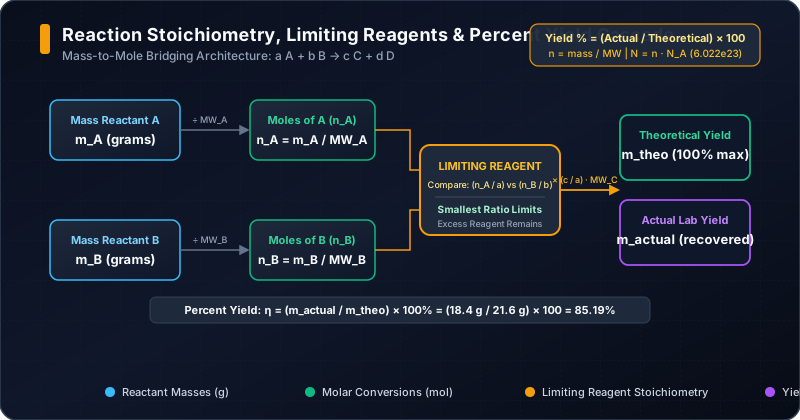
In chemical systems, reacting species interact on a discrete particulate level governed by quantum mechanics rather than macroscopic bulk weight. The fundamental unit of chemical quantity is the Mole, defined in the International System of Units (SI) as containing exactly 6.02214076 × 10²³ elementary entities (Avogadro's constant, N_A). The bridge between macroscopic mass measured on an analytical balance and particulate mole count is the Molar Mass (MW, in grams per mole):
When dissolving solutes into liquids, several distinct concentration frameworks are utilized depending on thermal and physical conditions:
- Molarity (M, mol/L): The most common laboratory volumetric standard, expressing moles of dissolved solute per liter of total solution. Because liquid volume expands and contracts with temperature, molarity exhibits slight thermal variability.
- Molality (m, mol/kg): Moles of solute dissolved per kilogram of pure solvent. Because mass is temperature-independent, molality is the mandatory thermodynamic metric for colligative properties (boiling point elevation and freezing point depression).
- Parts Per Million (ppm) & Parts Per Billion (ppb): Dimensionless mass fractions used in trace environmental toxicology and water quality auditing, where 1 ppm corresponds to 1 mg of solute per liter of water (or 1 mg/kg).
2. Acid-Base Equilibria, pH Scales & Henderson-Hasselbalch Buffers
In aqueous solutions, water undergoes spontaneous autoionization described by the ion product constant (Kw = 1.00 × 10⁻¹⁴ at 25°C):
In 1909, Danish biochemist Søren Sørensen devised the logarithmic pH scale to express wide hydronium concentration ranges cleanly:
Unlike strong monoprotic acids (such as HCl and HNO₃) that dissociate completely (100% ionization), weak acids (such as acetic acid, CH₃COOH) exist in a dynamic equilibrium governed by their acid dissociation constant (Ka):
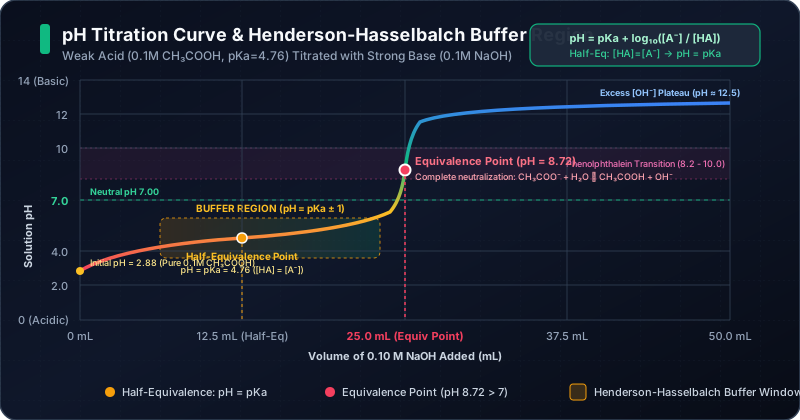
When a weak acid is combined with its conjugate base, the system forms a Buffer Solution that vigorously resists changes in pH upon addition of small amounts of strong acid or base. The operational pH of a buffer is predicted by the famous Henderson-Hasselbalch equation:
Maximum buffer capacity (resistance to pH shift, formalized by Van Slyke's index β) occurs when [A⁻] = [HA], at which point the logarithmic term drops to zero and pH exactly equals pKa.
3. Spectrophotometry & The Beer-Lambert Absorption Law
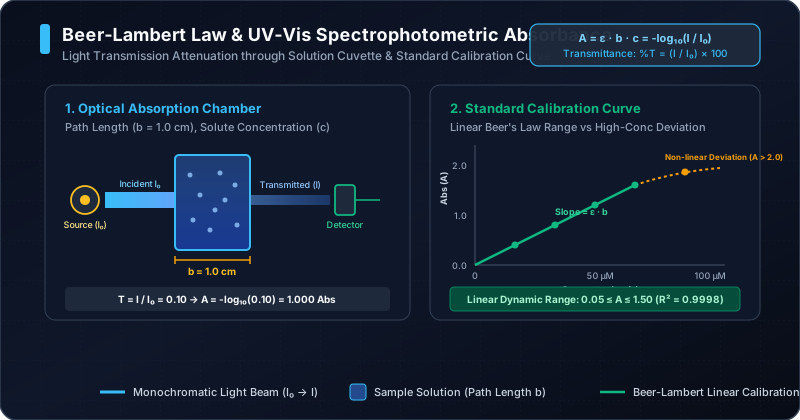
Quantitative molecular spectroscopy relies on the principle that chemical chromophores absorb characteristic wavelengths of light through electronic transitions. When a parallel beam of monochromatic light of initial intensity I₀ passes through a solution cuvette of path length b containing an absorbing solute at concentration c, the fraction of transmitted light I is governed by the Beer-Lambert Law:
Where A is dimensionless Absorbance (optical density), ε is the Molar Absorptivity (in L·mol⁻¹·cm⁻¹), b is the path length (typically 1.00 cm in standard quartz cuvettes), and c is the molar concentration. In rigorous laboratory analytical chemistry, Beer's law remains linear up to Absorbance ≈ 1.5. Beyond this range, non-linear deviations arise from electrostatic interactions between chromophores at high density and polychromatic stray light reaching the photodiode detector.
4. Thermodynamic Equilibrium & Le Chatelier's Dynamic Principle
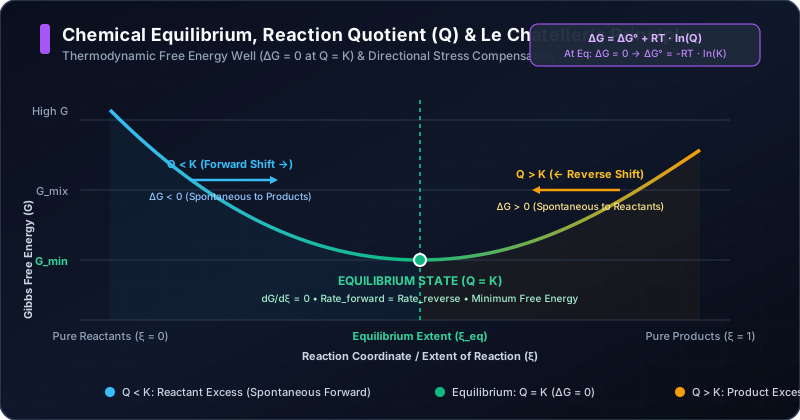
Chemical equilibrium represents a state of minimum free energy where forward and reverse reaction rates are identical. For a general gas-phase reaction a A + b B ⇌ c C + d D, the equilibrium constant can be expressed in terms of molar concentrations (Kc) or partial pressures (Kp), interrelated via the ideal gas law:
Where Δn = (c + d) - (a + b) represents the net change in gas moles. The connection between equilibrium and chemical thermodynamics is established through the standard Gibbs free energy of reaction:
If a system at equilibrium is subjected to an external perturbation (such as a change in concentration, temperature, or pressure), Le Chatelier's Principle dictates that the equilibrium position will shift in the direction that counteracts the imposed disturbance. Comparing the instantaneous Reaction Quotient (Q) against K predicts the spontaneous direction:
- Q < K: Reactant excess. Forward reaction proceeds spontaneously to produce more products (ΔG < 0).
- Q = K: System is at dynamic thermodynamic equilibrium (ΔG = 0).
- Q > K: Product excess. Reverse reaction proceeds spontaneously to regenerate reactants (ΔG > 0).