Science Calculator
Earth Science & Geology
☁️ Weather Parameter
2000 m (6562 ft)
Sea Level (0 m)Everest Base (5,364 m)Everest (8,848 m)Troposphere (11 km)
Atmospheric & Weather Output795.0 hPa
Pressure at Altitude
795.0 hPa
0.785 atm (11.53 psi)
Temperature at Altitude
2.0 °C
Lapse: −6.5 °C / km
Water Boiling Point
92.1 °C
Reduced vapor saturation
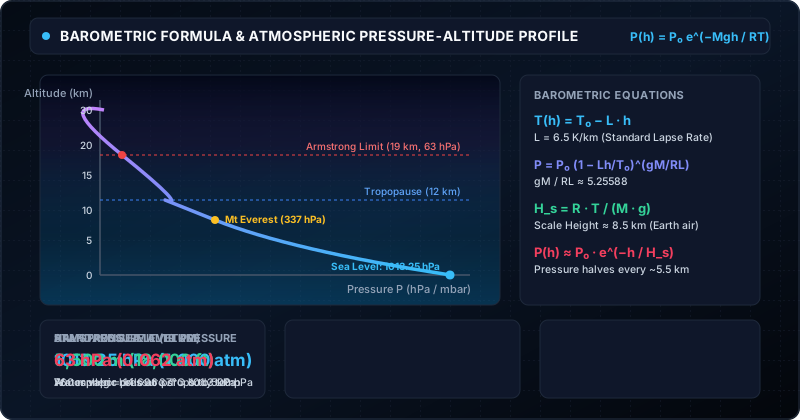
Barometric Pressure CurveP vs Altitude
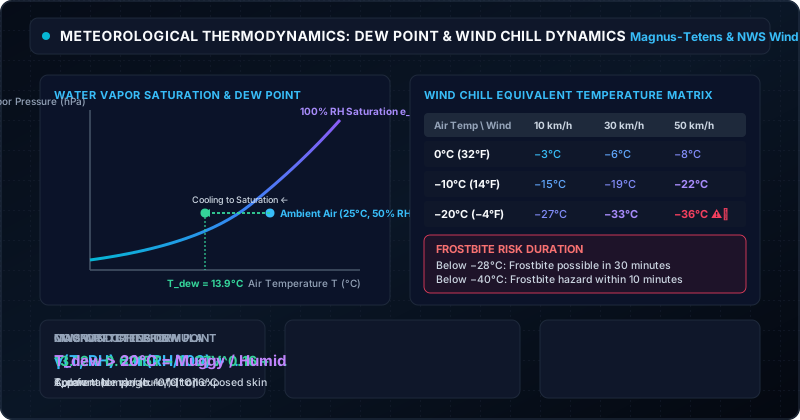
Dew Point & Wind ChillPsychrometrics
Institutional Guide: Earth Science, Geophysics, Atmospheric Physics & Geodesy
Rigorous Mathematical Formulations for Geologists, Meteorologists, Environmental Scientists, and Navigators
1. Earthquake Mechanics & Moment Magnitude Scaling
Earthquakes occur when stress accumulated along tectonic faults exceeds frictional resistance, triggering rapid seismic slip. While Charles Richter originally formulated local magnitude (ML) based on seismograph needle amplitudes in southern California, modern seismology relies universally on the Moment Magnitude scale (Mw) developed by Hiroo Kanamori:
M₀ = μ × A × D (Seismic Moment in N·m)
Mw = ⅔ log₁₀(M₀) − 10.7
Mw = ⅔ log₁₀(M₀) − 10.7
Where μ is the shear modulus of the faulted crustal rock (~3.0×10¹⁰ N/m²), A is the rupture surface area, and D is the average slip displacement. The Gutenberg-Richter empirical energy relation dictates that radiated seismic energy E scales as:
log₁₀(E) = 4.8 + 1.5 Mw ⇒ E = 10^(4.8 + 1.5 Mw) Joules
Crucially, each integer increase on the magnitude scale corresponds to a 10¹·⁵ ≈ 31.62-fold increase in energy released and a 10-fold increase in seismic ground motion amplitude.
2. Atmospheric Thermodynamics: Barometric Lapse & Moisture
Earth's atmosphere exhibits hydrostatic equilibrium where upward vertical pressure gradient force balances downward gravitational acceleration (dP/dh = −ρ g). Combining with the ideal gas law and standard tropospheric temperature lapse rate (L = 6.5 K/km), the international barometric formula is derived:
P(h) = P₀ · [ 1 − (L · h / T₀) ]^( (g · M) / (R · L) )
Dew point T_d represents the temperature to which moist air must be cooled under constant barometric pressure for water vapor to condense into liquid dew. Governed by the Clausius-Clapeyron relation, the Magnus-Tetens approximation computes dew point from dry-bulb temperature and relative humidity:
T_dew = (b · γ) / (a − γ) where γ(T, RH) = (a · T)/(b + T) + ln(RH / 100)
Wind chill quantifies the accelerated rate of sensible convective heat loss from exposed living tissue induced by turbulent air movement, governed by the empirical National Weather Service formula.
3. Solar Irradiance, Air Mass & Carbon Footprint
Extraterrestrial solar radiation enters Earth's upper atmosphere at the solar constant G_sc ≈ 1,361 W/m². As rays penetrate the atmosphere, absorption by ozone, water vapor, and aerosols attenuates the beam. The optical path length is quantified by the Air Mass (AM) coefficient:
AM = 1 / cos(θ_z) (Zenith Angle θ_z)
AM 1.0 corresponds to an overhead zenith sun, while AM 1.5 (θ_z = 48.2°) is the universal standard test condition for rating photovoltaic modules (1,000 W/m² irradiance at 25°C).
Carbon footprint accounting aggregates direct and indirect greenhouse gas emissions into equivalent metric tons of carbon dioxide (t CO2e) via Intergovernmental Panel on Climate Change (IPCC) emission factors, informing carbon neutrality and ecological offset strategies.
4. Geodesy: Great-Circle Navigation & Haversine Formula
On an idealized spherical Earth of mean volumetric radius R = 6,371.0 km, the shortest surface path between two points is the great-circle geodesic arc. Planar Euclidean geometry severely underestimates distances across large spans. The trigonometric Haversine formula provides a numerically robust solution immune to round-off error for small distances:
a = sin²(Δφ / 2) + cos φ₁ · cos φ₂ · sin²(Δλ / 2)
d = 2 · R · atan2( √a, √(1 − a) )
d = 2 · R · atan2( √a, √(1 − a) )
The initial forward bearing (azimuth) θ represents the true north heading on departure, tracing the orthodromic track utilized in modern intercontinental aviation and maritime routing.
❓ Frequently Asked Questions (FAQ)
Why was the Richter scale replaced by the Moment Magnitude scale (Mw)?
The Richter scale saturates for earthquakes greater than magnitude 7.0 because standard seismograph pendulums max out. The Moment Magnitude scale (Mw) does not saturate because it directly calculates the physical energy released from the rupture area and displacement of the fault plane (M₀ = μ A D).
Why does water boil at lower temperatures at high altitudes?
Boiling occurs when a liquid's vapor pressure equals the surrounding atmospheric pressure. Because barometric pressure decreases exponentially with altitude (e.g. from 1013 hPa at sea level to ~337 hPa on Mount Everest), less thermal kinetic energy is required for water molecules to escape into the vapor phase, reducing the boiling point to ~70°C at 8,848 m.
What is the difference between peak sun hours and daylight hours?
Daylight hours represent the total elapsed time between sunrise and sunset. Peak sun hours, however, represent the equivalent number of hours per day during which solar irradiance averages 1,000 W/m² (the standard test condition for solar photovoltaic generation).
Why is a great-circle route curved on a flat Mercator map?
The Mercator projection distorts areas away from the equator to preserve constant compass headings (rhumb lines as straight lines). A great-circle route is the true shortest geodesic distance on a spherical globe, which projects as a curved arc on flat rectangular maps.
About Atmospheric Pressure Calculator
Calculate pressure at altitude. Built for fast physics problem solving with step-by-step explanations, unit conversions, and practical help content.
Why this page helps
- Better than a plain formula page because it explains the result as well as calculates it
- Useful for school, college, exam practice, and quick engineering checks
- Helps reduce common unit-conversion mistakes
- Makes scenario testing faster with presets and instant recalculation
How to use it well
- Choose the Atmospheric Pressure Calculator and identify which motion values are already known.
- Enter the values carefully and set the matching units for distance, time, velocity, angle, or acceleration.
- Read the main answer first, then confirm the formula and the step-by-step derivation.
- Use the conversion output, graph, related tools, or download options if you need a report or comparison.