Input Number & Radix BaseBase 10 ➔ Base 16
Decimal Equivalent Reference
255 (Decimal Base 10)
Converted Radix String
Base 16 Representation
FF
255 (Base 10) = FF (Base 16).
Successive Modulo-Division Derivation (Decimal ➔ Base 16)
255 ÷ 16 = 15 with remainder 15 ('F')
15 ÷ 16 = 0 with remainder 15 ('F')
Simultaneous Multi-Base Comparison for Value 2556 Radix Systems
| Numeral System | Radix Base | Encoded Value |
|---|---|---|
| Binary (Base 2) | Base 2 | 11111111 |
| Octal (Base 8) | Base 8 | 377 |
| Decimal (Base 10) | Base 10 | 255 |
| Hexadecimal (Base 16) Selected Target | Base 16 | FF |
| Base 32 | Base 32 | 7V |
| Base 36 | Base 36 | 73 |
Positional Numeral Systems & Multi-Radix Arithmetic Guide
A rigorous computer science and mathematical analysis of positional radix representation, powers of 2 bit-grouping shortcuts, and successive modulo-division algorithms.
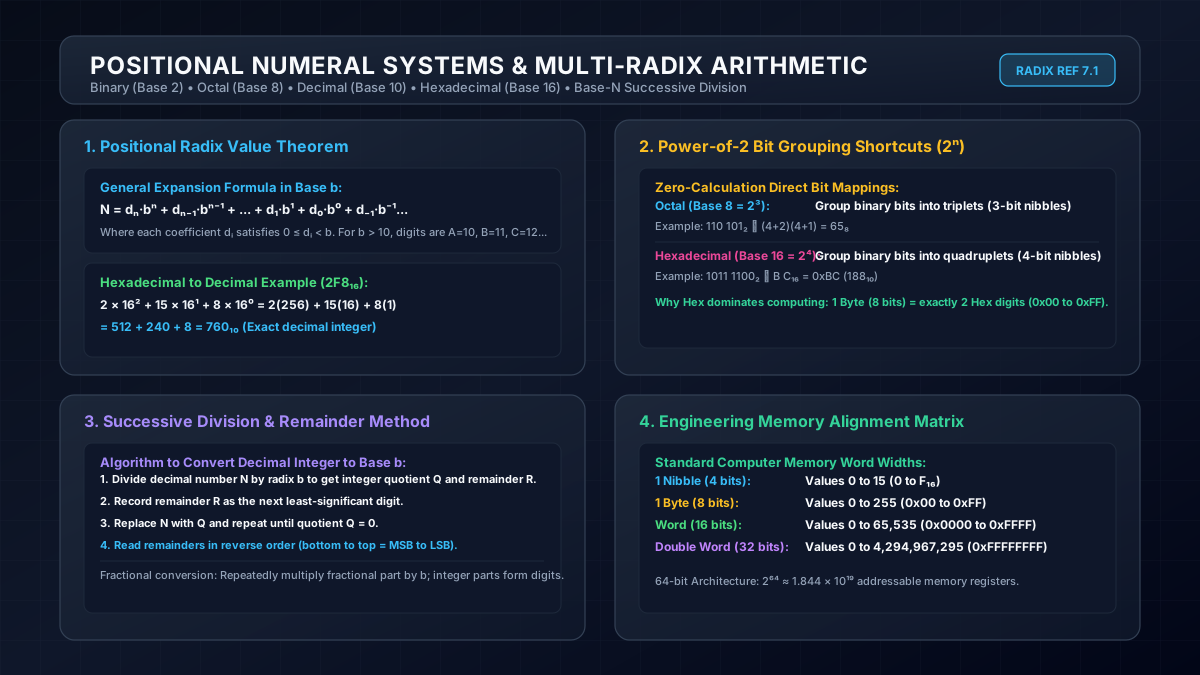
1The Positional Radix Value Theorem
In a positional numeral system with base radix b, any non-negative integer N is uniquely represented by an ordered sequence of digits (dₙ dₙ₋₁ ... d₁ d₀) where each digit satisfies 0 ≤ dᵢ < b. The numerical value is determined by the polynomial expansion:
N = ∑ (dᵢ × bⁱ) for i = 0 to n
Example: 3A7₁₆ in Hexadecimal (Base 16):
= 3 × 16² + 10 × 16¹ + 7 × 16⁰
= 3(256) + 10(16) + 7(1) = 768 + 160 + 7 = 935₁₀
Example: 3A7₁₆ in Hexadecimal (Base 16):
= 3 × 16² + 10 × 16¹ + 7 × 16⁰
= 3(256) + 10(16) + 7(1) = 768 + 160 + 7 = 935₁₀
When the radix b exceeds 10, alphabetical characters are assigned to represent values from 10 onward: A=10, B=11, C=12, D=13, E=14, F=15, continuing up to Z=35 for Base 36.
2Power-of-Two Bit Grouping Shortcuts (2ⁿ)
Because 8 = 2³ and 16 = 2⁴, converting between Binary (Base 2), Octal (Base 8), and Hexadecimal (Base 16) does not require converting to intermediate Decimal!
- Binary to Octal (3-bit Nibbles): Group binary bits in sets of 3 from right to left. Each 3-bit group maps directly to an octal digit (000₂ = 0, 111₂ = 7). For example, 11010110₂ = (011)(010)(110) = 326₈.
- Binary to Hexadecimal (4-bit Nibbles): Group binary bits in sets of 4 from right to left. Each 4-bit group maps directly to a hex digit (0000₂ = 0x0, 1111₂ = 0xF). For example, 11010110₂ = (1101)(0110) = 0xD6.
This one-to-one mapping is why hexadecimal is universally chosen in computer systems architecture for memory addresses, color codes (#FFFFFF), and machine code opcodes: exactly two hex digits represent a full 8-bit byte.
3Successive Modulo-Division Algorithm
To convert any positive decimal integer into an arbitrary target base b, the successive modulo-division algorithm is applied:
- Divide the decimal integer N by the target base b.
- Record the integer quotient Q and the remainder R (where 0 ≤ R < b).
- The remainder R becomes the next least significant digit (LSB).
- Repeat the division using quotient Q until Q reaches 0.
- Read all collected remainders in reverse order (from bottom to top) to obtain the final base-b string.