Date & Time Calculator
Date Calculations
Category 5: Date & Time Calculations • Workdays & Fiscal Scheduling
Business Days, Workday Deadlines & Fiscal Quarter Suite
Corporate & enterprise calendar scheduling suite. Compute net business working days (5-day and 6-day models), project delivery deadlines with holiday exclusions, historical weekdays via Zeller's congruence, and global fiscal quarters (US Federal, SEC, UK/India).
Business Days Interval & Workweek Policy
Workweek ExclusionStep-by-Step Scheduling Derivation
1. Calendar Span: 2026-11-01 to 2026-12-16 = 46 calendar days (inclusive end day)
2. Weekend Exclusion: -13 weekend days excluded (Saturday & Sunday)
3. Statutory Holiday Offset: -2 declared corporate holiday(s) deducted
4. Net Effective Workdays: 31 Business Days (6.2 working weeks)
5. Billable Resource Capacity: 248 standard working hours (8 hrs/day)
Primary Scheduling MetricEnterprise SLA
Net Business Working Days:
31 Workdays
Out of 46 total calendar days (6.2 working weeks)
Billable Hours248@ 8 hrs/day
Weekend + Holidays1513 wkd + 2 hol
Session Scheduling History
No pinned calculations yet. Click "Record & Pin" to save entries.
Business Days & Workday Scheduling Engine (7-Day Calendar Exclusion)
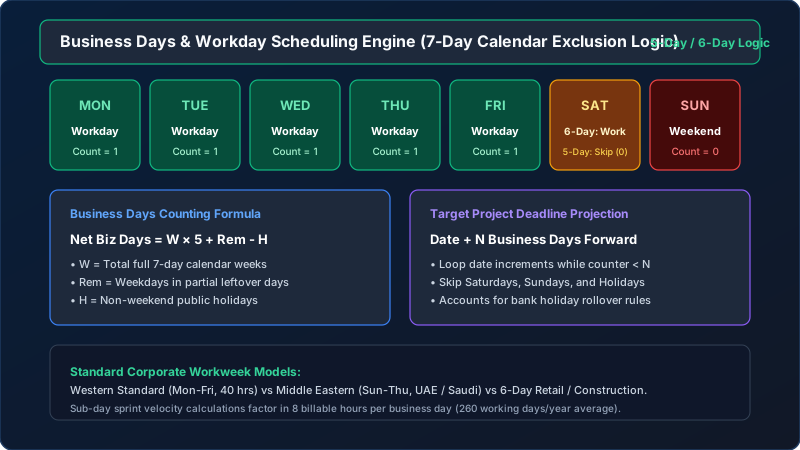
Structural 7-day calendar exclusion logic: Western 5-day (Mon-Fri) vs 6-day (Mon-Sat) commercial cycles, statutory holiday rollover, and project sprint deadlines.
Corporate & Sovereign Fiscal Year Quarter Cycles (Q1–Q4 Alignment)

SEC and GAAP fiscal quarters: Calendar (Jan-Dec), US Federal Government (Oct-Sep), India/UK (Apr-Mar), Australia (Jul-Jun), and Retail 4-4-5 cycles.
Institutional Guide to Business Workdays, Project Deadlines & Fiscal Calendar Mathematics
Author: Enterprise Project Management & Financial Accounting Standards Group • Updated for 2026/2027 Statutory Compliance
1. Business Days vs. Calendar Days: Corporate & Legal Frameworks
In international commercial contracting, banking transactions, and agile project engineering, the distinction between calendar days and business days (working days) carries profound financial and legal ramifications. A calendar day represents an astronomical 24-hour solar rotation, encompassing all seven days of the week regardless of commercial activity. In contrast, a business day represents an officially sanctioned day of work under municipal labor laws, banking regulatory statutes, and stock exchange trading schedules.
In the Western commercial sphere, the 5-day workweek (Monday through Friday, 40 hours per week) is statutory under the US Fair Labor Standards Act (FLSA), the UK Working Time Regulations 1998, and European Union Directive 2003/88/EC. In multiple Middle Eastern nations (such as the UAE and Saudi Arabia), labor reforms have transitioned from the historic Sunday-to-Thursday schedule to aligned Monday-to-Friday or hybrid 4.5-day models. Meanwhile, in sectors such as civil construction, retail logistics, and heavy manufacturing across Asia and Latin America, the 6-day workweek (Monday through Saturday) remains the operational norm.
Business Days Formula (Standard 5-Day Model):
Net Workdays = (W × 5) + R_weekdays - H_declared
Where W = complete 7-day calendar weeks, R_weekdays = weekdays in partial residual span, and H_declared = non-weekend official public holidays.
2. Weekday Determination: Christian Zeller's Congruence & Sakamoto's Algorithm
Determining the precise day of the week for an arbitrary date in human history without relying on exhaustive database lookups requires algorithmic number theory. In 1882, German mathematician Christian Zeller published Zeller's Congruence, an algebraic formula providing the day of the week for any Gregorian calendar date:
h = (q + ⌊13(m+1)/5⌋ + K + ⌊K/4⌋ + ⌊J/4⌋ - 2J) mod 7
In Zeller's formulation, January and February are counted as months 13 and 14 of the preceding year (to simplify the leap day intercalation at the end of February). Here, q is the day of the month, m is the shifted month number (3 = March, ... 14 = February), K is the year of the century (year mod 100), and J is the zero-based century (⌊year / 100⌋). The result h maps directly: 0 = Saturday, 1 = Sunday, 2 = Monday, ... 6 = Friday.
In modern computer systems, Japanese computer scientist Tomohiko Sakamoto developed an ultra-fast constant-time integer algorithm (1992) using an array of precomputed offsets [0, 3, 2, 5, 0, 3, 5, 1, 4, 6, 2, 4]:
weekday = (y + y/4 - y/100 + y/400 + t[m-1] + d) % 7
3. Global Corporate & Sovereign Fiscal Year Architectures
A fiscal year (financial year, or budget year) is a 12-month period used by governments and businesses for accounting, financial reporting, and taxation. While individuals commonly file taxes according to the calendar year (January 1 to December 31), sovereign nations and multinational corporations adopt varied fiscal calendars to match statutory budget cycles or business seasonality:
- Calendar Year (Jan 1 – Dec 31): Adopted by majority US corporations, tech enterprises (Apple, Google, Microsoft vary by custom bylaws), and individual tax filers.
- US Federal Government (Oct 1 – Sep 30): Established by the Congressional Budget and Impoundment Control Act of 1974. Q1 commences October 1, aligning with federal appropriations bills.
- UK, India & Commonwealth (Apr 1 – Mar 31): Mandated in India under Section 2(41) of the Companies Act 2013 and the Income Tax Act 1961. Originates from the historical British Lady Day tax calendar.
- Australia & New Zealand (Jul 1 – Jun 30): Mirrors the Southern Hemisphere agricultural harvest and mid-year statutory financial statements.
4. The Retail 4-4-5 / 4-5-4 Calendar System
In retail, hospitality, and consumer goods manufacturing, standard Gregorian calendar months create artificial reporting distortions because different months have different numbers of weekends (e.g., one month may have five Saturdays while the next has only four). Because retail sales surge dramatically on weekends, comparing month-over-month sales under standard calendar months generates misleading variances.
To eliminate this distortion, the National Retail Federation (NRF) and global retailers utilize the 4-4-5 Calendar. Under this system:
- Each quarter of 13 weeks is partitioned into three periods: Month 1 (4 weeks = 28 days), Month 2 (4 weeks = 28 days), and Month 3 (5 weeks = 35 days).
- Every quarter contains exactly $4 + 4 + 5 = 13$ weeks = 91 days.
- Four quarters yield exactly $13 \times 4 = 52$ weeks = 364 days.
- Because a solar year is 365.2425 days, the 364-day retail year falls behind by approximately 1.25 days per year. To compensate, every 5 to 6 years, an extra 53rd week (Leap Week) is appended to the final quarter.
Frequently Asked Questions (FAQ) on Business Days & Fiscal Scheduling
Q1: How are public holidays handled when computing business days?
When a statutory public holiday falls on a Saturday or Sunday, jurisdictions employ holiday rollover rules. In the US, UK, and India, if a bank holiday falls on Sunday, the observance rolls over to the following Monday (creating an observed bank holiday). Business day counters deduct only official non-weekend holidays touching the active interval.
Q2: What is the average number of working days in a year?
A standard common year of 365 days contains 52 full weeks plus 1 extra day (or 2 extra days in leap years), yielding 260 or 261 potential weekdays (Mon–Fri). After deducting the typical 10 to 12 federal/bank public holidays, the net average working year consists of approximately 249 to 251 business days (roughly 2,000 billable hours).
Q3: Why do some public companies have fiscal years ending on the last Friday of a month?
Many Fortune 500 corporations (such as Apple, Target, and Costco) use a floating 52-53 week fiscal year ending on the last Friday or Saturday of September, December, or January. This ensures that their financial year always ends on the close of a business week, streamlining store inventory counts and employee payroll reconciliation.
About Date Add/Subtract
Add or subtract specific time periods from dates. Designed for fast, accurate calculation with clear outputs, explanation, and device-friendly usability.
Why this page helps
- Fast answers without manual formula rearrangement
- Cleaner comparison of multiple scenarios
- Works on mobile, tablet, and desktop
- Useful for study, planning, and quick verification
How to use it well
- Open the Date Add/Subtract and enter the known input values.
- Select the correct units for each field before calculating.
- Review the main result, formula, and conversions shown on the page.
- Use the step-by-step breakdown to verify the logic and download or share the result if needed.
Expert tips
- Check that all inputs use the correct unit system before comparing values.
- Use the worked steps to confirm whether you entered the right known variables.