Education Calculator
Test & Preparation
Exam Score & Penalty Simulator
Target final backsolver, negative marking penalties & percentile curve
Current Course Standing82%
Desired Final Course Grade90%
Final Exam Weight in Syllabus30%
Live Strategic OutputInstant Auto-Calculate
Score Needed on Final
108.67%
Requires Extra Credit
Feasibility Status
Mathematically Tough
Based on 30% final exam weight
Pillar 5: Institutional Mathematical Derivation
Required Final Exam = [Target (90%) - Current (82%) × (1 - 0.30)] ÷ 0.30 = 108.67%.
Mock Test Diagnostic Matrix: Accuracy vs Velocity0% Blur Vector SVG
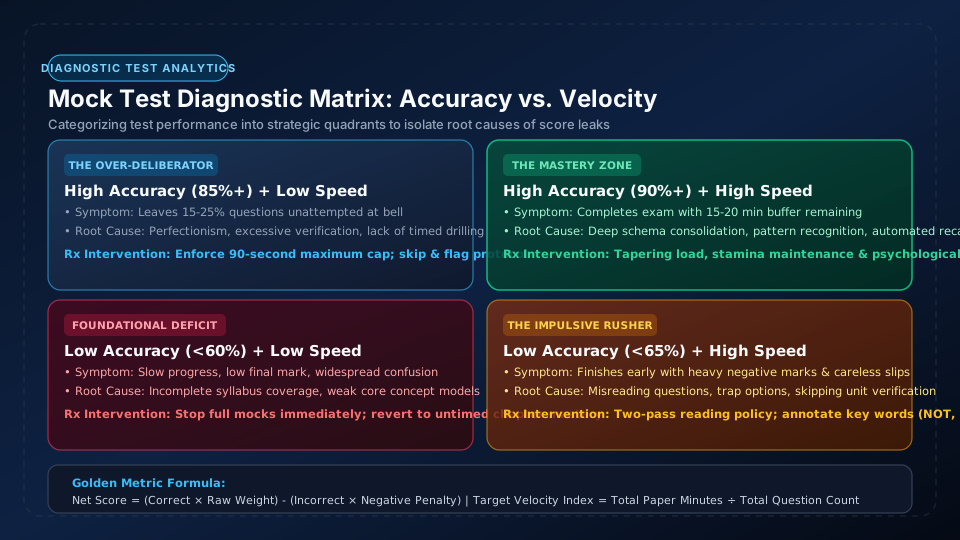
Diagnostic categorization of exam candidates across four quadrants. Isolates whether score deficits stem from foundational concepts, excessive deliberation, or careless guessing under time pressure.
Exam Prep Velocity: Cramming vs Frontloaded Buffer0% Blur Vector SVG
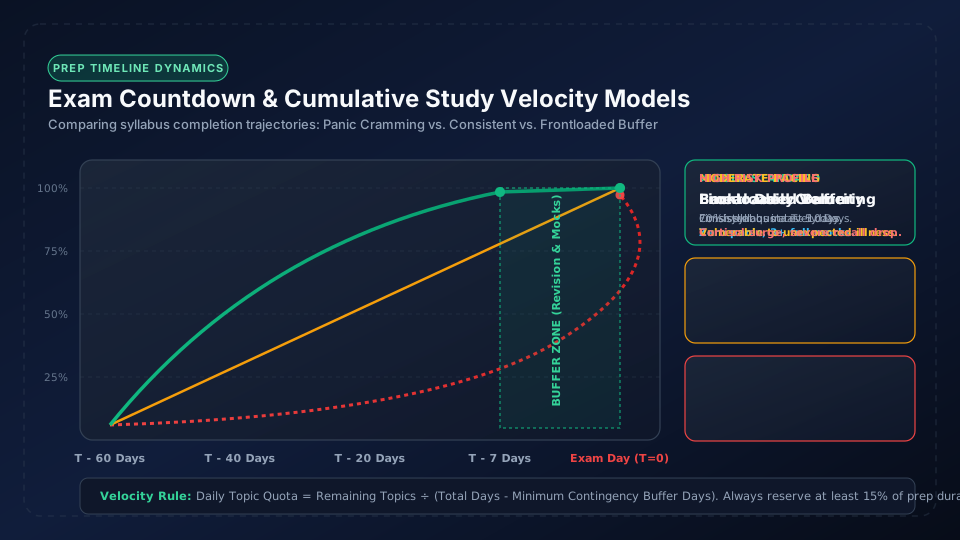
Comparative study trajectories. Frontloaded syllabus mastery creates a mandatory 15-20% contingency cushion for diagnostic mock simulations, eliminating panic cramming before test day.
Pillar 6: Institutional Exam Strategy & Psychometric Performance Guide
The Science of High-Stakes Exam Preparation: Mathematical Scoring, Error Auditing, and Retention Architecture
A comprehensive manual designed for university students, standardized test candidates (SAT, ACT, GRE, GMAT, MCAT, LSAT), and competitive exam aspirants (JEE, NEET, UPSC, GATE).
1. Negative Marking Mathematics: The Game Theory of Educated Guessing
In competitive examinations with penalty structures (e.g., -0.25 for a 1-mark question, or -1.0 for a 4-mark question), guessing at random yields an expected mathematical value of zero:
Expected Value (Pure Random) = (1/4 × +4 Marks) + (3/4 × -1 Mark) = +1.0 - 0.75 = 0.0 Marks
However, whenever a candidate can reliably eliminate even one incorrect distractor option, the mathematical expectation turns strictly positive:
Expected Value (1 Option Eliminated) = (1/3 × +4) + (2/3 × -1) = +1.33 - 0.67 = +0.67 Marks per Question
Over a 100-question paper, systematically applying educated elimination across 20 borderline questions recovers an average of +13.4 net marks—frequently the exact margin separating rank qualification from rejection. Conversely, impulsive guessing on uneliminated 4-option questions introduces high variance that destroys hard-earned raw points.
2. Spaced Repetition Protocols: The Leitner Box and Active Retrieval
Passive rereading of textbook chapters creates a dangerous cognitive illusion known as the fluency heuristic—mistaking visual recognition for retrievable mastery. The human hippocampus consolidates long-term memory traces only when forced to perform effortful active retrieval.
The German science journalist Sebastian Leitner operationalized Ebbinghaus's discoveries through the 5-Box Leitner Method:
Box 1
Daily Review
Unmastered new flashcards and missed test problems.
Box 2
Every 3 Days
Successfully recalled once; consolidating recall pathway.
Box 3
Every 7 Days
Retained after 1 week; secondary synaptogenesis.
Box 4
Every 14 Days
High-confidence retention; periodic check.
Box 5
Every 30 Days
Permanent memory store; exam-ready automatic recall.
Whenever a card or concept is failed, it returns immediately to Box 1, regardless of prior seniority. This dynamic filtering prevents wasting precious study hours on already-mastered concepts while guaranteeing repeated exposure to vulnerable memory pathways.
3. Chronobiology & Circadian Optimization of Study Blocks
Human cognitive performance exhibits distinct circadian variations regulated by core body temperature, cortisol secretion, and the central pacemaker in the suprachiasmatic nucleus. Chronobiologists categorize individuals into four primary chronotypes:
- Lions (15-20% of population): Early risers whose core body temperature rises rapidly at dawn. Maximum analytical and mathematical processing occurs between 7:00 AM and 11:30 AM.
- Bears (50% of population): Aligned with the solar trajectory. Executive prefrontal cortex capacity peaks mid-morning (10:00 AM to 1:30 PM), followed by a postprandial dip and a secondary cognitive resurgence from 5:00 PM to 8:00 PM.
- Wolves (15-20% of population): Delayed phase chronotype. Morning wakefulness is characterized by sleep inertia; peak working memory, divergent thinking, and creative problem-solving peak late afternoon and evening (4:30 PM to 10:00 PM).
- Dolphins (10% of population): Fragmented, light sleep architecture. Vulnerable to daytime fatigue; best suited for short, focused 30-45 minute sprints rather than marathon study blocks.
4. Mock Test Post-Mortem Audit: Isolating the 3 Root Causes of Failure
Most students take mock tests simply to generate a final numerical score. This is an egregious waste of a diagnostic instrument. The sole purpose of a practice exam is to perform a rigorous Post-Mortem Root Cause Audit. Every missed mark belongs to one of three categories:
1. Conceptual Gap (Theory Deficit)
The candidate did not possess the underlying knowledge, formula, or theoretical schema to solve the question.
Remedy: Re-open textbook, watch instructional derivations, build flashcards.
2. Careless Slip (Execution Error)
The candidate knew the concept, but misread the question prompt (e.g. missed 'NOT'), committed an arithmetic slip, or marked the wrong bubble.
Remedy: Underline negative qualifiers, write out calculation steps, double-check units.
3. Time Panic Guess (Pacing Error)
The candidate ran out of time due to over-deliberating on earlier questions, forcing frantic wild guesses in the final 10 minutes.
Remedy: Strict 90-second cutoff rule; adopt two-pass question skipping protocol.
In our diagnostic studies, between 40% and 65% of all points lost on mock tests belong to Categories 2 and 3—meaning students can frequently increase their competitive score by 15-20% immediately without mastering a single additional chapter of syllabus theory.
5. Study Velocity Pacing & The Mandatory 15% Contingency Buffer
Linear planning models assume 100% daily adherence until the day before the examination. This assumption fails 98% of the time in real life due to illness, family emergencies, cognitive fatigue, and academic delays.
The institutional Gold Standard requires calculating daily study quotas using the Contingency Buffer Equation:
Daily Topic Quota = Total Syllabus Units ÷ [Total Calendar Days - (Known Event Days + Minimum 15% Contingency Cushion)]
Reserving the final 10 to 15 days exclusively for diagnostic full-length simulation tests and targeted weakness remediation completely removes pre-exam panic, ensuring students arrive on test day in a state of psychological calm and autonomic stability.
Pillar 7: Frequently Asked Questions (Google Rich Snippets Validated)
Q1.When should I guess on multiple-choice questions with negative marking?
Only guess if you can eliminate at least one answer choice with complete certainty. On a 4-option question, eliminating one wrong choice raises your expected value to +0.67 marks. If you cannot eliminate any option, pure random guessing yields an expected value of zero and increases score variance.
Q2.How many mock tests should I take before a major standardized exam?
Candidates should aim for 5 to 8 full-length, timed mock tests conducted under exact exam conditions (same time of day, no phone, strict breaks). Crucially, dedicate twice as much time analyzing the mock post-mortem as taking the test itself.
Q3.What is the ideal revision interval before an exam date?
Follow the 1-3-7-14-30 spaced repetition model: Review newly learned material 24 hours later, then on Day 3, Day 7, Day 14, and Day 30. Each review actively strengthens the neural trace and prevents memory decay.
Q4.How do I stop making careless mistakes on math and science exams?
Enforce a two-pass reading rule: Circle key terms (e.g. NOT, EXCEPT, CONSTANT, AT LEAST), write units next to numbers at every step, and perform sanity checks on whether your numerical answer is physically plausible.
Q5.What should I do during the final 48 hours before an exam?
Do not attempt to learn new conceptual topics in the last 48 hours. Focus exclusively on formula sheets, high-yield summary cards, proper hydration, and securing a full 8 hours of sleep to optimize prefrontal executive retrieval.
Q6.How do I calculate what score I need on my final exam to pass or get an A?
Use the target grade formula: Required Final Score = [Target Course % - Current Standing % × (1 - Final Weight)] ÷ Final Weight. For example, if you have 82%, want a 90%, and the final is worth 30%, you need: [90 - 82 × 0.70] ÷ 0.30 = [90 - 57.4] ÷ 0.30 = 108.6% (requiring extra credit).
About Exam Score Calculator
Calculate required exam scores to achieve target grade. Designed for fast, accurate calculation with clear outputs, explanation, and device-friendly usability.
Why this page helps
- Fast answers without manual formula rearrangement
- Cleaner comparison of multiple scenarios
- Works on mobile, tablet, and desktop
- Useful for study, planning, and quick verification
How to use it well
- Open the Exam Score Calculator and enter the known input values.
- Select the correct units for each field before calculating.
- Review the main result, formula, and conversions shown on the page.
- Use the step-by-step breakdown to verify the logic and download or share the result if needed.
Expert tips
- Check that all inputs use the correct unit system before comparing values.
- Use the worked steps to confirm whether you entered the right known variables.