Date & Time Calculator
Historical & Astronomical
Historical Event Selection
Contemporary Space Age
0Years,0Months
0 days since Apollo 11 Moon Landing (1969-07-20)
Human Generations~025y per generation
Elapsed Decades010y block count
Centuries Fraction0100y block count
Next Decadal Jubilee (60 Years):5 years remaining
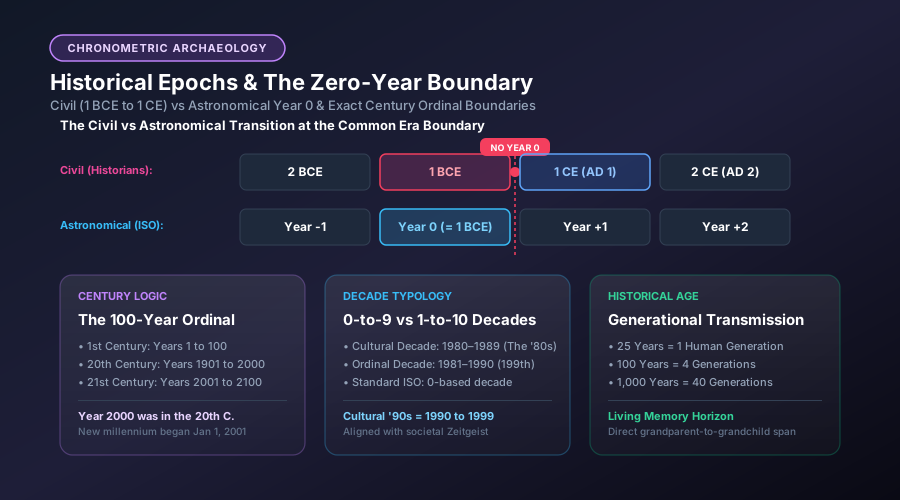
Historical Epochs & The Zero-Year Boundary
Visualizing the transition from 1 BCE to 1 CE in civil history vs Astronomical Year 0, and the exact century ordinal boundaries.
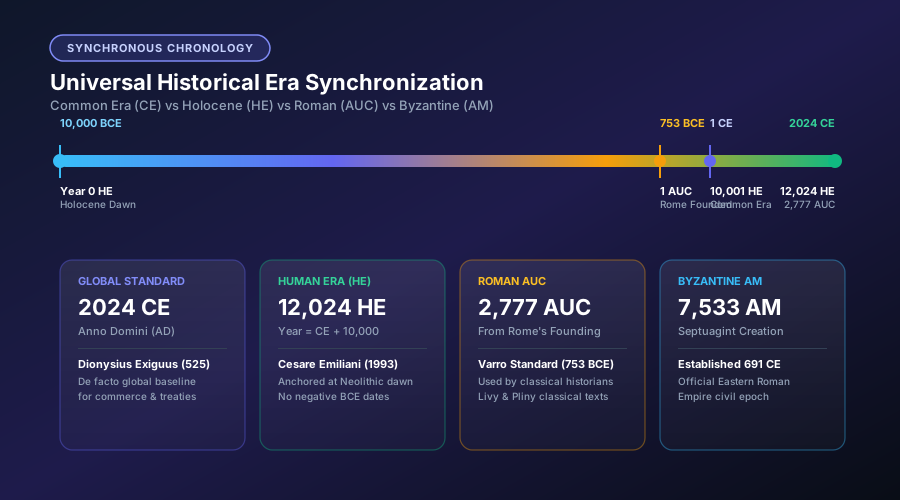
Universal Historical Era Synchronization
Comparative timeline scale aligning Common Era (CE), Holocene Human Era (HE), Roman Ab Urbe Condita (AUC), and Byzantine Anno Mundi.
The Chronology of Human Civilization: Eras, Centuries & Temporal Boundaries
Organizing human history requires reconciling disparate epochal baselines. Because civil calendars were formulated before the mathematical conception of zero gained widespread adoption in Western chronometry, historic dating possesses unique structural properties that frequently confound historical calculations.
1. The Missing Year Zero: Civil vs Astronomical Dating
In the 6th century CE, the monk Dionysius Exiguus established the Anno Domini (AD) system to date Easter. Centuries later, the Anglo-Saxon scholar Bede extended this framework backward by introducing Before Christ (BC). Crucially, neither Dionysius nor Bede used the number zero, as zero was not incorporated into European mathematics until Fibonacci popularized it in the 13th century.
Consequently, in civil history, 1 BCE is immediately followed by 1 CE. There is no Year 0. This creates an arithmetic dilemma: calculating the time span between January 1, 1 BCE and January 1, 1 CE yields exactly 1 year, not 2 years. In contrast, astronomers and ISO 8601 use astronomical year numbering, where Year 0 corresponds to 1 BCE, Year -1 corresponds to 2 BCE, and in general:
Year(Astronomical) = -(Year(BCE) - 1)
2. Century Ordinal Boundaries: Why 2000 was in the 20th Century
Because there is no Year 0, the 1st Century began on January 1, Year 1 and concluded on December 31, Year 100. Extending this logic through the centuries:
- 20th Century: January 1, 1901 to December 31, 2000.
- 21st Century & 3rd Millennium: January 1, 2001 to December 31, 2100.
While cultural celebrations occurred on New Year's Eve 1999 as the odometer rolled over to 2000, mathematically the 21st century and the third millennium did not officially commence until January 1, 2001.
3. Cesare Emiliani's Holocene Calendar (Human Era)
In 1993, geologist Cesare Emiliani proposed the Holocene Calendar (Human Era, HE). By adding exactly 10,000 years to the current Gregorian year (e.g., 2024 CE becomes 12,024 HE), the era begins near the dawn of human agricultural settlement and monumental architecture (such as Göbekli Tepe and Jericho). This eliminates the artificial division of human history into backwards-counting BCE years and forwards-counting CE years, placing all major human cultural achievements on a continuous, positive timeline.
Frequently Asked Questions
Why is there no Year 0 in the Gregorian calendar?
When the BC/AD system was developed in the early Middle Ages, Roman numerals were standard and zero was not recognized as a number in Europe. The timeline jumps directly from 1 BC to AD 1.
What is the difference between a cultural decade and an ordinal decade?
A cultural decade runs from year 0 to year 9 (e.g. 1990 to 1999 for the nineties). An ordinal decade runs from year 1 to year 10 (e.g. 1991 to 2000 for the 200th decade) because counting originally began at Year 1.
What does Ab Urbe Condita (AUC) mean?
Ab Urbe Condita is Latin for “from the founding of the City” (Rome), traditionally dated to 753 BCE by the Roman scholar Marcus Terentius Varro.
About Historical Event Age
Calculate years since historical events. Designed for fast, accurate calculation with clear outputs, explanation, and device-friendly usability.
Why this page helps
- Fast answers without manual formula rearrangement
- Cleaner comparison of multiple scenarios
- Works on mobile, tablet, and desktop
- Useful for study, planning, and quick verification
How to use it well
- Open the Historical Event Age and enter the known input values.
- Select the correct units for each field before calculating.
- Review the main result, formula, and conversions shown on the page.
- Use the step-by-step breakdown to verify the logic and download or share the result if needed.
Expert tips
- Check that all inputs use the correct unit system before comparing values.
- Use the worked steps to confirm whether you entered the right known variables.