Chronological Life Input Parameters
Global WHO statistical average: ~73.4y, OECD average: ~80.3y
Exact Lifespan Lived
0Days
Born on a (0 Years, 0 Months, 0 Days)
Lifespan Elapsed
0%
Based on 80y actuarial spanDay 0 (Birth)0 Days Remaining to 80y
Est. Heartbeats0.0M0 beats
Est. Breaths0.0M0 cycles
Sleep Invested0 Days0 hrs dreaming
Waking Hours0Conscious Canvas
Next 1,000-Day Milestone:
0 Days
0 Days Away
~0.00 years
Complete Temporal Dissection
Total Weeks:0
Total Hours:0
Total Minutes:0
Total Seconds:0
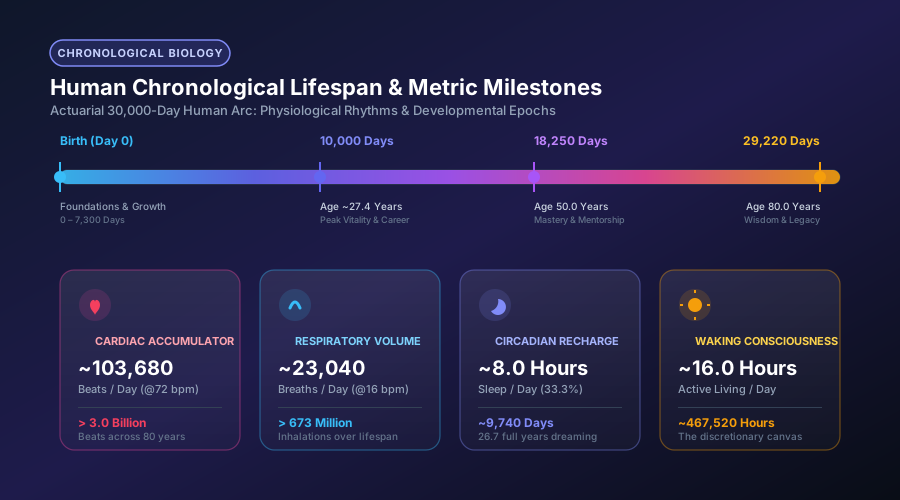
Human 30,000-Day Lifespan Arc & Physiological Rhythms
Empirical breakdown of chronological age, biological cardiac cycles (>3 billion beats), respiratory gas exchange, and finite conscious hours.
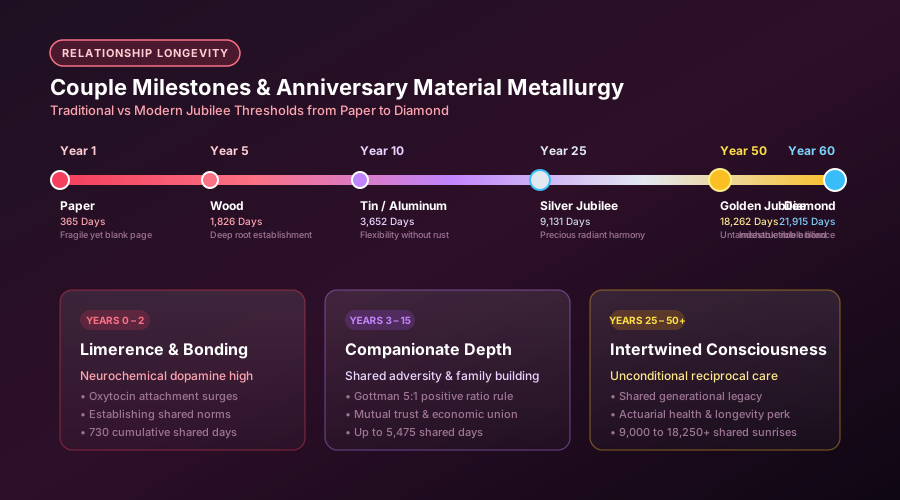
Relationship Longevity & Metallurgy Progression
Traditional and modern jubilee thresholds from Paper (Year 1) to Silver (Year 25) and Diamond (Year 60), mapped with psychological bonding stages.
The Science of Chronological Milestones: Biological Longevity & Relational Continuity
Time is the ultimate finite asset. While common civil timekeeping organizes human existence through coarse calendar years and months, chronological analytics operates on the fundamental quantum of human experience: the day. Across a statistical lifetime of 80 years, a human being experiences approximately 29,220 days. Breaking down this lifespan into exact accumulated days, cardiac contractions, respiratory volumes, and waking conscious hours transforms abstract calendar dates into tangible bio-temporal milestones.
1. The Biological Rhythms of Chronological Life
Every day lived represents a marvel of continuous metabolic activity. At an average resting heart rate of 72 beats per minute, the human heart pumps blood through approximately 103,680 cardiac cycles each day, exceeding 37.8 million contractions annually and over 3.0 billion beats across an 80-year lifespan. Simultaneously, resting respiration at 16 breaths per minute circulates roughly 23,040 breaths per day, oxygenating the blood through more than 673 million lifetime breaths.
Accounting for an average of 8 hours of sleep per night (one-third of biological existence), an 80-year-old individual spends approximately 26.7 full years (9,740 days) in circadian rejuvenation and REM dreaming, leaving approximately 467,520 hours of conscious waking experience to create, connect, and build lasting legacy.
2. Relationship Longevity & The Traditional Metallurgy of Anniversaries
Long-term romantic partnerships evolve through distinct psychological phases. John Gottman's marital research highlights that enduring partnerships maintain a minimum 5:1 ratio of positive to negative interactions during conflict. Over years of shared life, the traditional anniversary material guide—established in folklore and standardized by jeweler associations in 1937—reflects the physical hardening and increasing preciousness of the bond:
- Year 1 (Paper): Fragile and blank, symbolizing new beginnings and the unwritten pages of shared history.
- Year 5 (Wood): Deeply rooted, durable, and resilient against domestic winds.
- Year 10 (Tin / Aluminum): Highly malleable and resistant to oxidation; ductile without bending under stress.
- Year 25 (Silver Jubilee): Radiant, noble, and historically celebrated in Roman tradition with silver wreaths.
- Year 50 (Golden Jubilee): Impervious to corrosion, timeless, and globally revered.
- Year 60 (Diamond): Indestructible cubic crystalline carbon, formed under extreme pressure into permanent brilliance.
3. Memorial Continuity & Yahrzeit Remembrance
In grief psychology and cross-cultural traditions (such as Jewish Yahrzeit, Hindu Shraadh, and Christian All Souls), honoring a departure date provides an anchor for enduring love and intergenerational memory. Tracking the exact days, months, and milestone years since a loved one's passing validates the passage of time while honoring their lasting influence on family and community lore.
Frequently Asked Questions
How many days are in an average human lifespan?
At the OECD average life expectancy of 80.3 years, a person lives approximately 29,330 days. Reaching 10,000 days occurs at roughly age 27.4, 20,000 days at age 54.7, and 30,000 days at age 82.1.
Why do anniversary gifts start with paper and end with diamond?
The traditional gift list represents increasing durability, value, and resilience over time. Early gifts are humble and malleable (paper, cotton, leather), middle years feature resilient metals and crystals (tin, silver), and golden/diamond anniversaries reflect indestructible minerals.
What is a Yahrzeit date?
Yahrzeit is the Yiddish term for the annual anniversary of a person's passing in Jewish tradition, traditionally commemorated with the lighting of a 24-hour memorial candle and recitation of the Mourner's Kaddish.