

The Sovereign Small Savings Master Treatise: Regulatory Frameworks, Compounding Formulas & Taxation Blueprints
An authoritative institutional handbook detailing the Ministry of Finance small savings schemes, statutory EEE tax exemptions, Section 80C reinvestment deductions, and sovereign credit safety.
1. Institutional Architecture of India's Small Savings Schemes
The National Small Savings Fund (NSSF), administered by the Ministry of Finance, Government of India, operates as the sovereign bedrock of retail fixed-income savings in India. Established under the Constitution of India (Article 266(1)), all proceeds collected through Post Office savings banks and designated commercial bank branches are pooled into the Consolidated Fund of India.
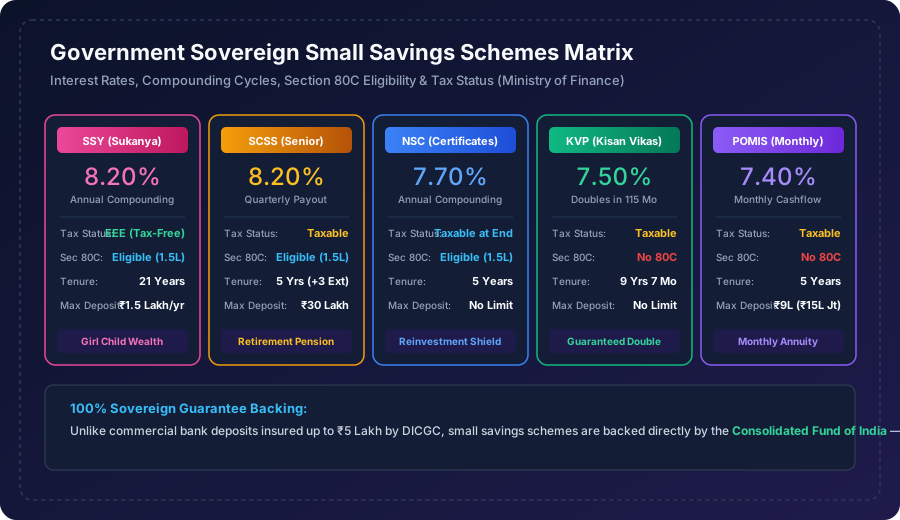
Unlike commercial bank deposits that rely on balance sheet solvency and the ₹5,00,000 insurance cap provided by the Deposit Insurance and Credit Guarantee Corporation (DICGC), small savings instruments carry an absolute sovereign guarantee. The central government guarantees the repayment of both principal and interest without any upper monetary ceiling, making these instruments the default risk-free asset benchmark in Indian domestic finance.
2. Sukanya Samriddhi Yojana (SSY): The Pinnacle of EEE Wealth Compounding
Launched under the Beti Bachao, Beti Padhao national initiative, Sukanya Samriddhi Yojana (SSY) represents the highest-yielding sovereign retail deposit vehicle available to Indian citizens. It is specifically designed to fund higher education and marriage expenses for girl children.
2.1 Statutory Eligibility & Contribution Constraints
- Account Opening Window: An SSY account can be opened by a parent or legal guardian for a girl child from her birth up to the age of 10 years.
- Beneficiary Cap: Maximum of two accounts per family (one account per girl child), with an exception granted for triplets or twins born in the second delivery.
- Deposit Thresholds: Minimum deposit of ₹250 per financial year; maximum limit capped at ₹1,50,000 per financial year.
- Deposit Duration: Deposits are accepted for exactly 15 years from the date of account inception.
- Statutory Maturity: The account matures at 21 years from the date of opening, or upon the marriage of the girl child after attaining age 18, whichever is earlier.
2.2 The 15+6 Dual Phase Compounding Dynamics
The defining financial feature of SSY is its 15+6 structure. During the first 15 years, the guardian actively contributes capital, which earns compounded interest annually. For the subsequent 6 years (from Year 16 to Year 21), no further deposits are permitted; however, the accumulated capital continues to compound at the prevailing sovereign interest rate (currently 8.20% p.a.).
If a parent deposits the maximum ₹1,50,000 annually for 15 years (total capital invested = ₹22,50,000), the terminal corpus at Year 21 reaches an astonishing ₹71,82,000+ at current rate benchmarks. Over ₹49.3 Lakh is generated purely through compound interest, delivering a wealth multiplier of 3.19×.
2.3 Triple Tax Exemption (EEE Status)
SSY is one of the rare investment vehicles in India granted full EEE (Exempt-Exempt-Exempt) tax status under the Income Tax Act:
- Exempt at Entry: Contributions qualify for tax deduction under Section 80C (up to ₹1.5 Lakh).
- Exempt during Accrual: Annual interest credited to the account is 100% tax-free under Section 10(11A).
- Exempt at Maturity: The entire terminal withdrawal amount (both principal and accumulated interest) is 100% tax-exempt.
3. Senior Citizens' Savings Scheme (SCSS): The Premier Retirement Pension Anchor
The Senior Citizens' Savings Scheme (SCSS) serves as the frontline fixed-income vehicle for senior citizen retirees seeking capital preservation coupled with predictable, high-yield quarterly cashflows.
3.1 Enhanced Investment Ceiling & Eligibility
- Eligibility: Resident individuals aged 60 years or above. Individuals retiring under Voluntary Retirement Schemes (VRS) or superannuation between ages 55 and 60 can also open an account within 1 month of receiving retirement benefits. Retired defense personnel are eligible from age 50.
- Ceiling Expansion: In recent Union Budgets, the central government doubled the statutory deposit ceiling from ₹15 Lakh to ₹30 Lakh per individual (or up to ₹60 Lakh for a married senior citizen couple holding separate accounts).
- Tenure: 5 years, with the option to extend in 3-year blocks indefinitely upon submitting Form-4.
3.2 Quarterly Pension Disbursement Schedule
Unlike cumulative fixed deposits where interest is locked until maturity, SCSS is strictly a regular income scheme. By statutory rule, interest is disbursed directly into the retiree's bank or post office savings account on the final day of each calendar quarter:
- Q1: June 30
- Q2: September 30
- Q3: December 31
- Q4: March 31
At the current sovereign rate of 8.20% p.a., an individual deploying the full ₹30 Lakh quota receives exactly ₹61,500 every quarter (amounting to ₹2,46,000 annually or an effective monthly pension of ₹20,500).
4. National Savings Certificate (NSC): The 5-Year Capital Accrual Shield
The National Savings Certificate (VIII Issue) is a 5-year fixed-term sovereign instrument designed for middle-class capital accumulation and tax planning.
4.1 Deemed Reinvestment Tax Benefit under Section 80C
A unique tax attribute of NSC distinguishes it from commercial bank term deposits. While interest on bank FDs is taxed every year on an accrual basis, NSC interest is compounded annually and paid only at maturity.
Crucially, under Indian Income Tax rules, the interest accrued at the end of each year for the first 4 years is treated as "deemed reinvested" in NSC. Because this interest is reinvested into the scheme, it qualifies as a fresh eligible investment under Section 80C. Only the interest earned in the final 5th year cannot be reinvested and is taxed in the investor's hands at maturity.
5. Kisan Vikas Patra (KVP): Guaranteed Sovereign Capital Doubling
First introduced in 1988 to mobilize rural and semi-urban savings for nation-building, Kisan Vikas Patra (KVP) is the simplest sovereign instrument in existence: an explicit guarantee to double your invested principal over a precisely defined statutory holding period.
5.1 The Mathematical Doubling Horizon
The tenure required for KVP to double is adjusted by the Ministry of Finance whenever sovereign interest rates are recalibrated. At the current 7.50% p.a. rate compounded annually:
An investment of ₹10 Lakh in KVP is guaranteed to pay out exactly ₹20 Lakh at the end of 115 months. Unlike Section 80C instruments, KVP has no upper investment ceiling, requires no annual fee, and provides premature exit liquidity after a lock-in period of 2.5 years (30 months).
6. Post Office Monthly Income Scheme (POMIS): Risk-Free Monthly Cashflow
For retirees, homemakers, and risk-averse investors seeking predictable monthly cash inflows without exposure to stock market dividend fluctuations, the Post Office Monthly Income Scheme (POMIS) provides an unshakeable sovereign solution.
- Ceilings: Raised to ₹9,00,000 for single account holders and ₹15,00,000 for joint accounts.
- Rate: 7.40% p.a., paid out on a strict monthly cadence.
- Monthly Yield: A single account with ₹9 Lakh yields ₹5,550/month; a joint account with ₹15 Lakh yields ₹9,250/month for 5 years.
- Capital Safety: The principal remains 100% intact and is returned in full at the end of the 5-year tenure.
7. Comparative Sovereign Taxonomy Matrix
| Scheme | Current Rate | Payout Mode | Max Ceiling | Tax Bracket (Entry / Accrual / Exit) |
|---|---|---|---|---|
| Sukanya Samriddhi (SSY) | 8.20% | 21-Year Lump Sum | ₹1.5 Lakh / year | EEE (100% Tax-Free) |
| Senior Citizens (SCSS) | 8.20% | Quarterly Direct Credit | ₹30 Lakh | ETE (Sec 80TTB ₹50k Free) |
| National Savings (NSC) | 7.70% | 5-Year Cumulative | No Upper Limit | ETE (Deemed Reinvestment) |
| Kisan Vikas Patra (KVP) | 7.50% | Doubles in 115 Months | No Upper Limit | TTE (Taxable at Slab) |
| Monthly Income (POMIS) | 7.40% | Monthly Credit | ₹9L Single / ₹15L Joint | TTE (Taxable Monthly) |
8. Conclusion: Strategic Sovereign Asset Allocation
In wealth preservation architecture, small savings schemes represent the supreme tier of safety. By maximizing SSY for daughters, deploying post-retirement windfalls into SCSS for inflation-protected quarterly cashflow, leveraging NSC for Section 80C reinvestment cycles, and utilizing POMIS for steady living allowances, investors establish a bulletproof financial foundation backed by the sovereign credit of the Republic of India.