


The Institutional Compendium on Term Deposits, Yield Engineering & Liquidity Optimization
A comprehensive authoritative treatise on fixed deposit compounding dynamics, recurring deposit annuities, reinvestment laddering, regulatory tax withholding (Section 194A / 80TTB), and DICGC sovereign insurance frameworks.
1. Anatomy of Commercial Bank Term Deposits (Fixed Deposits)
A Term Deposit (commonly known across Commonwealth and Asian banking jurisdictions as a Fixed Deposit or FD, and in North American markets as a Certificate of Deposit or CD) is an institutional debt instrument issued by commercial banks and non-banking financial companies (NBFCs). Under a term deposit contract, a depositor commits a specified sum of money to the lending institution for a predetermined tenure ranging from 7 days to 10 years, in exchange for a guaranteed interest rate return.
Unlike standard demand deposit savings accounts where balances can be withdrawn at will with daily interest calculation, term deposits represent stable, contractual funding for banking institutions. Under the Reserve Bank of India (RBI) Master Direction on Interest Rates on Deposits and corresponding international standards (such as Basel III Liquidity Coverage Ratio regulations), term deposits with non-call options constitute Stable Retail Deposits. Because banks can deploy this capital into medium-to-long-term lending assets (such as home mortgages, corporate credit lines, and infrastructure loans), they pay a substantially higher interest yield on term deposits compared to liquid savings accounts.
2. The Mathematical Mechanics of Compounding: Flat vs. Quarterly Accrual
One of the most frequent sources of confusion among retail and corporate depositors is the disparity between the Nominal Contracted Rate and the Effective Annual Yield (Annual Percentage Yield or APY). By regulatory mandate in India and many global jurisdictions, commercial banks compound interest on term deposits on a quarterly basis for tenures of six months and above.
2.1 The Standard Quarterly Compounding Equation
When a term deposit is booked on a Cumulative (Reinvestment) plan, the maturity value A is governed by the classical compound interest equation with compounding frequency m = 4:
Where:
- A = Maturity Amount receivable at the conclusion of tenure
- P = Initial Principal Deposit placed with the financial institution
- r = Nominal Annual Rate of Interest (expressed as a percentage, e.g., 7.10%)
- t = Deposit Tenure in years (fractional years for broken months: t = Years + Months / 12)
- 4 × t = Total number of discrete compounding quarters elapsed
2.2 Derivation of Effective Annual Yield (APY / EAR)
Because interest earned in Quarter 1 is added to the principal balance for Quarter 2, the depositor earns interest on interest. The Effective Annual Rate (EAR) or Annual Percentage Yield (APY) reflects the true annualized rate of return realized over a 365-day year:
Consider a 3-year Fixed Deposit of ₹1,000,000 booked at a nominal rate of 7.25% p.a. Under flat simple interest, the deposit would earn ₹72,500 annually, totaling ₹217,500 over 3 years. Under quarterly compounding, however:
- Quarterly Rate = 7.25% / 4 = 1.8125% per quarter
- Compounding Factor after 12 quarters = (1.018125)12 ≈ 1.23927
- Total Maturity Amount = ₹1,000,000 × 1.23927 = ₹1,239,270
- Total Interest Realized = ₹239,270
- Compounding Bonus = +₹21,770 in pure interest-on-interest surplus
- Effective Annual Yield (APY) = ((1.018125)4 - 1) × 100 = 7.45%
3. Recurring Deposit (RD) Mathematics: Systematic Annuity Compounding
A Recurring Deposit (RD) serves as the banking sector's systematic savings vehicle, allowing salaried and individual savers to accumulate a substantial capital corpus through equal monthly contributions. Unlike a mutual fund Systematic Investment Plan (SIP) where unit net asset values fluctuate with stock market volatility, an RD guarantees a deterministic terminal maturity sum backed by bank balance sheet solvency.
Because each monthly installment remains invested for a successively decreasing duration, computing RD maturity requires summing an arithmetic-geometric series. In Indian banking (under Indian Banks' Association and Post Office guidelines), interest is compounded quarterly. The maturity formula for a monthly installment R paid over n months is expressed as:
Alternatively, the closed-form approximation utilized across institutional core banking systems (CBS like Finacle and BaNCS) approximates quarterly compounding across monthly flows using:
Where i = r / 400 represents the effective quarterly rate. For example, an investor contributing ₹10,000 every month for 36 months at 7.00% p.a. deposits an aggregate principal of ₹360,000, yet receives a guaranteed maturity sum of approximately ₹401,515, earning ₹41,515 in risk-free compound interest.
4. The Fixed Deposit Laddering Strategy: Eliminating Reinvestment & Penalty Risk
One of the greatest dilemmas faced by fixed-income depositors is Interest Rate Risk versus Liquidity Risk:
- If an investor locks all their capital into a long-term 5-year FD to capture the highest promotional rates, they lose access to their money and face steep premature break penalties if an emergency strikes. Furthermore, if interest rates rise in Year 2, their capital remains trapped at legacy lower rates.
- Conversely, if the investor keeps rolling short-term 1-year FDs to preserve flexibility, they sacrifice the higher yields associated with the long-term yield curve and suffer reinvestment risk if central banks slash rates.
4.1 Architectural Blueprints of a 5-Year Ladder
The Fixed Deposit Laddering Strategy resolves this tradeoff through systematic duration diversification. Instead of depositing ₹1,000,000 in a single tranche, the investor divides the corpus into five equal tranches of ₹200,000 each:
- Tranche A (₹200,000): Booked for 1 Year at 6.80% p.a.
- Tranche B (₹200,000): Booked for 2 Years at 7.00% p.a.
- Tranche C (₹200,000): Booked for 3 Years at 7.15% p.a.
- Tranche D (₹200,000): Booked for 4 Years at 7.30% p.a.
- Tranche E (₹200,000): Booked for 5 Years at 7.50% p.a.
4.2 The Perpetual Rolling Mechanism
At the end of Year 1, Tranche A matures with principal plus accumulated compound interest. The investor now has two choices:
- If liquidity is needed: Cash is available immediately with zero penalties.
- If liquidity is not needed: The maturing proceeds are reinvested into a new 5-Year FD.
At the end of Year 2, Tranche B matures and is similarly rolled into a 5-year FD. By Year 5, all five tranches are locked at the highest possible 5-year card rates, yet 20% of the total portfolio matures every single year like clockwork. This guarantees perpetual peak long-term yields while providing steady annual liquidity and completely neutralizing interest rate cycles.
5. The Cost of Premature Withdrawal: Deconstructing the Dual Haircut
Liquidity emergencies occasionally compel depositors to liquidate a fixed deposit before the agreed contract maturity date. Commercial banks penalize premature withdrawals through a punitive regulatory mechanism known as the Dual Haircut:
- The Run-Period Card Rate Reset: The bank does not calculate interest at your booked contractual rate. Instead, it resets the rate to the card rate prevailing on the original booking date for the tenure actually completed. For example, if you booked a 5-year FD at 7.50% and break it after 14 months, your rate drops to the 1-year rate that was active when you booked (e.g., 6.00%), immediately wiping out 1.50% in rate spread.
- The Bank Penalty Deduction (0.50% to 1.00%): From that reduced run-period rate, the bank subtracts a mandatory contractual fine (typically 1.00% in leading public and private sector banks, or 0.50% for deposits below ₹5 Lakh). Continuing the example: 6.00% - 1.00% = 5.00%.
The net result is catastrophic to capital accumulation: an investor who expected to earn 7.50% compound interest ends up receiving a mere 5.00% simple-like interest, surrendering up to 35% to 50% of their earned interest back to the bank.
5.1 The Superior Alternative: Loan Against Fixed Deposit (Overdraft)
Before liquidating an unbroken term deposit, savvy depositors utilize a Loan Against Fixed Deposit (Overdraft Facility). Under RBI guidelines:
- Banks permit depositors to draw up to 90% to 95% of the deposit's accrued value as an instant overdraft line.
- The interest charged on the borrowed overdraft sum is strictly capped at Contracted FD Rate + 1.00% (or +2.00% in certain NBFCs).
- Interest is charged only on the exact amount utilized and for the exact number of days borrowed.
- Crucially, the underlying Fixed Deposit continues compounding at its full 7.50% rate without interruption. If the cash is needed for only 30 to 90 days, an overdraft line costs a fraction of the thousands lost in a premature liquidation penalty.
6. Taxation, Section 80C Tax-Saving FDs & TDS Regulations
Understanding the tax treatment of term deposits is vital to preserving net real yields. Interest income earned on fixed deposits is fully taxable at your applicable personal income tax slab rate under the head "Income from Other Sources".
6.1 Section 80C Tax-Saving Fixed Deposits
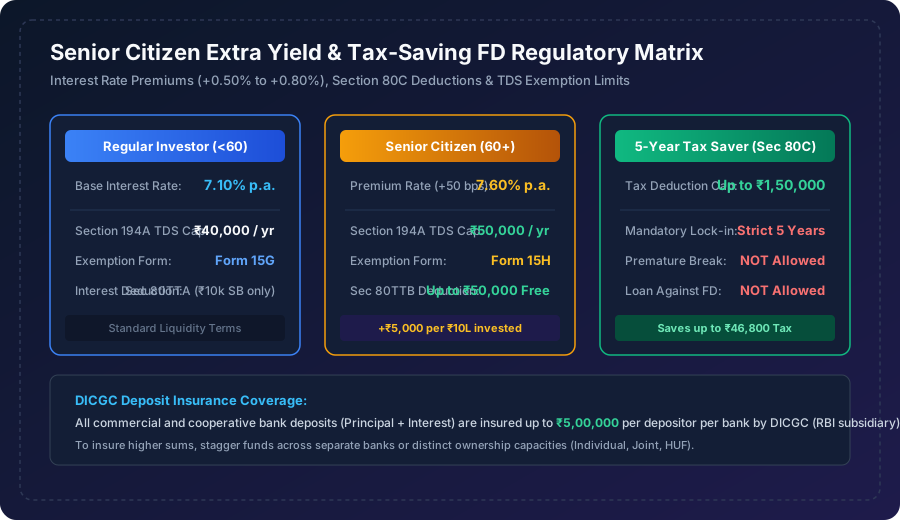
Under Section 80C of the Indian Income Tax Act (available under the Old Tax Regime), investments in specialized 5-Year Tax-Saving Fixed Deposits qualify for a tax deduction of up to ₹1,50,000 per financial year.
- Mandatory Lock-in: Strict 5 years. No premature withdrawal is permitted under any circumstance prior to 5 years, except in the event of the depositor's demise.
- No Loan/Pledge: Tax-saving FDs cannot be pledged as collateral or used to obtain an overdraft facility.
- Tax Benefit at Entry: An individual in the 30% tax bracket saves ₹46,800 in income tax (including 4% health & education cess) by deploying ₹150,000 into a 5-year tax saver.
- Interest Taxation at Exit: While the principal investment is tax-deductible at entry, the annual interest earned remains fully taxable every year as per the depositor's slab rate.
6.2 Section 194A TDS Withholding & Form 15G / 15H
Under Section 194A of the Income Tax Act:
- Banks must deduct Tax Deducted at Source (TDS) at 10% if total annual interest credited across all branches of the bank exceeds ₹40,000 for regular citizens, or ₹50,000 for Senior Citizens (aged 60 and above).
- If the depositor fails to furnish a valid Permanent Account Number (PAN), TDS is deducted at a punitive rate of 20%.
- Form 15G: Resident individuals below age 60 whose total estimated annual income is below the basic tax exemption limit (and total interest is within basic limits) can submit Form 15G at the beginning of the financial year to receive interest without TDS deduction.
- Form 15H: Senior citizens aged 60 and above can submit Form 15H provided their estimated net tax liability for the financial year is nil.
6.3 Senior Citizen Benefits under Section 80TTB
The Finance Act enacted Section 80TTB specifically to support senior citizen retirees. Under Section 80TTB, resident senior citizens can claim a deduction of up to ₹50,000 from their gross total income in respect of interest income earned from bank fixed deposits, recurring deposits, and post office savings schemes. Consequently, the first ₹50,000 in interest is completely tax-free for senior citizens.
7. Sovereign Safety: The DICGC Deposit Insurance Guarantee
A cornerstone of depositor security in the commercial banking system is the deposit insurance provided by the Deposit Insurance and Credit Guarantee Corporation (DICGC), a wholly owned subsidiary of the Reserve Bank of India.
- Insurance Limit: Each depositor in an insured bank is insured up to a maximum of ₹5,00,000 (Rupees Five Lakh) for both principal and interest amounts held in the same capacity and same right.
- Coverage Scope: All commercial banks (including public sector banks, private banks, foreign bank branches in India, and small finance banks) and cooperative banks are covered under the DICGC scheme.
- Different Ownership Capacities: The ₹5 Lakh limit applies per depositor per bank. However, deposits held in different capacities—such as an individual account in your name, a joint account with your spouse, and an account held as a Karta of a Hindu Undivided Family (HUF)—are each treated as separate entities, enjoying independent ₹5 Lakh insurance covers within the same bank.
8. Comparative Institutional Decision Matrix
The table below synthesizes the structural differences across retail fixed-income vehicles to guide strategic capital allocation:
| Instrument | Typical Tenure | Compounding Frequency | Sec 80C Tax Deduction | Liquidity & Overdraft | Sovereign / Insurance Cover |
|---|---|---|---|---|---|
| Standard Bank FD | 7 Days – 10 Years | Quarterly | No | Instant OD up to 90% | DICGC up to ₹5 Lakh |
| Tax-Saving Bank FD | Strict 5 Years | Quarterly | Yes (Up to ₹1.5L) | Strict Lock-in (No Loan) | DICGC up to ₹5 Lakh |
| Recurring Deposit (RD) | 6 Months – 10 Years | Quarterly | No (Except PO 5-Yr) | Loan against RD available | DICGC up to ₹5 Lakh |
| Post Office TD (POTD) | 1, 2, 3, 5 Years | Quarterly (Paid Annually) | 5-Year Only | Premature break after 6 mo | 100% Sovereign Guarantee |
| Senior Citizen Savings (SCSS) | 5 Years (+ 3 Yr Ext) | Quarterly Payout | Yes (Up to ₹1.5L) | Quarterly regular cashflow | 100% Sovereign Guarantee |
9. Strategic Conclusion: Building a Robust Fixed-Income Core
In modern financial portfolio architecture, term deposits represent the impervious ballast that shields investors against stock market drawdowns, emergency cash needs, and deflationary environments. By structuring capital across a staggered 5-year ladder, avoiding destructive premature liquidation penalties through overdraft credit lines, leveraging senior citizen rate spreads, and monitoring Section 194A TDS thresholds with Form 15G/15H, depositors can engineer optimal risk-adjusted returns while enjoying institutional peace of mind.