529 College & K-12 Tuition
Longitudinal pediatric budgeting, childcare logistics & compound education modeling.
Pediatric Financial InsightsLive Dynamic
Projected 529 College Fund
$138568
99.0% of $140,000 Goal in 16 Years
Parental Deposits
$72200
Compound Returns
+$66368
529 Compounding Derivation
In 16 years (Age 2 to 18): Depositing $350/mo at 7% APY grows to $138568.33 ($72200 principal + $66368 compound interest). Reaches 99.0% of your $140,000 4-year college tuition goal.
Infant Essentials & Diaper/Formula Lifecycle
Daycare Logistics & 18-Year Education 529 Timeline
Parenting Economics: The Longitudinal Guide to Childcare, Infant Essentials & Education Financing
Authoritative financial modeling spanning newborn diapering, formula feeding, daycare center rates, Dependent Care FSAs, and 18-year 529 compound investment portfolios.
1. The Complete Diapering Lifecycle: Frequency Curves & Cloth Economics
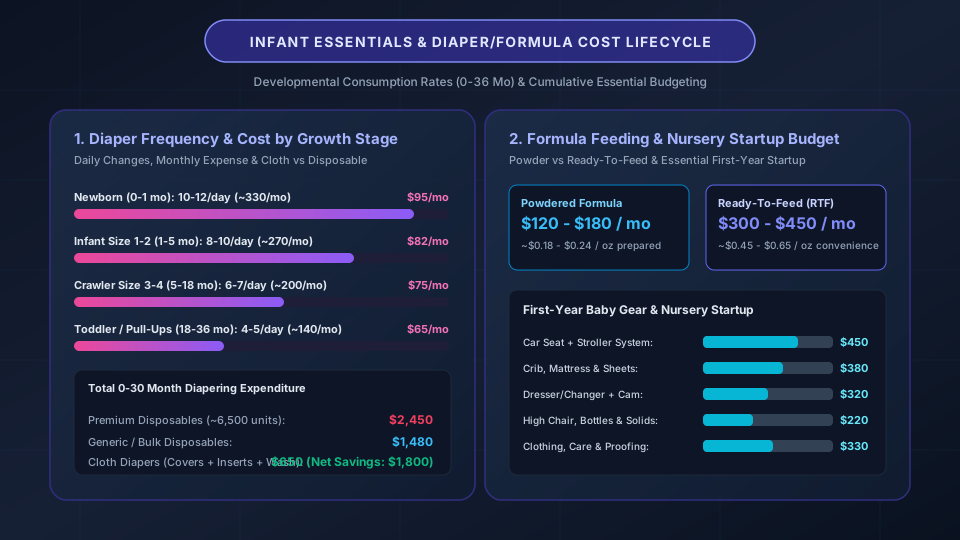
From birth to potty training (typically occurring between 28 and 36 months of age), an average child requires between 6,200 and 7,200 diaper changes. However, daily frequency is heavily front-loaded during the newborn developmental phase and decreases systematically as bladder capacity expands:
- Newborn (0-1 Month): 10 to 12 changes per day (~330 diapers/month). Frequent bowel movements and sensitive skin require immediate changing to prevent diaper dermatitis.
- Infant Sizes 1 & 2 (1-6 Months): 8 to 10 changes per day (~260 diapers/month).
- Crawler Sizes 3 & 4 (6-18 Months): 6 to 7 changes per day (~200 diapers/month). Stools become formed as solid foods are introduced.
- Toddler & Pull-Ups (18-36 Months): 4 to 5 changes per day (~140 diapers/month). Training pants cost approximately 30-45% more per unit.
When comparing modern cloth diapering systems (all-in-ones and pocket diapers with hemp or bamboo inserts) against disposable brands, families encounter a trade-off between upfront capital expenditure and recurring operating liabilities. A high-quality cloth diapering stash (24 to 30 diapers, wet bags, and sprayer) requires an initial investment of $400 to $550, accompanied by approximately $10 to $15 monthly in supplementary water, detergent, and electrical utility expenses. In contrast, premium disposable diapers cost approximately $2,200 to $2,600 over 30 months, yielding a net household savings of $1,600 to $2,000 for families utilizing cloth.
2. Infant Formula Feeding: Format Cost Arbitrage & Caloric Dynamics
Infant nutritional guidelines from the American Academy of Pediatrics (AAP) recommend feeding infants on demand, averaging 2.5 ounces of formula per pound of body weight daily during the first six months, up to a typical maximum ceiling of 32 ounces per day.
Powdered FormulaMost economical ($0.18 - $0.24 / prepared oz). Requires mixing with sterilized water at ~158°F (70°C) to eliminate potential Cronobacter bacteria. Monthly cost: $120 - $180.
Liquid ConcentrateMid-tier pricing ($0.30 - $0.38 / prepared oz). Pre-sterilized, requires 1:1 dilution with clean water. Monthly cost: $220 - $280.
Ready-To-Feed (RTF)Premium convenience ($0.45 - $0.65 / prepared oz). Sterile liquid, zero mixing required. Indispensable for immunocompromised neonates or travel, but monthly cost ranges from $320 - $480.
For mothers practicing combo feeding (supplementing breastmilk with formula), every 25% substitution of formula with breastmilk saves an average of $35 to $50 monthly in grocery expenditures, while providing maternal antibodies.
3. Childcare Logistics: Center Care, In-Home, Nannies & Tax Mitigation
Childcare represents the largest single recurring household outflow for working parents with children under age 5, often exceeding mortgage or rent liabilities in major metropolitan regions. Childcare options vary considerably across cost, flexibility, and regulatory oversight:
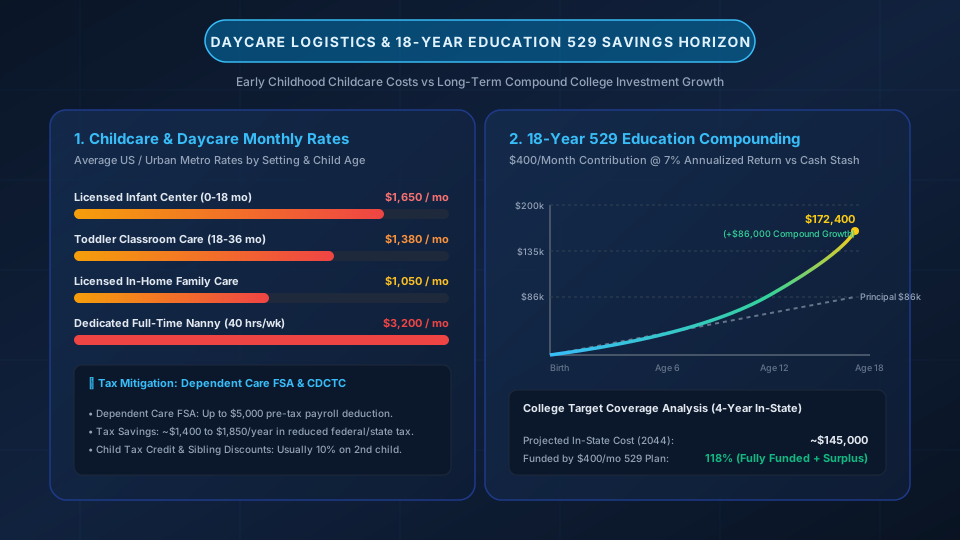
- Licensed Childcare Centers: Average $1,300 to $2,400/month per infant in urban areas. Strict staff-to-child ratios (1:4 for infants, 1:6 for toddlers), structured early childhood curricula, but rigid pick-up/drop-off hours and illness exclusion policies.
- Licensed In-Home Family Daycare: Typically 25% to 40% less expensive ($850 to $1,400/month). Smaller group settings in residential homes with mixed-age peer groups.
- Dedicated Private Nanny: $22 to $35/hour ($3,200 to $5,200/month). Maximum flexibility, 1-on-1 personalized attention, in-home care, but requires parental employer payroll tax compliance (Nanny Tax: FICA, FUTA, Workers' Comp).
To mitigate childcare expenses, working parents should optimize two primary tax instruments:
1. Dependent Care FSA (Flexible Spending Account): Allows contributing up to $5,000 per household in pre-tax payroll deductions. In a 24% federal + 6% state tax bracket, this generates an instant $1,500 net annual tax savings.
2. Child and Dependent Care Tax Credit (CDCTC): Provides a non-refundable credit between 20% and 35% on qualifying expenses up to $3,000 for one child or $6,000 for two or more children (offset by any FSA contributions).
4. The 18-Year 529 College Investment Horizon: Compounding Physics
Higher education costs have historically outpaced general consumer inflation, averaging 4.5% to 6.0% annual cost increases over the past three decades. Projecting forward 18 years, a four-year undergraduate degree at a public in-state university is forecasted to cost approximately $140,000 to $175,000 (including tuition, fees, room, and board), while private institutions may exceed $350,000.
The 529 College Savings Plan offers unmatched tax efficiency for education wealth accumulation. Contributions grow 100% tax-free at the federal level, and qualified withdrawals (tuition, room and board, books, computers, and up to $10,000/year for K-12 private tuition) are 100% tax-free. Under SECURE Act 2.0, up to $35,000 of leftover 529 funds can be rolled over penalty-free into the beneficiary's Roth IRA after 15 years.
Compound Growth Formula: Future Value = P × (1 + r/12)^(12×t) + PMT × [((1 + r/12)^(12×t) - 1) / (r/12)]
$350/Month from Birth to Age 18 @ 7% Annualized Return:
• Total Out-of-Pocket Deposits: $75,600
• Compound Investment Returns: $82,400
• Total Accumulated College Fund: $158,000 (Compound interest delivers 52% of the total fund!).
Frequently Asked Questions (FAQ)
How many diapers will my baby use during their first year?
Most infants use between 2,500 and 3,000 diapers in their first 12 months. Usage starts at 10-12 changes per day as a newborn, tapering to 8-10 changes by month 3, and approximately 6-7 changes per day from 6 to 12 months.
Is cloth diapering really worth the laundry effort financially?
Yes. A full cloth diapering stash costs $400 to $500 upfront and approximately $12/month in extra hot-water laundry expenses ($800 total over 2.5 years). Compared to disposable diapers costing $2,200 to $2,500, cloth saves approximately $1,400 to $1,700 for the first child, and even more if reused for subsequent siblings.
How much should I contribute to a 529 plan each month?
Contributing $250 to $400 per month starting at birth in an age-based aggressive growth index portfolio (targeting a 6.5% to 7.5% annualized return) will accumulate between $115,000 and $175,000 by age 18, covering 80% to 100% of four-year in-state public university costs.
How does a Dependent Care FSA reduce daycare expenses?
A Dependent Care FSA allows you to set aside up to $5,000 per year in pre-tax payroll funds for qualifying child care (daycare, preschool, after-school care, summer camps). By shielding $5,000 from federal, state, and FICA payroll taxes, most households save between $1,200 and $1,800 annually in real taxes.