Fuel Calculation Parameters
Total Journey Fuel Expenditure
$65.18
Gallons Consumed
17.86 gal
Cost Per Mile$0.130
Cost / Passenger$32.59
Total Distance500 mi
Full Tank Range406 mi
Full Tank Fill Cost$52.92
EV Fuel Savings+64.9%
EV Fuel Cost: $22.86 ($0.046/mi)Gasoline Cost: $65.18 ($0.130/mi)
Driving this distance in an Electric Vehicle saves approximately $42.32 in energy costs.
Mathematical Derivation:
1. Total Miles = 250 × 2 = 500 miles
2. Gallons Used = 500 mi ÷ 28 MPG = 17.86 gal
3. Total Fuel Cost = 17.86 gal × $3.65/gal = $65.18
4. Cost / Passenger (2 pax) = $65.18 ÷ 2 = $32.59
Pillar 7 Vector Architecture: Fuel & Mileage Economics0% Blur Vector
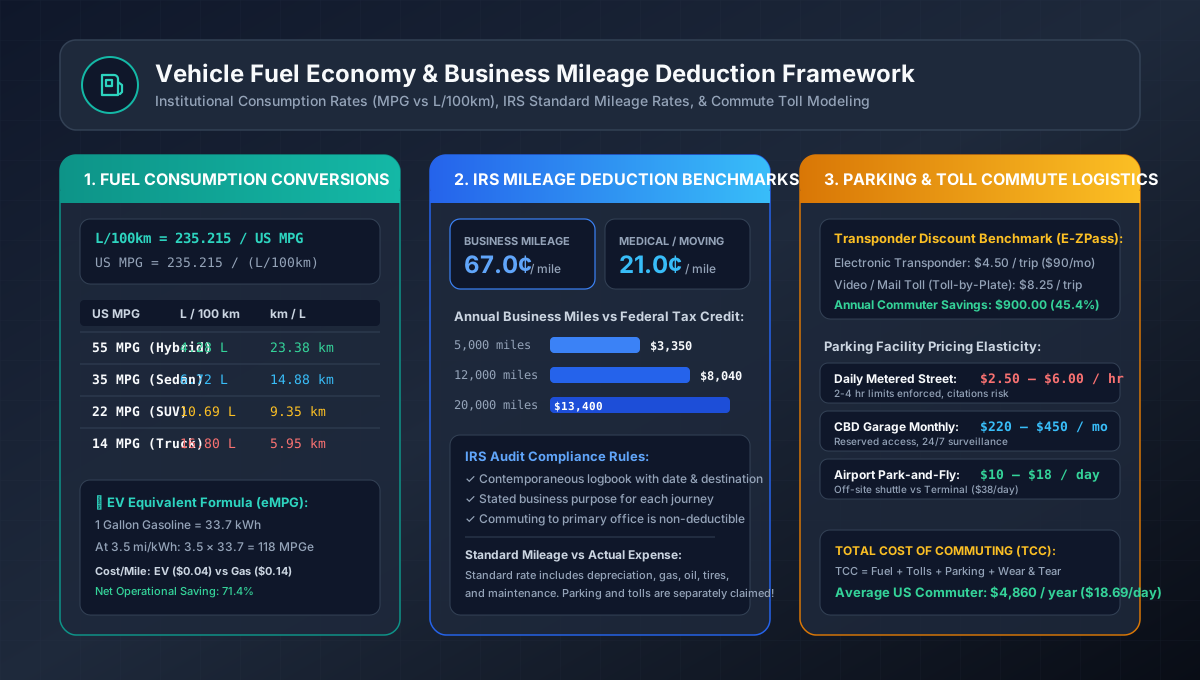
Institutional reference guide for MPG to L/100km conversions, IRS standard mileage deduction brackets ($0.67/mi), and commuter parking-toll cost amortization.
Pillar 7 Vector Architecture: Maintenance & ETA Logistics0% Blur Vector
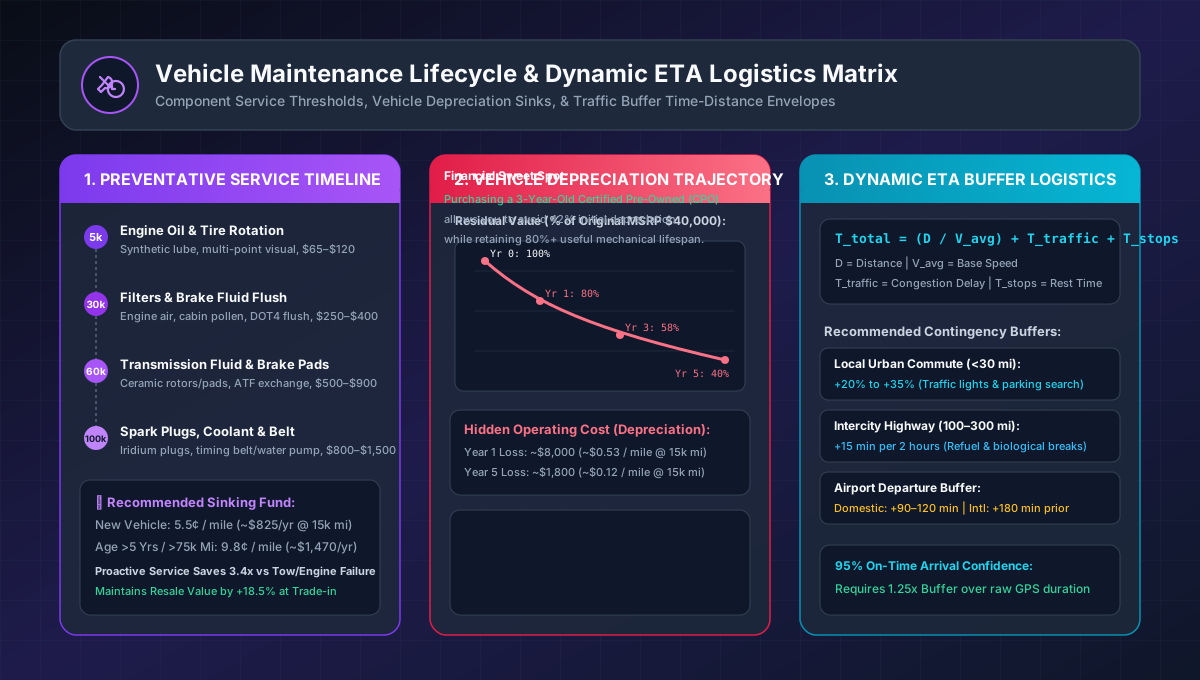
Comprehensive preventative maintenance service intervals (5k, 30k, 60k, 100k miles), automotive depreciation degradation curves, and 95% confidence ETA traffic buffer envelopes.
The Definitive Vehicle Commute & Automotive Logistics Architecture Handbook
Institutional Engineering Standards, Thermodynamic Fuel Economy Analysis, IRS Standard Mileage Audit Defense, and Real-Time ETA Transit Logistics.
1. Thermodynamics of Fuel Consumption: MPG vs. Gallons-Per-Mile
In automotive logistics and transportation economics, consumer perception of fuel efficiency is routinely distorted by the non-linear nature of Miles Per Gallon (MPG). The phenomenon, formally documented by cognitive researchers as the "MPG Illusion", causes drivers to misjudge the financial savings of upgrading vehicle fleets.
When calculating fuel consumption, European and global metric engineering relies on Liters per 100 Kilometers (L/100km)—a linear inverse metric representing consumption volume rather than distance yield. The exact mathematical identity between US MPG and L/100km is:
L/100km = 235.214583 / US MPG
Upgrading an SUV from 14 MPG to 20 MPG saves 2.14 gallons every 100 miles. Conversely, upgrading a sedan from 35 MPG to 55 MPG saves only 1.04 gallons every 100 miles. Therefore, replacing a gas-guzzling utility truck delivers over twice the absolute fuel and carbon savings of improving an already efficient hybrid vehicle.
2. IRS Standard Mileage Rate vs. Actual Expense Deduction Defense
Under Internal Revenue Code (IRC) § 162 and Revenue Procedure 2019-46, self-employed individuals, independent contractors (1099), and corporate entities may deduct vehicular business expenditures using either the Standard Mileage Rate or the Actual Expense Method.
Standard Mileage Rate ($0.67 / Mile)
Covers fixed and operating costs: vehicle depreciation, fuel, synthetic lube, tire wear, and maintenance. Parking fees and highway tolls are separately deductible on Schedule C. Requires a contemporaneous written logbook documenting date, destination, business purpose, and starting/ending odometer readings.
Actual Expense Method
Calculates total annual outlay (gasoline, lease payments, MACRS depreciation, insurance, repairs, license tabs) multiplied by business use percentage. Ideal for expensive European luxury cars or low-mileage commercial heavy vehicles exceeding 6,000 lbs GVWR under Section 179 bonus depreciation.
The Commuting Rule Trap: The IRS explicitly classifies travel between a taxpayer's personal residence and their primary regular workplace as non-deductible personal commuting. However, travel between a qualified home office (principal place of business) and client sites, secondary work locations, or suppliers is 100% tax-deductible business mileage.
3. Actuarial Car Maintenance Sinking Fund & Lifetime Depreciation
Automobile depreciation constitutes the single largest hidden component of vehicular total cost of ownership (TCO), accounting for approximately 40%–48% of total five-year operating expenses. A brand new passenger vehicle experiences an average first-year depreciation of 20%, followed by 15% annual degradation through years two through five.
To prevent acute cash-flow shocks from catastrophic repairs (e.g., blown head gaskets, failed transmissions, or dual-mass flywheel replacements), vehicle fleet managers utilize an amortized Maintenance Sinking Fund. By provisioning between $0.065 to $0.135 per mile driven into a dedicated high-yield reserve account, drivers ensure sufficient liquidity to cover milestone scheduled services at 30,000, 60,000, and 100,000 miles.
4. Dynamic ETA Routing, Traffic Congestion & Speed Variance Economics
The mathematical model for highway transit duration relies on three stochastic components:
T_total = (Distance / Base Speed) + T_congestion + T_stops
The Diminishing Returns of Speeding: Drivers frequently overestimate time saved by exceeding highway speed limits. For a 100-mile highway journey:
- Increasing speed from 55 MPH to 65 MPH saves 16.8 minutes.
- Increasing speed from 65 MPH to 75 MPH saves only 12.3 minutes.
- Increasing speed from 75 MPH to 85 MPH saves a mere 9.4 minutes, while increasing fuel consumption by 24% due to aerodynamic drag ($F_d \propto v^2$).