Compute the n-th term aₙ = a · rⁿ⁻¹, finite partial sum Sₙ, and infinite convergent series S_∞ = a / (1 - r).
Sample Elements:
2, 6, 18, 54, 162, 486 ...
GP Results
Term #6
N-th Term (aₙ)486
Finite Sum (Sₙ)728
Infinite Sum (S_∞)Diverges (|r| ≥ 1)
Visual Guides & Sequences Architecture
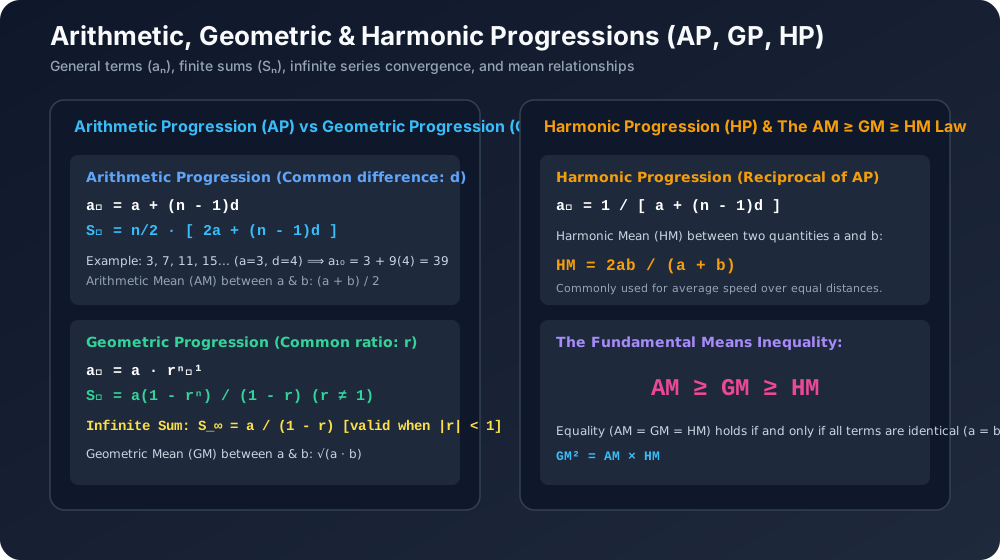
Authoritative reference charts illustrating AP and GP sequence progressions, infinite series convergence, and mean inequalities.
AP, GP & HP Sequences Formulations
Mathematical closed-form equations for arithmetic progressions, geometric decay, and the AM ≥ GM ≥ HM inequality.
Series Summations & Gauss Laws
Formulas for sums of natural numbers, squares, and cubes derived from Gauss summation principles.
Comprehensive Reference: Progressions, Mathematical Sequences, and Series Convergence
In pure mathematics and financial engineering, numerical progressions describe interest compounding, loan amortizations, radioactive half-life decay, and harmonic acoustics.
1. Infinite Geometric Series and Convergence
When the absolute value of the common ratio is strictly less than one ($|r| < 1$), higher powers of $r$ diminish to zero ($r^n \to 0$ as $n \to \infty$). Consequently, the finite sum formula simplifies into the famous infinite sum:
S_∞ = a / (1 - r) [strictly for |r| < 1]
Frequently Asked Questions (FAQ)
About Geometric Progression Calculator
Compute arithmetic, geometric, and harmonic progressions with n-th terms, finite/infinite series summations, and AM-GM-HM inequality verification.
Why this page helps
Indispensable for financial compound interest, physics harmonic motion, and discrete math
Automatic divergence detection for geometric series when |r| ≥ 1
Step-by-step formula explanations for classroom and competitive exams
How to use it well
Select your sequence type: Arithmetic Progression (AP), Geometric Progression (GP), Harmonic Progression (HP), or Means Comparison (AM-GM-HM).
Enter the first term (a), common difference (d) or common ratio (r), and the number of terms (n).
Inspect the calculated n-th term, series summation, convergence status, and generated sequence terms.
Export your sequence analysis to PDF or save to history.
Expert tips
Math Calculator
Algebra & Equations
Sequences & Progressions Suite
AP, GP, HP & Infinite Series
Geometric Progression Calculator
Calculate GP terms and sum.
Geometric Progression (GP) Calculator
Compute the n-th term aₙ = a · rⁿ⁻¹, finite partial sum Sₙ, and infinite convergent series S_∞ = a / (1 - r).
Sample Elements:
2, 6, 18, 54, 162, 486 ...
GP Results
Term #6
N-th Term (aₙ)486
Finite Sum (Sₙ)728
Infinite Sum (S_∞)Diverges (|r| ≥ 1)
Visual Guides & Sequences Architecture
Authoritative reference charts illustrating AP and GP sequence progressions, infinite series convergence, and mean inequalities.
AP, GP & HP Sequences Formulations
Mathematical closed-form equations for arithmetic progressions, geometric decay, and the AM ≥ GM ≥ HM inequality.
Series Summations & Gauss Laws
Formulas for sums of natural numbers, squares, and cubes derived from Gauss summation principles.
Comprehensive Reference: Progressions, Mathematical Sequences, and Series Convergence
In pure mathematics and financial engineering, numerical progressions describe interest compounding, loan amortizations, radioactive half-life decay, and harmonic acoustics.
1. Infinite Geometric Series and Convergence
When the absolute value of the common ratio is strictly less than one ($|r| < 1$), higher powers of $r$ diminish to zero ($r^n \to 0$ as $n \to \infty$). Consequently, the finite sum formula simplifies into the famous infinite sum:
S_∞ = a / (1 - r) [strictly for |r| < 1]
Frequently Asked Questions (FAQ)
About Geometric Progression Calculator
Compute arithmetic, geometric, and harmonic progressions with n-th terms, finite/infinite series summations, and AM-GM-HM inequality verification.
Why this page helps
Indispensable for financial compound interest, physics harmonic motion, and discrete math
Automatic divergence detection for geometric series when |r| ≥ 1
Step-by-step formula explanations for classroom and competitive exams
How to use it well
Select your sequence type: Arithmetic Progression (AP), Geometric Progression (GP), Harmonic Progression (HP), or Means Comparison (AM-GM-HM).
Enter the first term (a), common difference (d) or common ratio (r), and the number of terms (n).
Inspect the calculated n-th term, series summation, convergence status, and generated sequence terms.
Export your sequence analysis to PDF or save to history.
Expert tips
For compounding interest calculations, use GP where the common ratio is r = (1 + annual_rate).
Frequently Asked Questions (FAQ)
Mathematical & Transparency Notice:Calculations are algorithmic simulations intended for educational and estimation purposes.