Math Calculator
Number Systems & Converters
Configuration & Inputs8-Bit Precision
Two’s Complement Range [-128 to 127]:
Most Significant Bit (MSB) acts as the sign flag (0 = Positive, 1 = Negative). Negation rule: Invert all bits and add 1.
Two’s Complement Result
8-Bit Binary String
Sign Bit (MSB): 1 (Negative)
11010110
Hex: 0xD6Decimal: -42
Derivation Steps:
1. Absolute Magnitude |N|
Unsigned binary of 42
00101010
2. Invert Bits (1's Compl.)
Flip all 0s to 1s and 1s to 0s
11010101
3. Add 1 (2’s Complement)
Add 1 to least significant bit (LSB)
11010110
Arithmetic Logic Unit (ALU) & Bitwise Complements Guide
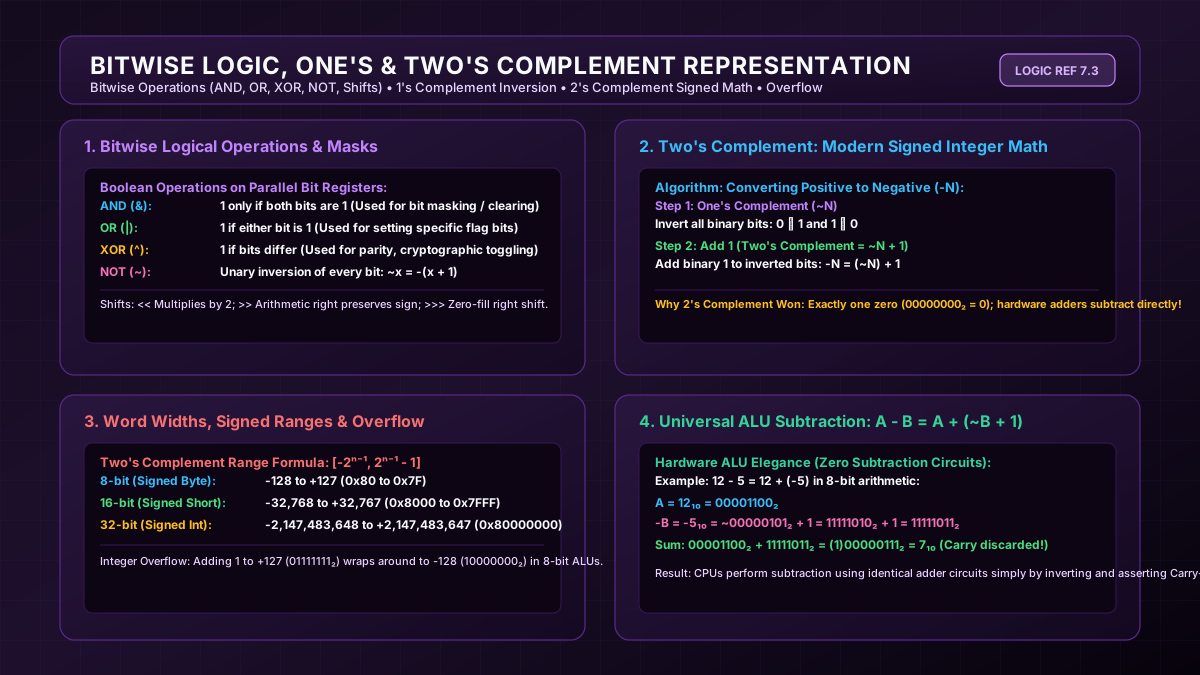
Visual reference explaining two’s complement negation pipelines, overflow flag generation, sign extension, and transistor logic gates (AND, OR, XOR, NOT).
1. Binary Arithmetic in Hardware and the Supremacy of Two’s Complement
Digital computation requires a method to represent both positive and negative quantities using strictly binary signals. While intuitive systems such as Sign-and-Magnitude (where the first bit denotes sign and remaining bits represent absolute value) and One’s Complement (inverting all bits for negative values) were tested in early computing history, both introduced a catastrophic architectural flaw: the existence of two distinct zeros ($+0$ and $-0$).
In addition to consuming two code points for a single mathematical entity, dual zeros require complex comparison circuitry in every branch instruction. Two’s Complement, pioneered by John von Neumann in his 1945 First Draft of a Report on the EDVAC, solved this fundamentally. By representing negative numbers as the modular complement $2^N - |X|$, two’s complement provides a single unique zero ($00000000_2 = 0$) and allows hardware addition and subtraction to be performed by the exact same physical adder circuits without separate subtractor logic.
2. The Mechanical Two’s Complement Negation Algorithm
To negate any signed binary integer of width $N$:
- Bitwise NOT (One’s Complement): Flip every bit in the binary sequence (0 to 1 and 1 to 0). Mathematically, this corresponds to (2^N - 1) - X.
- Increment by 1: Add 1 to the least significant bit (LSB). The resulting value is (2^N - 1 - X) + 1 = 2^N - X = -X (modulo 2^N).
- Shortcut (Right-to-Left Scanning): Scanning from right to left (LSB to MSB), keep all trailing zeros and the first '1' unchanged; flip all remaining bits to the left of the first '1'.
3. Bitwise Manipulation Idioms in Systems Programming
Bitwise operators operate directly on individual bits rather than high-level numerical values. They form the bedrock of systems programming, device drivers, network protocol parsing, and cryptographic algorithms:
- Bit Masking (Clearing Bits):
x & ~(1 << n)clears bit $n$ to 0. - Setting Bits:
x | (1 << n)sets bit $n$ to 1. - Toggling Bits:
x ^ (1 << n)inverts bit $n$. - Brian Kernighan’s Algorithm:
x & (x - 1)clears the lowest set bit, enabling $O(k)$ population counting where $k$ is the number of set bits. - Power of Two Test: A positive integer $x$ is a power of 2 if and only if
(x & (x - 1)) == 0.
Frequently Asked Questions (FAQ)
About 2's Complement Calculator
Professional ALU logic and signed binary complements suite. Compute two’s complement and one’s complement across 8, 16, 32, and 64-bit word widths with step-by-step bitwise inversion and negation, overflow bounds checking, and live multi-base bitwise logic gates (AND, OR, XOR, NOT, NAND, NOR, XNOR, Shifts).
Why this page helps
- Crucial for embedded systems developers, assembly programmers, and computer architecture students
- Demystifies integer overflow, sign extension, and ALU logic execution
- Zero-blur vector SVG infographic depicts hardware logic gates and full adder circuits
How to use it well
- Select your target mode: Two's Complement, One's Complement, or Bitwise Logic.
- Choose your bit precision width (8-bit Byte, 16-bit Short, 32-bit Integer, or 64-bit Long).
- Enter your signed decimal number or raw binary bitstring.
- Examine the sign bit (MSB), hexadecimal representation, and step-by-step inversion derivation.
- Perform multi-operand bitwise logic operations (AND, OR, XOR, NOT, NAND, NOR, XNOR, Shifts) with vertical bit alignment.