Category 2: ConstructionSubcategory 6: Electrical & Power
Building Electrical Engineering & Power Distribution Suite
National Electrical Code (NEC NFPA 70) conductor sizing, conduit fill ratios, demand load balancing, breaker trip curves, voltage drop compliance, transformers, and renewable solar PV topology.
Distribution Transformer Rating & Fault Levels
IEEE C57 / IEC 60076Real-Time Mathematical Derivation:
1. Primary Rated Current = 13.12 A (at 11000 V)
2. Secondary Rated Current = 347.8 A (at 415 V)
3. Short Circuit Fault Level = 6.96 kA (at 5% Z)
Engineering Output
347.8 A Secondary
Short Circuit Fault: 6.96 kA
NEC Safety & Fill Utilization MeterSafety Margin
NEC & IEC Electrical Rules of Thumb
Maximum Branch Voltage Drop:≤ 3.0% (NEC 210.19)
Maximum Conduit Fill (3+ wires):≤ 40% (NEC Ch 9 Table 1)
Continuous Load Sizing Factor:125% of continuous current
Curve C MCB Trip Multiplier:5x to 10x full-load rating
Solar Array Roof Area Density:~100 sq ft per 2.0 kWp
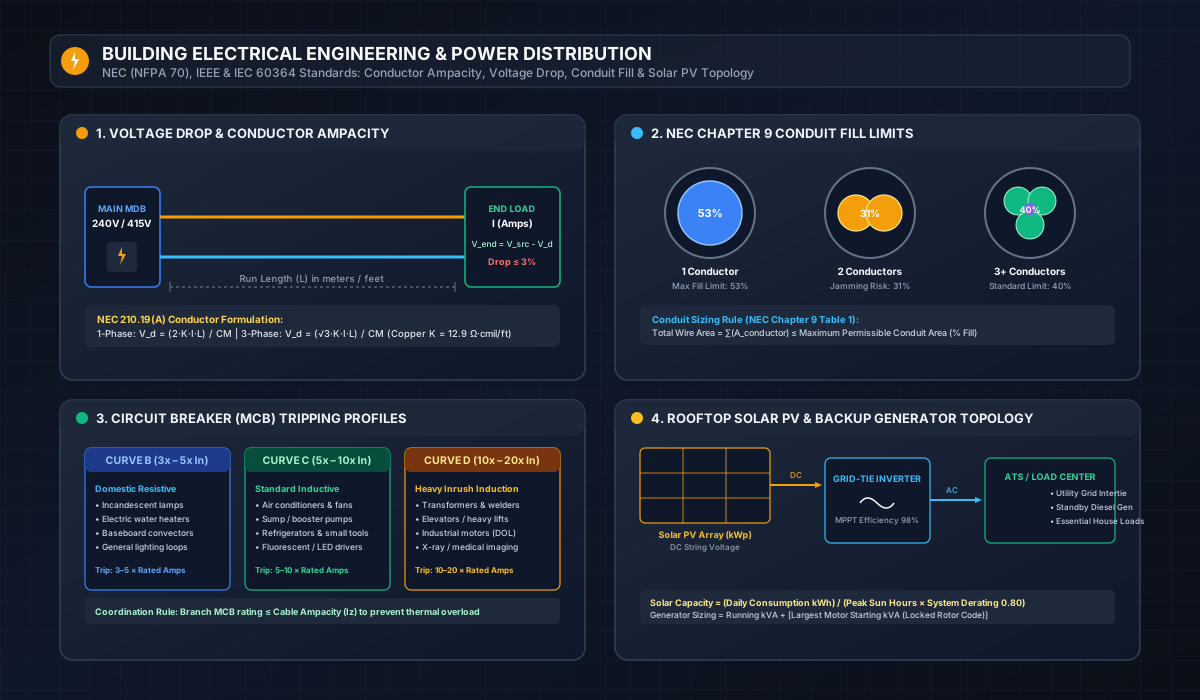
Institutional Infographic: Building Electrical Power Distribution
Visual technical reference illustrating NEC conductor voltage drop formulas, Chapter 9 conduit fill cross-sections, MCB tripping curves, and rooftop solar string inverter topology.
E-E-A-T Academic Engineering Manual
Building Electrical Power Distribution, Circuit Protection & Renewable Integration
Professional guidelines adhering to the National Electrical Code (NEC / NFPA 70), IEEE Standard 141 (Red Book), and IEC 60364 Electrical Installations for Buildings.
1Conductor Sizing, Temperature Derating & Continuous Duty
Sizing electrical conductors requires balancing three critical engineering constraints: thermal ampacity limits, permissible voltage drop, and short-circuit withstand rating. Under NEC Article 310, ampacity is defined as the maximum current in amperes that a conductor can carry continuously under the conditions of use without exceeding its temperature rating.
When conductors operate in elevated ambient temperatures (such as unconditioned attic spaces or exterior rooftop conduits), correction factors must be applied:
I_derated = I_table × TempCorrectionFactor × ConductorBundlingFactor
Furthermore, under NEC 210.19(A), any branch circuit supplying a continuous load (defined as a load where the maximum current continues for 3 hours or more, such as commercial store lighting or electric vehicle charging) must carry an ampacity rating not less than 125% of the continuous load plus 100% of the non-continuous load.
2Voltage Drop Mitigation & Efficiency Standards
While a conductor may satisfy thermal ampacity criteria, excessive circuit length can introduce unacceptably high internal resistance, resulting in severe voltage drop. Low voltage at the load terminal causes electric motors to draw higher operating current, overheat windings, and trip overload relays, while electronic ballasts and LED drivers suffer degraded life expectancies.
NEC Informational Note 210.19(A) recommends that conductors be sized to limit voltage drop to:
- Branch Circuits: Maximum 3% voltage drop at the farthest outlet.
- Feeder & Branch Combined: Maximum 5% total voltage drop from the utility service meter to the end device.
3Circuit Breaker Selection: Tripping Characteristics (B, C, D Curves)
Miniature Circuit Breakers (MCBs) conforming to IEC 60898 provide dual protection: a bimetallic thermal strip for sustained moderate overloads, and an electromagnetic solenoid for instantaneous short-circuit clearing:
Type B Characteristic
Trips instantaneously between 3x and 5x rated current.
Ideal for domestic resistive circuits with negligible switching surges (lighting and heaters).
Type C Characteristic
Trips instantaneously between 5x and 10x rated current.
Standard for residential and commercial inductive loads (air conditioners, refrigerators, pumps).
Type D Characteristic
Trips instantaneously between 10x and 20x rated current.
Essential for high inrush inductive loads (welding machines, transformers, large motors).
4Rooftop Solar PV Array & Inverter Integration
Grid-tied rooftop solar photovoltaic systems convert solar irradiance directly into clean DC power, which is transformed into synchronized AC voltage by a grid-tie string inverter. Sizing a solar PV array requires accurate estimation of daily energy consumption and local Peak Sun Hours (PSH):
Array Capacity (kWp) = Daily Consumption (kWh) / [Peak Sun Hours (hrs) × System Performance Ratio (PR)]
The Performance Ratio (PR) accounts for real-world optical and thermal losses (module soiling, temperature coefficient power degradation at 65°C cell temperature, inverter clipping, and DC wiring losses), typically totaling 20% to 22% loss (PR ≈ 0.78 to 0.82).