Nuclear Stability, Fission & Thermonuclear Fusion
Nuclear Mass Defect & Binding Energy per Nucleon Calculator
Analyze nuclear mass defects Δm = Σm_nucleons - M_nucleus, calculate binding energy per nucleon (BE/A) across the chart of nuclides, and compare fusion uphill climb with fission decay.
Configuration InputsKinetic & Relativistic Engine
Thermodynamic & Nuclear OutputReactive Physical Engine
BINDING-ENERGYBE per Nucleon (BE/A)8.553MeV / nucleon
Total Binding Energy478.97 MeV(7.67e-11 Joules)
Nuclear Mass Defect (Δm):0.51420 u (8.538e-28 kg)
Constituent Nucleons:26 Protons + 30 Neutrons (56 Total)
Thermonuclear Regime:Cosmic Stability Maximum (Cannot yield Fusion or Fission energy)
Nuclear Binding Energy Curve Reference
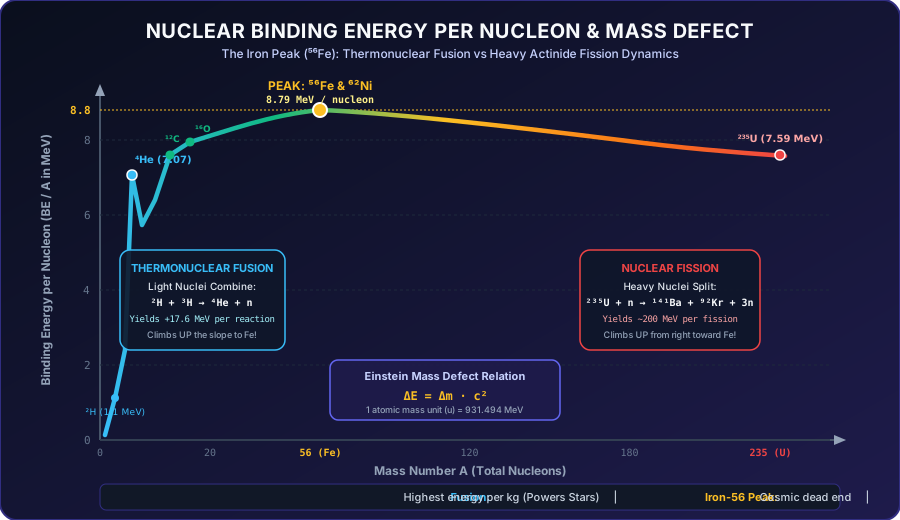
Figure 1: Nuclear binding energy per nucleon (BE/A in MeV) vs mass number A, showing the Iron-56 peak.
Institutional Thermodynamics & Nuclear Physics Reference Guide
Ideal Gas Equations of State, Chemical Spontaneity, and Nuclear Mass Defects
An exhaustive technical dissertation detailing microscopic gas kinetics, Van der Waals non-ideal corrections, Gibbs free energy criterion, Einsteinian mass-energy equivalence, and nuclear binding energy curves.
1. The Ideal Gas Law and Van der Waals Real Gas Correction
The ideal gas equation of state combines Boyle's Law (P ∝ 1/V), Charles's Law (V ∝ T), and Avogadro's Law (V ∝ n) into a unified thermodynamic expression:
P · V = n · R · T = N · k_B · T
Where P is absolute pressure in Pascals, V is volume in m³, n is amount of substance in moles, R = 8.314462 J/(mol·K) is the universal gas constant, and T is absolute temperature in Kelvin.
While the ideal gas model assumes point-like molecules with zero volume and no intermolecular interactions, real gases at high pressure or low temperature deviate substantially from ideality. In 1873, Johannes Diderik van der Waals introduced two empirical corrections:
[ P + a · ( n / V )² ] · [ V - n · b ] = n · R · T
Where:
- a accounts for attractive intermolecular forces (van der Waals forces), which reduce measured wall pressure.
- b represents the finite excluded volume occupied by the gas molecules themselves (approximately four times the molecular volume).
2. Gibbs Free Energy and Thermodynamic Spontaneity Criteria
The Second Law of Thermodynamics dictates that for an isolated system, total entropy always increases (ΔS_universe > 0). For closed chemical systems operating at constant temperature and pressure, the criterion for spontaneous change is captured by the Gibbs Free Energy (G):
ΔG = ΔH - T · ΔS
The sign of ΔG reveals the feasibility of a physical or chemical process:
- ΔG < 0 (Exergonic / Spontaneous): The reaction proceeds forward spontaneously, releasing free energy available to perform non-PV work.
- ΔG = 0 (Equilibrium): The forward and reverse rates are equal; the system is in dynamic chemical equilibrium.
- ΔG > 0 (Endergonic / Non-Spontaneous): The process cannot proceed forward on its own; energy input is required to drive it.
Standard Gibbs free energy connects directly to the thermodynamic equilibrium constant K_eq via:
ΔG° = -R · T · ln( K_eq ) ⇒ K_eq = e^( -ΔG° / ( R · T ) )
3. Einstein's Mass-Energy Equivalence: E = mc²
In his 1905 paper on Special Relativity, Albert Einstein showed that mass and energy are interchangeable manifestations of the same physical quantity. The rest energy E₀ of a stationary particle with invariant rest mass m₀ is:
E₀ = m₀ · c²
Because the speed of light squared (c² ≈ 8.98755 × 10¹⁶ m²/s²) is gigantic, even tiny amounts of mass hold colossal energy reserves. Complete conversion of just 1.0 gram of matter releases:
E = 0.001 kg × (2.998 × 10⁸ m/s)² = 8.988 × 10¹³ Joules ≈ 21.48 Kilotons of TNT ≈ 25 Million kWh
When a particle travels at relativistic velocity v, its total energy and momentum are governed by the relativistic dispersion relation:
E² = ( p · c )² + ( m₀ · c² )², where p = γ · m₀ · v, γ = 1 / √( 1 - v²/c² )
4. Nuclear Mass Defect and the Binding Energy Curve
Precise mass spectrometry reveals that the actual mass of any stable atomic nucleus is always strictly less than the combined sum of its individual isolated protons and neutrons. This missing mass is the nuclear mass defect (Δm):
Δm = [ Z · m_p + ( A - Z ) · m_n ] - M_nucleus
According to mass-energy equivalence, this missing mass was converted into binding energy (BE = Δm · c²) released when the strong nuclear force bound the nucleons together. In nuclear physics:
1 atomic mass unit (1 u) = 931.494 MeV of binding energy
Plotting the binding energy per nucleon (BE/A) against mass number A yields the famous nuclear stability curve:
- Light Elements (A < 20): BE/A climbs sharply from 1.1 MeV for Deuterium (²H) to 7.07 MeV for Helium-4 (⁴He). Combining light nuclei (Thermonuclear Fusion) moves up this steep hill, releasing massive energy per unit mass (powers the Sun and hydrogen weapons).
- The Iron Peak (A ≈ 56–62): Binding energy per nucleon peaks at Iron-56 (⁵⁶Fe at 8.79 MeV/nucleon) and Nickel-62 (⁶²Ni at 8.795 MeV/nucleon). Nuclei at the iron peak represent the most thermodynamically stable matter in the universe; stellar core fusion terminates at iron, precipitating core-collapse Type II supernovae.
- Heavy Actinides (A > 200): BE/A gently declines to ~7.59 MeV for Uranium-235 (²³⁵U) due to cumulative long-range electrostatic Coulomb repulsion between 92 positive protons. Splitting heavy nuclei (Nuclear Fission) into intermediate fragments moves back UP toward the iron peak, releasing ~200 MeV per fission event.
Nuclide Mass Defect & Nuclear Binding Energy Data Matrix
| Nuclide | Protons (Z) | Neutrons (N) | Actual Mass (u) | Mass Defect Δm (u) | BE / A (MeV) |
|---|---|---|---|---|---|
| Deuterium (²H) | 1 | 1 | 2.01410 u | 0.00239 u | 1.112 MeV |
| Helium-4 (⁴He) | 2 | 2 | 4.00260 u | 0.03038 u | 7.074 MeV |
| Carbon-12 (¹²C) | 6 | 6 | 12.00000 u | 0.09894 u | 7.680 MeV |
| Iron-56 (⁵⁶Fe) | 26 | 30 | 55.93494 u | 0.52846 u | 8.790 MeV |
| Uranium-235 (²³⁵U) | 92 | 143 | 235.04393 u | 1.91514 u | 7.591 MeV |
Frequently Asked Questions (Gas Laws & Nuclear Physics FAQ)
Why does nuclear fusion release more energy per gram than fission?
In D-T fusion (²H + ³H → ⁴He + n), the binding energy jumps from ~1.1–2.8 MeV/nucleon up to 7.07 MeV/nucleon—a massive gain of ~3.5 MeV per nucleon. In Uranium fission, the jump is only from 7.6 to 8.5 MeV (~0.9 MeV per nucleon). Because light nucleons have smaller mass, fusion produces roughly 4 times more energy per gram of fuel.
Can an endothermic reaction (ΔH > 0) ever be spontaneous?
Yes, provided the reaction generates a positive change in entropy (ΔS > 0). As temperature T increases, the -TΔS term becomes increasingly negative until it outweighs positive ΔH, making ΔG < 0 above the threshold temperature T* = ΔH / ΔS. Melting ice at room temperature is an everyday example.
What is the physical meaning of the compressibility factor Z?
The compressibility factor Z = PV / nRT measures deviation from ideal gas behavior. For an ideal gas, Z = 1.000. When Z < 1, attractive intermolecular forces dominate, making the gas more compressible than ideal. When Z > 1, molecular volume repulsion dominates, making the gas less compressible.
Why can stars not produce energy by fusing iron (⁵⁶Fe)?
Iron-56 sits at the absolute peak of the nuclear binding energy per nucleon curve. Fusing iron into heavier elements requires adding energy (it is strongly endothermic) rather than releasing it, robbing the stellar core of thermal radiation pressure and triggering catastrophic gravitational collapse into a neutron star or black hole.