Science Calculator
Mechanics & Motion
🕰️ Simple Pendulum Configuration
Model point-mass gravity pendulums with exact small-angle and Borda-Bernoulli finite amplitude expansions.
1.0000 m standard
15.0° (0.262 rad)
1° (Linear SHM)15° (Standard)45° (Nonlinear)85° (Extreme)
Harmonic Period & Kinematics Output
Finite Amplitude RegimeSmall-Angle Period (T₀)
2.0064 s
f₀ = 0.498 Hz (29.9 ticks/min)
Borda Corrected (T)
2.0150 s
ΔT = +0.430% error from SHM
Angular Frequency (ω₀)
3.132 rad/s
Natural circular rate √(g/L)
Finite Amplitude Period Dilatation Factor:1.00430× T₀
0% (Small Angle <5°)2% (At ~35°)4% (At ~50°)>7.3% (At 60°+)
Peak Speed (v_max):0.818 m/s
Peak Tension (T_max):5.24 N
Min Tension (T_min):4.74 N
Arc Length (s):26.2 cm
Step-by-Step Harmonic Derivation:
1. Small-angle restoring torque: τ = -m·g·L·sin(θ) ≈ -m·g·L·θ
2. Natural angular frequency: ω₀ = √(g / L) = √(9.807 / 1.000) = 3.1316 rad/s
3. Ideal SHM Period: T₀ = 2π / ω₀ = 2π × √(1.000 / 9.807) = 2.0064 s
4. Borda amplitude expansion: T = T₀ [ 1 + (1/16)θ₀² + (11/3072)θ₀⁴ ] = 2.0064 × 1.00430 = 2.0150 s
5. Apex drop height: Δh = L(1 - cos θ₀) = 0.0341 m ➔ v_max = √(2gΔh) = 0.818 m/s
📊 Architectural Vector Schematics & Oscillation Dynamics
Crystal-clear zero-blur vector diagrams illustrating restoring force resolution, compound pendulum gyration, spring networks, and phase space energy conservation.
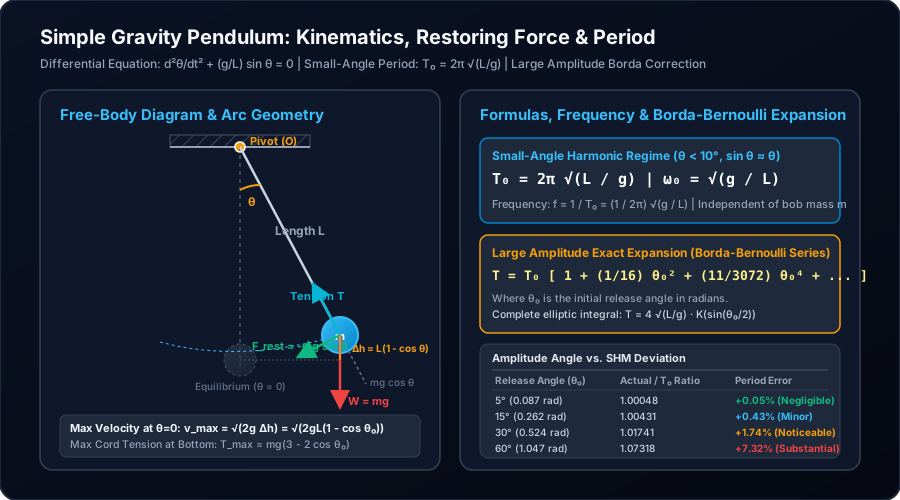
Figure 1: Simple Gravity Pendulum Free-Body Vectors, Small-Angle Approximation & Borda Dilatation.
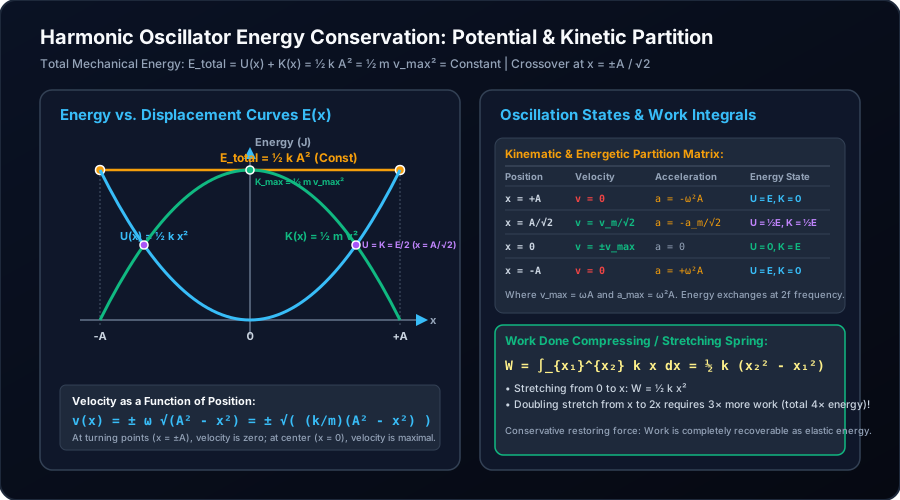
Figure 2: Mechanical Energy Conservation & Velocity-Displacement Partition in Simple Harmonic Motion.
Comprehensive Institutional Reference: Harmonic Oscillations, Pendulums & Elastic Strain Dynamics
Authoritative Engineering Guide on Simple Harmonic Motion (SHM), Hooke's Law, Non-linear Amplitude Expansions, and Rigid-Body Gravimetry.
1. Foundations of Simple Harmonic Motion (SHM)
Simple Harmonic Motion (SHM) is the fundamental archetype of oscillatory systems throughout classical mechanics, acoustic engineering, quantum mechanics, and electrodynamics. An oscillating system executes SHM whenever the net restoring force acting on an inertial mass is directly proportional to its displacement from an equilibrium position and directed toward that equilibrium:
F_restoring = -k · x ⟺ m · (d²x / dt²) + k · x = 0
The general solution to this second-order linear ordinary differential equation is given by sinusoidal functions with constant angular frequency:
x(t) = A · cos(ω₀ · t + φ), where ω₀ = √(k / m) and T₀ = 2π / ω₀ = 2π √(m / k)
The key hallmark of ideal SHM is isochronism: the oscillation period and natural resonance frequency are entirely independent of the oscillation amplitude $A$. Whether a pendulum or mass-spring oscillates with 1 millimeter or 5 centimeters displacement, each full cycle completes in the exact same time duration $T_0$.
2. Simple Pendulum & The Small-Angle vs. Borda Approximation
A simple gravity pendulum consists of a concentrated point mass m suspended by an inextensible, massless cord of length L in a uniform gravitational field g. Resolving forces in polar coordinates yields the exact non-linear equation of motion:
(d²θ / dt²) + (g / L) · sin(θ) = 0
For small angular displacements (θ ≪ 1 radian), the Taylor expansion sin(θ) ≈ θ - θ³/6 + ... justifies replacing sin(θ) with θ, linearizing the equation to the classic SHM form with period T₀ = 2π √(L/g).
However, when release amplitudes exceed 10° (0.175 rad), the non-linear restorative deficit causes the pendulum to travel slower than ideal harmonic motion, increasing the period. The exact closed-form solution requires Legendre's complete elliptic integral of the first kind K(k):
T = 4 √(L / g) · K(sin(θ₀ / 2)) = 2π √(L / g) · [ 1 + (1/4) sin²(θ₀/2) + (9/64) sin⁴(θ₀/2) + ... ]
In practical metrology and clockmaking, the Borda-Bernoulli series expansion provides parts-per-million accuracy:
T = T₀ · [ 1 + (1/16) θ₀² + (11/3072) θ₀⁴ + (173/737280) θ₀⁶ + ... ]
For example, at a 15° release angle, the period increases by +0.43% (a clock would lose ~6.2 minutes per day if uncompensated); at 30°, the period increases by +1.74%; and at 60°, the period dilates by +7.32%.
3. Compound (Physical) Pendulums & Kater's Reversible Gravimetry
Real-world pendulums are extended rigid bodies oscillating about a fixed horizontal axis. By applying the parallel-axis theorem, the total moment of inertia about pivot O is I_O = I_cm + m d², where d is the distance from the pivot to the body's center of mass (CM). The governing torque equation yields:
T = 2π √( I_O / (m · g · d) ) = 2π √( (I_cm + m d²) / (m · g · d) ) = 2π √( (k_gyr² + d²) / (g · d) )
Every physical pendulum has an Equivalent Simple Pendulum Length L_eq = I_O / (m d) = d + k_gyr² / d. A simple pendulum of length L_eq will oscillate with the exact same period as the complex physical body.
The point located on the center-of-mass line at distance L_eq from pivot O is known as the Center of Oscillation (Point P). According to the Huygens-Kater Conjugacy Principle, if the body is inverted and pivoted from Point P, its center of oscillation becomes the original pivot O, and its period T_P equals T_O. Henry Kater utilized this principle in 1818 to build the reversible pendulum, allowing geophysicists to measure local gravity g to 1 part in 100,000 without needing to measure the object's mass or internal density distribution!
4. Hooke's Law, Spring Networks & Helical Spring Sizing
Robert Hooke's 1678 anagram "ceiiinosssttuv" (Latin: Ut tensio, sic vis — "as the extension, so the force") established linear elasticity: the restoring force exerted by a deformed elastic spring is directly proportional to displacement within its proportional elastic limit: F = -k Δx.
Parallel Springs: Additive Stiffness
When springs are connected side-by-side, they undergo identical elongation (Δx₁ = Δx₂ = Δx), but divide the total external force (F = F₁ + F₂).
k_eq = k₁ + k₂ + ... + k_n
Parallel connections increase system stiffness and raise the resonant frequency.
Series Springs: Harmonic Compliance
When springs are arranged end-to-end, each spring transmits the identical load (F₁ = F₂ = F), while the total displacement is the sum of elongations (Δx = Δx₁ + Δx₂).
1 / k_eq = 1 / k₁ + 1 / k₂ + ... + 1 / k_n
Series connections decrease system stiffness (k_eq < min(k_i)) and lower natural frequency.
For round-wire helical compression and extension springs, mechanical engineering design calculates stiffness directly from wire metallurgy and geometry:
k = (G · d⁴) / (8 · D³ · N_a)
Where G is the torsional shear modulus of the alloy (typically 79.3 GPa for ASTM A228 music wire), d is wire diameter, D is mean coil diameter, and N_a is the active coil count. Because wire diameter d enters to the fourth power, minute changes in wire gauge dramatically alter spring stiffness!
5. Energy Conservation & Instantaneous Harmonic Phase Space
Because restoring forces in linear elasticity and ideal pendulums are conservative, mechanical energy is conserved throughout the oscillation:
E_total = U(x) + K(x) = ½ · k · x² + ½ · m · v² = ½ · k · A² = ½ · m · v_max² = Constant
At the turning points (x = ±A), the oscillator momentarily halts (v = 0), and all energy is stored as elastic strain potential (U = E_total). As it passes through equilibrium (x = 0), potential energy vanishes (U = 0), and all mechanical energy is concentrated as kinetic energy with maximum velocity v_max = ωA. At displacement x = ±A / √2 ≈ ±0.707 A, energy is partitioned exactly 50% potential and 50% kinetic.
❓ Frequently Asked Questions (FAQ)
Why does the period of a simple pendulum not depend on the mass of the bob?▼
Gravitational mass and inertial mass are equivalent. When the bob's mass m increases, the gravitational restoring force increases proportionally (F = -m·g·sin θ). However, Newton's second law dictates that acceleration is a = F / m. The mass terms cancel out exactly in the differential equation (m·d²θ/dt² = -m(g/L)θ ➔ d²θ/dt² + (g/L)θ = 0), making the oscillation period T = 2π√(L/g) strictly dependent on length and gravity, regardless of mass.
When does the small-angle approximation break down for a pendulum?▼
For angles under 5° (0.087 rad), the error of the small-angle formula T₀ = 2π√(L/g) is less than 0.05% (about 40 seconds per day). By 15°, the period error reaches +0.43% (~6.2 minutes per day). At 30°, the error is +1.74% (~25 minutes per day). For precision timekeeping or laboratory physics above 10°, the Borda-Bernoulli series correction T ≈ T₀ [ 1 + (1/16)θ₀² + (11/3072)θ₀⁴ ] must be used.
What is the difference between a simple pendulum and a physical (compound) pendulum?▼
A simple pendulum is an idealized point mass attached to a massless cord. A physical (compound) pendulum is any real, rigid body of arbitrary shape oscillating about a pivot axis. Its period depends on the body's mass moment of inertia I_O about the pivot and distance d to the center of mass: T = 2π√(I_O / mgd).
How does a torsion pendulum differ from a gravity pendulum?▼
A torsion pendulum oscillates through the twisting and untwisting of an elastic wire or fiber. Its restoring torque is provided by the material shear elasticity (τ = -κ θ) rather than gravity. Consequently, its period T = 2π√(I/κ) is entirely independent of local gravity g, allowing mechanical clocks (like the 400-day torsion anniversary clock) to operate in zero gravity.
What happens when springs are combined in series vs. parallel?▼
In parallel, displacements are equal and forces add (k_parallel = ∑ k_i), creating a stiffer assembly with a higher resonant frequency. In series, forces are equal and displacements add (1/k_series = ∑ 1/k_i), creating a softer, more compliant assembly whose equivalent spring constant is always lower than the softest individual spring.
Why is elastic strain energy U = ½ k x² and not F · x?▼
Work is force times displacement only when force is constant. For an elastic spring, the force starts at zero and grows linearly to F = kx. The total work done is the integral under the linear force curve W = ∫₀ˣ k·s ds = ½ k x², which corresponds geometrically to the triangular area under the F vs. x graph.
About Simple Pendulum Calculator
Calculate period of a pendulum. Built for fast physics problem solving with step-by-step explanations, unit conversions, and practical help content.
Why this page helps
- Better than a plain formula page because it explains the result as well as calculates it
- Useful for school, college, exam practice, and quick engineering checks
- Helps reduce common unit-conversion mistakes
- Makes scenario testing faster with presets and instant recalculation
How to use it well
- Choose the Simple Pendulum Calculator and identify which motion values are already known.
- Enter the values carefully and set the matching units for distance, time, velocity, angle, or acceleration.
- Read the main answer first, then confirm the formula and the step-by-step derivation.
- Use the conversion output, graph, related tools, or download options if you need a report or comparison.