Education Calculator
Attendance & Performance
Assignment Parameters & Milestones
Rubric EngineDays
Hours
Done
70% Complete
✓
Prompt Deconstruction & Scope Definition✓
Literature Review & 10+ Academic Citations✓
Methodology & First Complete DraftCitation Formatting (APA/IEEE) & Revisions
15% WeightTurnitin Anti-Plagiarism & Final Polish
15% WeightLate Submission Decay Modeling & Grade Weight
% of Grade
Days Late
Assignment Completion PaceRELAXED PACING
70%
10 hours left to complete across 5 days
0% (Start)Current: 70%100% (Submitted)
Required Velocity
2 hrs/day
Pacing needed to submit on-time
Max Grade Ceiling
100%
Full 100% On-Time Credit
Institutional Rubric Guidelines
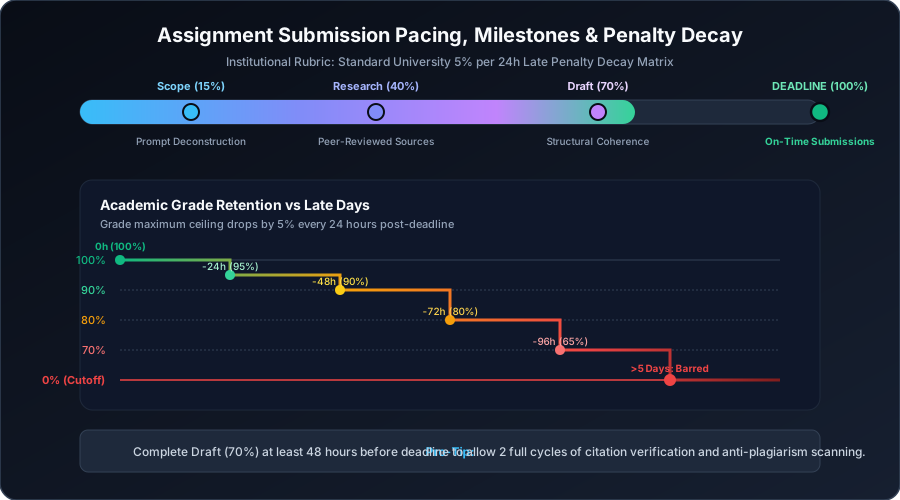
Assignments submitted within the scheduled window earn full unpenalized credit. Submissions post-deadline decay at 5% per 24 hours. Zero credit is awarded after 5 days past the formal cutoff unless verified extenuating circumstances are officially approved.
Institutional Assignment Pacing & Recovery Schematics
Assignment Milestones & Late Decay Curve
Staircase penalty model: 5% per 24 hours post-deadline deduction.
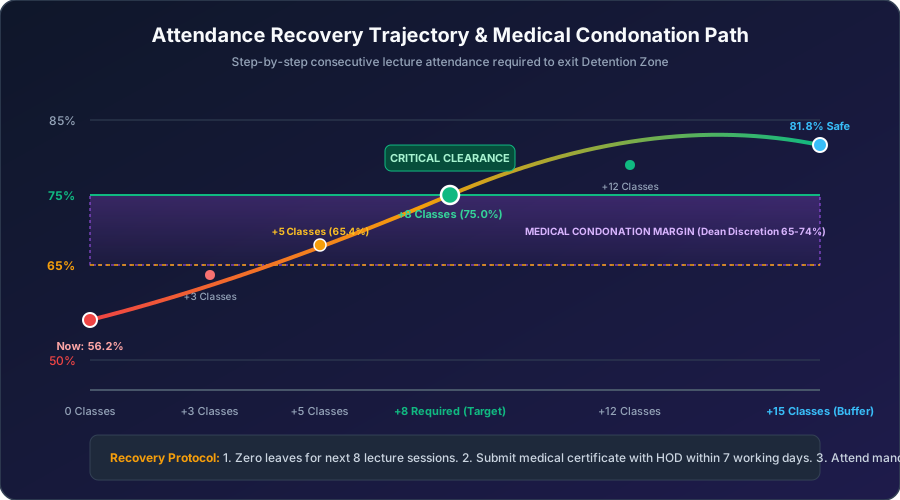
Attendance Recovery Trajectory & Medical Buffer
Step-by-step consecutive recovery path climbing to 75% examination eligibility.
Academic Rigor & Rubric Mathematics
Assignment Pacing Velocity
V = (H_est - H_done) / D_left
Calculates daily hours required to avoid last-minute cramming and ensure thorough anti-plagiarism verification.
Late Penalty Decay
G_retained = max(0, 100 - (D_late × R_pen))
Standard university model: -5% per 24 hours. A paper scoring 88/100 submitted 2 days late caps at 90% (Net: 79.2%).
CIA Participation Matrix
Score = 0.4(V_comp) + 0.3(S_sem) + 0.3(P_peer)
Blends oral questioning (40%), structured presentations (30%), and collaborative engagement (30%).
University Case Studies & Rubric Scenarios
Case 1: Term Paper Pacing vs All-Nighter Quality
Scenario: A student who phased an engineering literature review across 5 milestones over 10 days achieved a 94% peer-review score with 0% Turnitin flag. In contrast, cramming in 24 hours historically correlates with a 22% lower argumentation rubric score and elevated citation errors.
Case 2: The 48-Hour Late Submission Tradeoff
Scenario: Submitting an incomplete paper on-time at 70% quality yields 70 marks. Taking 24 hours extra to polish to 90% quality under a -5% late policy yields 90 - 5 = 85 marks. The calculator helps decide whether taking a 1-day penalty mathematically pays off.
Frequently Asked Questions
About Assignment Submission Tracker
Track assignment deadlines and completion. Designed for fast, accurate calculation with clear outputs, explanation, and device-friendly usability.
Why this page helps
- Fast answers without manual formula rearrangement
- Cleaner comparison of multiple scenarios
- Works on mobile, tablet, and desktop
- Useful for study, planning, and quick verification
How to use it well
- Open the Assignment Submission Tracker and enter the known input values.
- Select the correct units for each field before calculating.
- Review the main result, formula, and conversions shown on the page.
- Use the step-by-step breakdown to verify the logic and download or share the result if needed.
Expert tips
- Check that all inputs use the correct unit system before comparing values.