Continuous Internal Assessment (CIA) Rubric
Weighted ScoreSpeaking / Question Frequency4 contributions / week
Silent (0)Regular Contributor (4-6)Class Leader (8-10)
Insight & Discussion Quality Rubric8 / 10 Score
Basic Query (1-4)Constructive Critique (5-7)Scholarly Synthesis (8-10)
Participation CompositeB+
78.3
Out of 100 on Continuous Internal Assessment (CIA) Rubric
Marks Earned
15.7
Out of 20 course internal marks
Verbal Score
72%
Questions & synthesis index
Institutional Rubric Guidelines
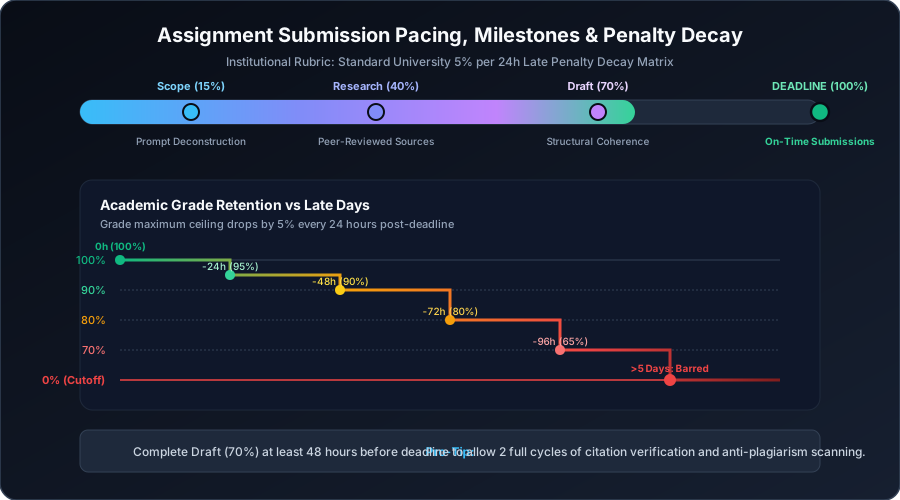
Assignments submitted within the scheduled window earn full unpenalized credit. Submissions post-deadline decay at 5% per 24 hours. Zero credit is awarded after 5 days past the formal cutoff unless verified extenuating circumstances are officially approved.
Institutional Assignment Pacing & Recovery Schematics
Assignment Milestones & Late Decay Curve
Staircase penalty model: 5% per 24 hours post-deadline deduction.
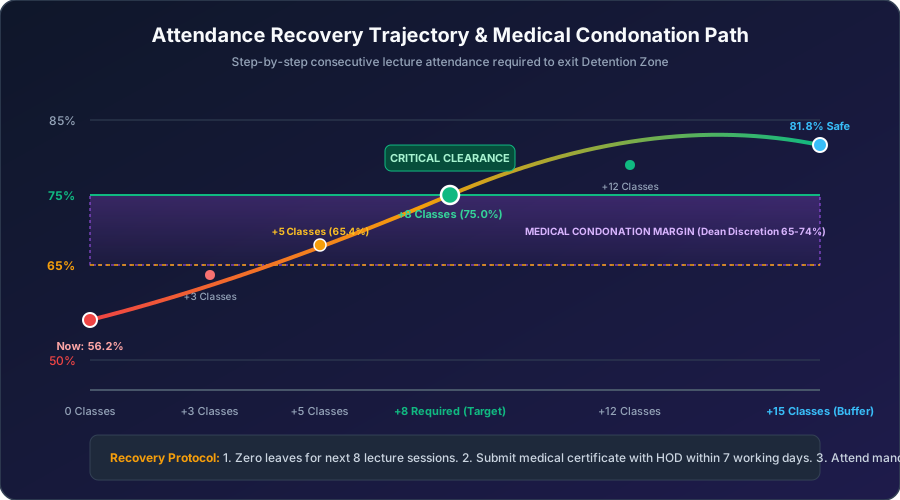
Attendance Recovery Trajectory & Medical Buffer
Step-by-step consecutive recovery path climbing to 75% examination eligibility.
Academic Rigor & Rubric Mathematics
Assignment Pacing Velocity
V = (H_est - H_done) / D_left
Calculates daily hours required to avoid last-minute cramming and ensure thorough anti-plagiarism verification.
Late Penalty Decay
G_retained = max(0, 100 - (D_late × R_pen))
Standard university model: -5% per 24 hours. A paper scoring 88/100 submitted 2 days late caps at 90% (Net: 79.2%).
CIA Participation Matrix
Score = 0.4(V_comp) + 0.3(S_sem) + 0.3(P_peer)
Blends oral questioning (40%), structured presentations (30%), and collaborative engagement (30%).
University Case Studies & Rubric Scenarios
Case 1: Term Paper Pacing vs All-Nighter Quality
Scenario: A student who phased an engineering literature review across 5 milestones over 10 days achieved a 94% peer-review score with 0% Turnitin flag. In contrast, cramming in 24 hours historically correlates with a 22% lower argumentation rubric score and elevated citation errors.
Case 2: The 48-Hour Late Submission Tradeoff
Scenario: Submitting an incomplete paper on-time at 70% quality yields 70 marks. Taking 24 hours extra to polish to 90% quality under a -5% late policy yields 90 - 5 = 85 marks. The calculator helps decide whether taking a 1-day penalty mathematically pays off.