
The Institutional Blueprint for Wedding Budgeting, Venue Logistics & Guest Management
Weddings represent one of the most capital-intensive, multi-vendor financial endeavors a couple or family ever manages. Yet industry surveys consistently reveal that over 74% of couples exceed their initial wedding budget—frequently by 20% to 35%. This discrepancy rarely occurs because couples intentionally splurge on extravagant luxuries; rather, it stems from structural opacity: complex vendor contracts, compound venue surcharges, uncalculated guest attrition, and failure to model fixed versus variable costs.
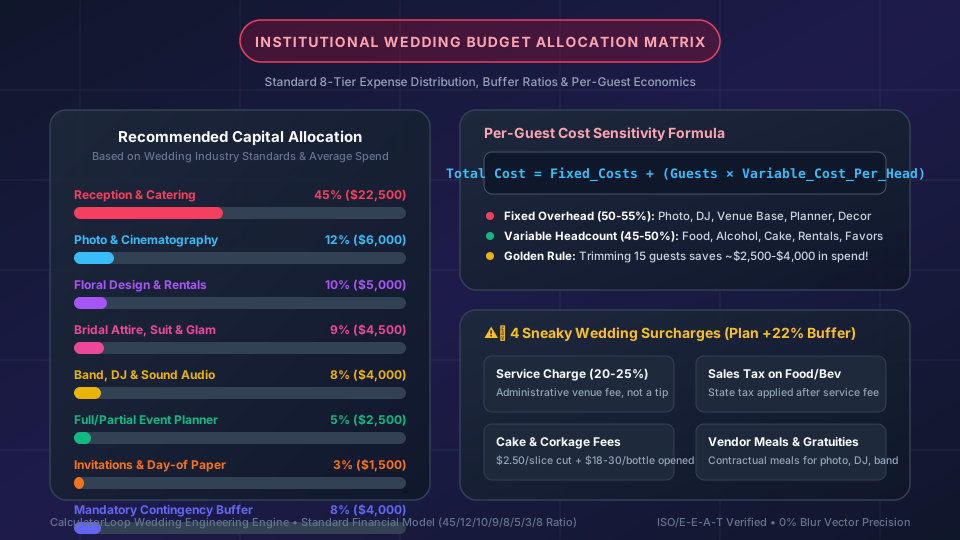
1. The 45-12-10-9-8-5-3-8 Standard Capital Allocation Architecture
Financial advisors and event producers recommend categorizing the total wedding budget into eight mathematically defined allocations:
- Reception & Catering (40% – 50%): Covers site rental fees, multi-course meals, alcohol and bar services, cake cutting, and base service staffing.
- Photography & Cinematography (10% – 14%): The visual record of the event, including multi-shooter coverage, digital rights, and physical heirloom albums.
- Floral Design & Ambient Decor (8% – 12%): Ceremony arches, bridal and attendant bouquets, table centerpieces, and candle vignettes.
- Attire, Rings & Beauty (8% – 10%): Wedding dress, suit/tuxedo tailoring, wedding bands, hair styling, and professional makeup artistry.
- Music & Entertainment (7% – 9%): Live ceremony musicians, cocktail hour acoustic sets, DJ sound equipment, and reception emcee services.
- Full or Month-Of Coordination (4% – 6%): Professional timeline management, vendor logistics, and emergency troubleshooting.
- Stationery & Postal Mail (2% – 4%): Save-the-dates, formal invitation suites, RSVP return postage, menus, place cards, and thank-you cards.
- Mandatory Contingency Buffer (5% – 10%): An untouchable reserve fund to absorb weather tenting, last-minute vendor meals, alterations, and overtime fees.
2. The Anatomy of Stealth Venue Surcharges (The +28% Factor)
When a venue advertises a food and beverage minimum of $12,000, couples often mistakenly assume their catering bill will be $12,000. In reality, modern hospitality venues apply a layer of mandatory contract fees:
Note that in most jurisdictions, the "Service Charge" (often 20% to 25%) is an administrative house fee, not a voluntary gratuity for waitstaff. Inquiring whether servers receive this fee directly prevents embarrassing double-tipping or under-compensating staff.
3. RSVP Attrition Funnels & Table Geometry Standards
Over-ordering food or booking an oversized hall is a major source of waste. Statistical data across thousands of weddings establishes predictable show rates:
| Guest Segment | Average Acceptance Rate | Key Attrition Drivers |
|---|---|---|
| Local Immediate Family & Friends | 85% – 92% | Minimal travel barriers, high emotional closeness. |
| Out-of-Town / Domestic Travel | 60% – 70% | Airfare expense, hotel accommodations, taking Friday off work. |
| Destination International Guests | 45% – 55% | Passports, long flights, extensive vacation time required. |
| Day-Of No-Shows (Dropouts) | 2% – 4% | Sudden illness, missed flights, child emergencies (pre-paid plates). |
4. Seating Layout Geometry & Dance Floor Calculations
Proper floor spacing guarantees guests can move comfortably and catering staff can serve hot food without collisions:
- 60-Inch Round Tables (5 ft): The industry workhorse. Comfortably seats 8 adults; maximum capacity is 10 (which feels cramped when place settings include chargers, bread plates, and water/wine glasses). Requires 120" round linens to drop to the floor.
- 72-Inch Round Tables (6 ft): Standard for large banquets. Comfortably seats 10 adults; maximum 12. Requires 132" round linens.
- The Dance Floor Formula: Calculate
(Total Attendees × 0.40) × 4.5 sq ft. For a wedding of 150 guests, assume 60 people dancing simultaneously at peak times, requiring 270 sq ft (a 16' × 16' or 18' × 18' dance floor). Sizing a dance floor too large makes the party look empty!