Comprehensive Guide to Wedding Media, Stationery Logistics & Registry Economics
Wedding media and stationery represent both the opening introduction and the permanent historical record of a couple's marriage. However, navigating the physical printing specifications, postal regulations, photography timelines, and honeymoon budget structures requires strict logistical precision. Miscalculating envelope weights or coverage schedules frequently leads to returned mail, missing bridal portraits, and significant budget overruns.
1. The Household Ordering Principle: Avoiding the 40% Paper Waste Trap
The single most common mistake engaged couples make is ordering invitations based on their guest headcount rather than household units. If you are inviting 150 guests, you do not need 150 invitations:
Ordering 97 suites instead of 150 saves an average of $350 to $650 across printing, custom calligraphy addressing, and USPS postage.
2. USPS Postage Rules: The Hidden Weight, Rigidity & Shape Traps
Wedding invitations frequently incur unexpected postal surcharges due to United States Postal Service (USPS) dimensional and processing standards:
- The 1-Ounce Threshold ($0.73): A basic 5x7 invitation card and single paper envelope generally weigh under 1.0 oz. However, adding an RSVP card, RSVP envelope, accommodations card, and heavy cardstock pushes the suite to 1.3–1.8 oz, requiring a 2-oz Forever stamp ($1.01).
- Wax Seals & Silk Ribbons (Non-Machinable Surcharge): Wax seals create an uneven bump in the envelope. USPS sorting machines cannot feed bumpy envelopes through automated rollers. They require manual hand-cancellation, triggering a mandatory $0.44 non-machinable surcharge per letter.
- Square Envelopes: Regardless of weight, square envelopes (e.g., 6" × 6") do not match standard automated aspect ratios and automatically trigger the non-machinable surcharge.
- The Golden Postal Rule: Take a fully assembled, sealed invitation with all cards and wax seals to your local post office counter and have a clerk weigh it on a digital scale before purchasing or printing stamps!
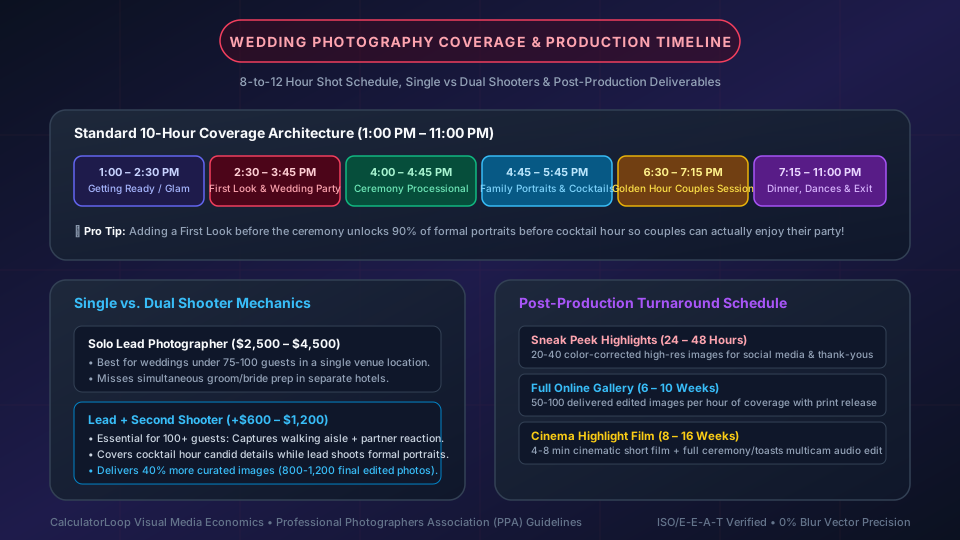
3. Photography Coverage Architecture: 8 Hours vs 10 Hours vs 12 Hours
Booking sufficient coverage is critical to preventing wedding day stress. The following breakdown shows how coverage hours translate to wedding day events:
| Coverage Duration | Events Covered | Ideal For |
|---|---|---|
| 6 Hours (Essential) | Ceremony, family portraits, golden hour portraits, reception dinner, speeches. | Intimate weddings; single venue; no getting-ready or late-night exit shots. |
| 8 Hours (Standard) | Final prep, first look, ceremony, family formals, reception intros, toasts, cake, open dance. | Standard timeline when prep and reception are in the same general area. |
| 10 Hours (Full Day - Recommended) | Full hair/makeup prep, first look, ceremony, portraits, full reception, and sparkler exit. | Weddings with separate hotel prep, church ceremony, and reception venue locations. |
| 12 Hours (Comprehensive) | Complete start-to-finish documentary storytelling from morning breakfast through after-party. | Multi-cultural weddings, tea ceremonies, or multi-location events with strict schedules. |
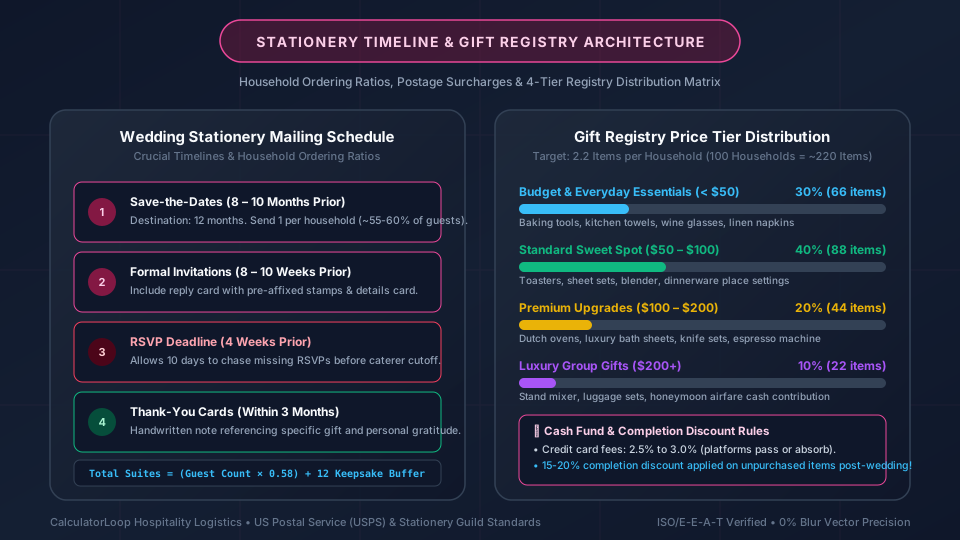
4. The 4-Tier Gift Registry Distribution Formula
A well-structured registry provides gift options across all financial levels, ensuring no guest feels priced out or restricted:
- Under $50 (30% of Items): Everyday kitchen gadgets, specialty baking pans, linen napkins, and wine glasses. Essential for younger friends, college peers, and coworkers.
- $50 to $100 (40% of Items): The sweet spot for wedding gifts. Quality bedsheet sets, knife blocks, blenders, and everyday dinnerware sets.
- $100 to $200 (20% of Items): Premium cookware (Le Creuset Dutch ovens, Vitamix, espresso machines, luxury bath towels). Favored by close aunts, uncles, and mentors.
- $200+ (10% of Items): Luxury group gifts (stand mixers, patio furniture, honeymoon flight contributions). Enable group gifting where several friends chip in together.