Site Earthwork & Civil Volumetrics
Excavation & Trenching Takeoff Calculator
Quantify in-situ bank volume, soil swell expansion, safety batter slopes, working space berms, and haulage dump truck rotations for foundation pits and utility trenches.
Primary Takeoff Output
452.25 m³ Bank
OSHA Slopes, Swell & Haulage
Project Parameters
Formwork clearance (typically 0.5m / 1.5ft)
Haulage Truck Capacity (m³ per trip)10 m³
Calculation Formula & Step Derivation
Prismoidal Excavation (Pit/Basement, Depth 3 m)
- 1.Top Area: 209.25 m², Bottom Area: 99.00 m²
- 2.Bank Volume: 452.25 m³
- 3.Loose Volume with 25% Swell: 565.31 m³
- 4.Haulage Dump Truck Trips required: 57 trips (@ 10 m³/trip)
Takeoff Metrics Summary
Total In-Situ Bank Volume
452.25 m³
Loose Haul Volume
565.3 m³
25% Soil SwellTruck Trips Needed
57 trips
@10 m³/truckTop Opening Dimensions:15.50 × 13.50 m
Bottom Excavation Base:11.00 × 9.00 m
Civil Site Standards & OSHA Guidelines
- OSHA 1926 Subpart P: Any excavation deeper than 5 ft (1.5 m) requires shoring, shielding, or sloping (Type A: 0.75:1, Type B: 1:1, Type C: 1.5:1).
- Earth Bulking: Common loam expands ~20–30% upon excavation; always arrange haulage based on loose volume rather than bank volume.
- Water Sump Freeboard: Provide a minimum 300 mm (12 in) air gap above maximum water surface level to prevent float valve jamming.
Institutional Guide to Civil Site Earthwork, Water Storage Hydraulics & Structural Geometries
A comprehensive engineering manual covering prismoidal trench excavation, soil swell dynamics, cut-and-fill mass balances, cistern hydrodynamic design, and frustum stress distribution.
Engineering Vector Schematics: Site Excavation, Water Sump & Footing Frustums
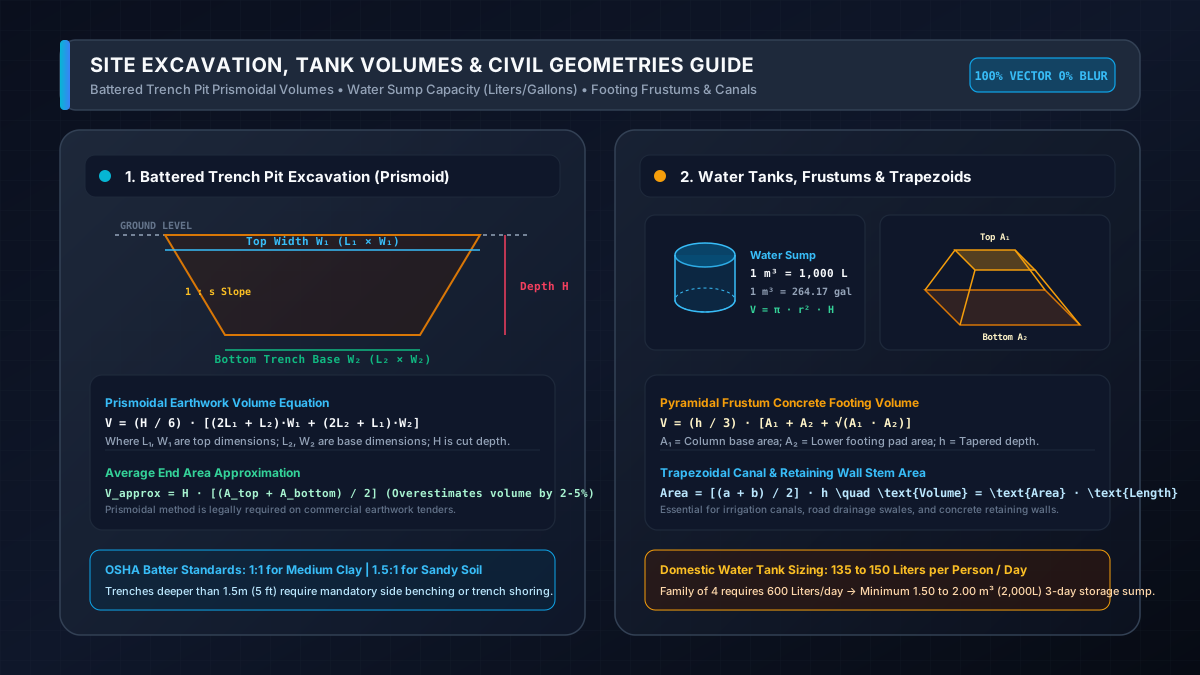
Figure 1: Cross-sectional schematics of prismoidal battered pit excavation, underground water cistern geometry with freeboard safety buffer, and isolated footing trapezoidal frustum stress transfer.
1. Geotechnical Soil Mechanics: Bank, Loose, and Compacted Volumes
In earthwork estimation and site civil engineering, soil volume exists in three distinct thermodynamic and mechanical states:
- Bank Volume (In-Situ): The undisturbed natural soil mass as it rests in the ground prior to excavation. All civil engineering site surveys measure cuts and fills in bank cubic meters (BCM) or bank cubic yards (BCY).
- Loose Volume (Bulked): When excavated by a mechanical backhoe or hydraulic excavator, the natural soil structure breaks apart, entraining interstitial air voids. The resulting expansion is characterized by the Soil Swell Factor (S_w):
V_loose = V_bank · (1 + S_w) = V_bank · Swell Ratio
Failing to account for bulking is a primary cause of transport budget overruns on commercial construction projects. A 1,000 BCM pit of wet clay can easily swell into 1,350 LCM (loose cubic meters), requiring 35% more haulage dump truck rotations.
- Compacted Volume: When earth is placed in engineered fill layers (lifts of 150 mm to 250 mm) and rolled with sheepsfoot or smooth vibratory rollers to reach 95% to 98% Standard Proctor Density (ASTM D698), air voids are expelled. The volume becomes smaller than the original bank volume, governed by the Shrinkage Factor (S_h):
V_compacted = V_bank · (1 - S_h) → Required Bank Cut = V_compacted / (1 - S_h)
2. OSHA 1926 Subpart P Trenching & Excavation Safety Slopes
According to the United States Occupational Safety and Health Administration (OSHA 29 CFR 1926 Subpart P), unbraced open cut excavations deeper than 5 feet (1.52 meters) present severe trench cave-in hazards and must be benched or sloped according to soil classification:
| OSHA Soil Classification | Unconfined Compressive Strength (q_u) | Maximum Safe Slope (H : 1V) | Side Angle (θ) |
|---|---|---|---|
| Stable Rock | > 4.0 tons/sq ft | Vertical (0 : 1) | 90° |
| Type A (Hardpan, Clay, Sandy Clay) | ≥ 1.5 tons/sq ft | 0.75 : 1 | 53° |
| Type B (Silt, Loam, Sandy Loam) | 0.5 to 1.5 tons/sq ft | 1.0 : 1 | 45° |
| Type C (Gravel, Loose Sand, Submerged Soil) | < 0.5 tons/sq ft | 1.5 : 1 | 34° |
When side slopes are battered back at 1.5:1, the top surface width of the excavation expands drastically: for a 4 m deep basement pit, the top boundary extends 6 meters further out on each side than the foundation bottom line, necessitating careful right-of-way planning and safety fencing.
3. The Mathematics of Prismoidal & Simpson End-Area Earthwork Formulations
Calculating the volume of tapered earth excavations with planar battered faces cannot be accurately performed using simple average end areas (Average End Area Formula: V ≈ L · (A₁ + A₂)/2), which routinely overestimates true prismatic excavation volume by 2% to 15%.
Instead, civil engineers utilize Simpson's Prismoidal Formula, derived from quadratic parabolic interpolation across the vertical profile:
V = (H / 6) · [A_bottom + 4 · A_mid + A_top]
Where A_mid is the horizontal cross-sectional area at half-depth, computed directly from mid-length and mid-width coordinates:
L_mid = (L_bottom + L_top) / 2 , W_mid = (W_bottom + W_top) / 2 → A_mid = L_mid · W_mid
This prismoidal formula yields the mathematically exact solid volume for all frustums, prismoids, pyramids, and tapered retaining berms.
4. Water Storage Tank Sizing: IS 3370 & ACI 350 Sump Hydraulics
Underground water sumps and overhead distribution tanks must satisfy dual design criteria: statutory water reserve autonomy and structural hydrostatic containment:
- Per Capita Consumption (IS 1172 / Uniform Plumbing Code): Residential domestic consumption averages 135 Liters per capita per day (LPCD) for conventional multi-fixture houses, escalating to 200–250 LPCD in luxury residential estates with lawn irrigation.
- Reserve Autonomy: Municipal water supply interruptions require a minimum storage buffer of 2 to 3 days of average domestic demand.
- The Critical Freeboard Buffer: A minimum air gap of 300 mm (12 inches) between the high water level (HWL) and the underside of the roof slab is mandatory to permit ball float valve travel, accommodate wave action, and prevent structural inundation of the overflow pipe.
- Structural Dead Load Considerations: 1 cubic meter of fresh water exerts an exact downward gravitational mass of 1,000 kg (1.0 Metric Ton, or 62.43 lbs/ft³). For an overhead rooftop tank holding 10,000 Liters (10 m³), the supporting reinforced concrete columns and slab must carry a concentrated sustained dead load of 10 Metric Tons (98.1 kN) in addition to hydrostatic lateral bursting pressure against the tank walls.
5. Pyramidal Frustums in Reinforced Concrete Foundations
In isolated column pad footings (governed by IS 456 Clause 34.1.2 and ACI 318 Section 13.3), foundations are frequently tapered into a trapezoidal frustum from the thick vertical column pedestal junction down to the outer perimeter edge.
This trapezoidal geometry distributes compressive column stresses outward at an approximate 45° shear cone angle, maximizing flexural and punching shear resistance at the critical column perimeter while saving 20% to 35% of high-grade structural concrete compared to a full-depth rectangular block.
The concrete volume of the sloped frustum portion is quantified by:
V_frustum = (h / 3) · [A₁ + A₂ + √(A₁ · A₂)]
Where A₁ is the area of the lower base pad, A₂ is the area of the top column pedestal contact, and h is the vertical taper height.