Everyday Calculator
Productivity Tools
Category 5: Date & Time Calculations • Shift Work & Productivity
Shift Scheduling, Statutory Breaks & Focus Productivity Suite
Industrial shift and cognitive engineering platform. Schedule 24/7 rotational shifts (Pitman, DuPont, Day/Swing/Graveyard), audit statutory meal and rest breaks, structure Pomodoro focus blocks, and quantify distraction context-switching penalties.
24/7 Rotational Shift Model & Differentials
Rotational Schedule$
Step-by-Step Shift & Cognitive Derivation
1. Schedule Architecture: Pitman 2-2-3 Rotation (12h Shifts) (7 shifts on, 7 days off per fortnight)
2. Effective Hourly Rate: $30/hr
3. Shift Earnings: 12 hrs × $30 = $360 per shift
4. Bi-Weekly & Annualized: $2520 per 14 days (~$65520 / year)
Primary Shift OutputInstitutional Standard
Bi-Weekly Gross Wages:
$2520
Based on 7 shifts per 14 days (~42 hrs/wk)
Earnings / Shift$360$30/hr
Annualized Gross$6552026 pay periods
Session Productivity History
No pinned calculations yet. Click "Record & Pin" to save entries.
24/7 Rotational Shift Work Architectures (Pitman & DuPont Schedules)
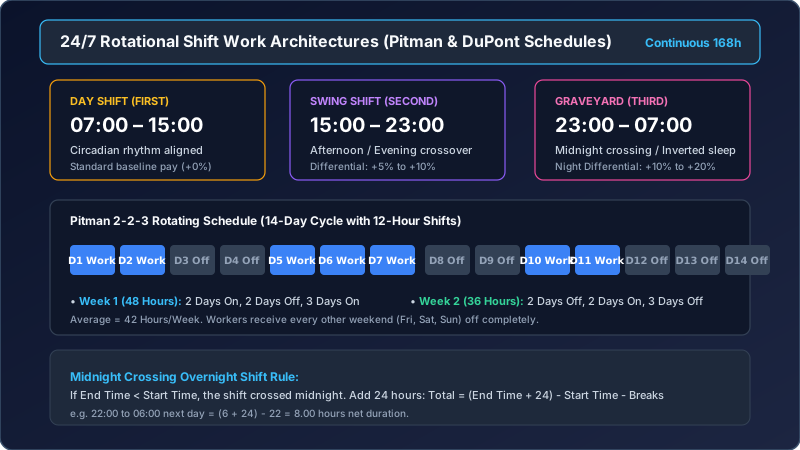
Continuous 168-hour plant staffing: 14-day Pitman 2-2-3 schedule, DuPont 12-hour rotation, and graveyard shift differential pay.
Cognitive Work Rhythms: Pomodoro 25/5 & Ultradian 90/20 Architectures
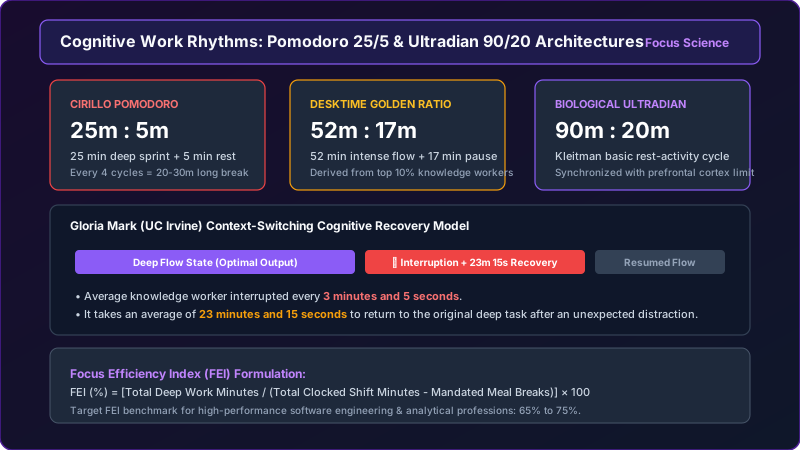
Cognitive pacing science: Francesco Cirillo 25/5 Pomodoro method, DeskTime 52/17 golden ratio, and Gloria Mark 23-minute distraction cost.
Institutional Guide to Rotational Shift Scheduling, Statutory Rest Breaks & Focus Ergonomics
Author: Industrial Ergonomics & Cognitive Performance Research Council • Updated for 2026/2027 Workplace Standards
1. Continuous 24/7 Operations: Pitman, DuPont & Continental Schedules
In process manufacturing (petrochemical refineries, power generation, semiconductor fabrication), emergency services (hospitals, law enforcement, fire protection), and critical IT infrastructure (data center SREs), equipment and operations cannot pause. To cover all 168 hours of the week, organizations deploy specialized rotational shift architectures using four distinct crews:
- Pitman 2-2-3 (Every Other Weekend Off): A 14-day repeating cycle using 12-hour shifts. Crew works 2 days, off 2 days, works 3 days, off 2 days, works 2 days, off 3 days. Over 14 days, workers complete seven 12-hour shifts (84 hours = 42 hours/week average) and enjoy a full 3-day weekend every two weeks.
- DuPont 12-Hour Schedule: A 28-day rotational cycle designed by DuPont chemical engineers. Features a signature 7 consecutive calendar days off work every 4 weeks, granting employees a "mini-vacation" monthly without using paid time off.
- Southern Swing (Continental 8-Hour): Rotates four crews across Day (07:00-15:00), Swing (15:00-23:00), and Graveyard (23:00-07:00) shifts, with two to three days off between rotations.
2. Statutory Rest & Meal Break Jurisprudence
Under statutory labor laws, employee break entitlements are classified into two legally distinct categories:
| Jurisdiction | Paid Rest Breaks | Unpaid Meal Breaks | Statutory Citation |
|---|---|---|---|
| California | 10 min per 4 hours worked | 30 min if > 5 hours (2nd if > 10h) | Cal. Lab. Code § 226.7 |
| US Federal (FLSA) | 5 to 20 min must be paid | Bona fide 30m+ unpaid | 29 C.F.R. § 785.18 |
| United Kingdom | Internal company policy | 20 min uninterrupted if > 6h | WTR 1998 Reg. 12 |
3. Chronobiology & The Pomodoro Technique
Developed by Italian university student Francesco Cirillo in the late 1980s, the Pomodoro Technique uses timeboxing to transform time from an adversary into an ally. The human prefrontal cortex relies on finite glucose and neurotransmitter reserves to sustain high-order executive function.
By partitioning work into disciplined 25-minute sprints interspersed with 5-minute micro-recoveries, dopamine levels are sustained, preventing mental exhaustion. After four consecutive pomodoro blocks (100 minutes of pure work), a substantial 15 to 30 minute restorative break resets cognitive capacity.
Cirillo Sprint Formulation:
Total Sprint Time = (N × T_work) + ((N - ⌊N/4⌋ - 1) × T_short) + (⌊N/4⌋ × T_long)
4. Context Switching & Gloria Mark's Cognitive Recovery Cost
In modern knowledge work, multi-tasking is an illusion: the brain does not execute parallel analytical streams; it rapidly switches attention between competing contexts. Research conducted by Dr. Gloria Mark at the University of California, Irvine revealed that knowledge workers are interrupted or switch tasks every 3 minutes and 5 seconds on average.
Critically, Dr. Mark established that it requires an average of 23 minutes and 15 seconds of cognitive refractory time to regain the original depth of flow following an unexpected interruption (such as a Slack notification, urgent email, or unscheduled drop-in). Therefore, four distractions in an 8-hour workday consume approximately 1.55 hours of prime executive attention.
Focus Efficiency Index (%) = [Net Effective Deep Work Hours / Total Clocked Hours] × 100
Frequently Asked Questions (FAQ) on Shift Work & Productivity
Q1: What is Shift Work Sleep Disorder (SWSD) and how is it mitigated?
SWSD is a chronic circadian rhythm sleep disorder affecting workers on non-traditional night or rotating shifts. Symptoms include severe insomnia during daytime sleep and excessive sleepiness during work shifts. Mitigation protocols include blackout curtains, blue-light blocking glasses during the morning commute home, maintaining consistent sleep schedules on off days, and scheduled 20-minute prophylactic naps before night shifts.
Q2: How does the DeskTime 52/17 rule compare to the 25/5 Pomodoro?
While the 25/5 Pomodoro is optimal for rapid task initiation and overcoming procrastination, productivity analytics firm DeskTime studied thousands of high-performing knowledge workers and identified the 52/17 rhythm: 52 minutes of intense, unbroken deep work followed by 17 minutes of complete cognitive disengagement (walking, stretching, hydration). The 52/17 rhythm aligns closely with longer-form software architecture and technical writing.
Q3: Is night shift differential pay legally required under federal law?
Under the federal FLSA, night shift differential pay is not mandatory; it is determined by collective bargaining agreements (CBAs) or employer policy. However, prevailing market rates typically provide a +10% to +20% hourly wage premium to compensate workers for circadian disruption and graveyard shift demands.
About Lunch Break Optimizer
Calculate optimal break timing. Designed for fast, accurate calculation with clear outputs, explanation, and device-friendly usability.
Why this page helps
- Fast answers without manual formula rearrangement
- Cleaner comparison of multiple scenarios
- Works on mobile, tablet, and desktop
- Useful for study, planning, and quick verification
How to use it well
- Open the Lunch Break Optimizer and enter the known input values.
- Select the correct units for each field before calculating.
- Review the main result, formula, and conversions shown on the page.
- Use the step-by-step breakdown to verify the logic and download or share the result if needed.
Expert tips
- Check that all inputs use the correct unit system before comparing values.
- Use the worked steps to confirm whether you entered the right known variables.