Everyday Calculator
Productivity Tools
Category 5: Date & Time Calculations • Work & Business Days
Work Hours, Timesheet & Overtime Wage Suite
Professional payroll and workforce time tracking engine. Calculate daily clock-in/out hours, 7-day weekly timesheets, FLSA and California overtime tiers (1.5× and 2.0× double-time), and freelance billable utilization rates.
Daily Clock In / Out & Break Deductions
Shift Decimal Hours$
Step-by-Step Payroll & Hours Derivation
1. Clock In/Out Span: 08:30 to 17:15 = 525 total minutes (8h 45m)
2. Unpaid Meal Break: -45 minutes (0.75 hrs)
3. Net Work Time: 480 minutes = 8 decimal hours
4. Gross Earnings: 8 hrs × $32/hr = $256.00
Primary Payroll OutputInstitutional FLSA
Total Net Decimal Hours:
8 Hours
Equivalent to 8h 0m of payable work
Gross Daily Pay$256.00@ $32/hr
Unpaid Break45mDeducted from shift
Session Payroll History
No pinned calculations yet. Click "Record & Pin" to save entries.
FLSA & California Statutory Overtime Compensation Tiers
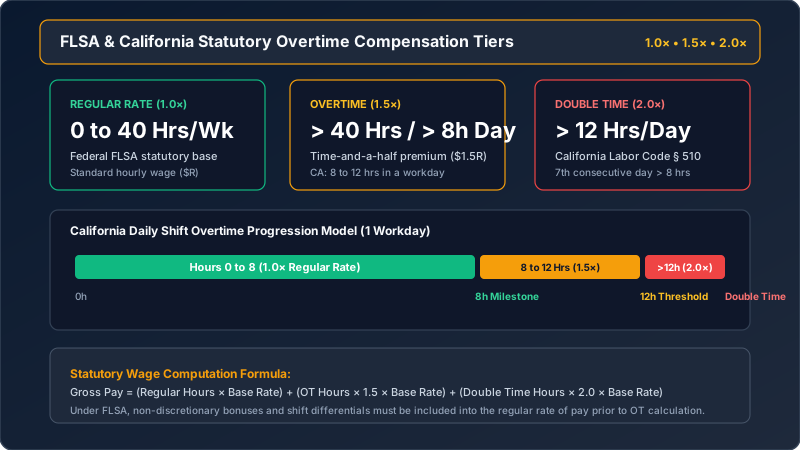
Statutory overtime rate progression: Federal 40-hr weekly threshold (1.5×), California daily 8-hr (1.5×) and 12-hr (2.0× double-time) rules.
Standard 7-Day Weekly Timesheet & Payroll Disaggregation
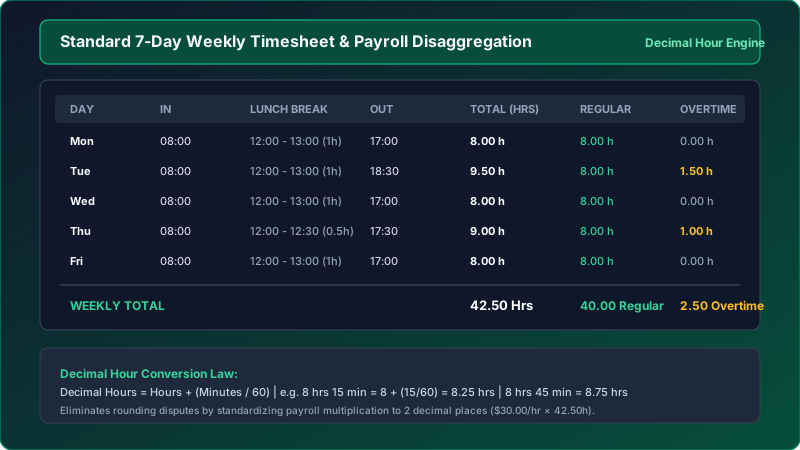
Full 7-day Monday through Sunday work record: clock-in/out stamps, mandatory meal break deductions, decimal hour payroll multiplication, and gross pay.
Institutional Guide to Workplace Timesheets, Overtime Laws & Billable Utilization
Author: Compensation & Statutory Labor Compliance Standards Group • Updated for 2026/2027 US Department of Labor & State Regulations
1. The Fair Labor Standards Act (FLSA) & Overtime Mandates
Enacted by the United States Congress in 1938, the Fair Labor Standards Act (FLSA) (29 U.S.C. § 201 et seq.) establishes minimum wage, overtime pay eligibility, recordkeeping, and youth employment standards affecting non-exempt workers in both the private sector and in federal, state, and local governments.
Under Section 7(a)(1) of the FLSA, non-exempt covered employees who work more than 40 hours in a defined workweek must receive overtime pay for each excess hour at a rate not less than one and one-half times (1.5×) their regular rate of pay. A "workweek" is defined as a fixed and regularly recurring period of 168 consecutive hours (seven consecutive 24-hour periods), which need not coincide with the calendar week.
Federal Statutory Overtime Formula:
Gross Pay = (Min(Hours, 40) × Regular Rate) + (Max(0, Hours - 40) × 1.5 × Regular Rate)
Crucially, the FLSA applies overtime on a workweek basis. Averaging hours over two or more weeks is strictly prohibited. For example, if an employee works 50 hours in Week 1 and 30 hours in Week 2, they must be paid 10 hours of overtime in Week 1, even though their bi-weekly total equals 80 hours.
2. California Daily Overtime & Double-Time Regulations
While federal law evaluates overtime solely on weekly hours, several states—most notably California under California Labor Code Section 510—enforce stringent daily overtime and double-time requirements for non-exempt employees:
- Daily Overtime (1.5× Base Rate): Any work performed beyond 8 hours up to and including 12 hours in any single workday, and for the first 8 hours worked on the seventh consecutive day of work in a workweek.
- Double Time (2.0× Base Rate): Any work performed beyond 12 hours in any single workday, and for all hours worked in excess of 8 hours on the seventh consecutive day of work in a workweek.
- Mandatory Meal Breaks: Under California wage orders, an employer may not employ an employee for a work period of more than five hours without providing an unpaid meal break of not less than 30 minutes. If the total workday does not exceed six hours, the meal period may be waived by mutual consent.
3. Decimal Hour Conversion & Rounding Standards
Payroll accounting systems do not multiply wages directly by sexagesimal time strings (hours and minutes). Instead, minutes must be converted into decimal hours by dividing minutes by 60:
Decimal Hours = Hours + (Minutes / 60)
Common decimal minute equivalents include:
15 min = 0.25 hrs
30 min = 0.50 hrs
45 min = 0.75 hrs
6 min = 0.10 hrs (tenth)
Under federal regulations (29 C.F.R. § 785.48(b)), employers are permitted to round employee punch times to the nearest 5 minutes, 6 minutes (tenth of an hour), or 15 minutes (quarter of an hour), provided that the rounding mechanism operates neutrally and does not systematically underpay employees over time (the "7-minute rule" for 15-minute intervals).
4. Professional Billable Utilization & Realized Rates
In legal practices, software engineering agencies, management consulting, and freelance contracting, the core operating metric is the Billable Utilization Rate. Utilization measures the proportion of an individual's working time that is directly billable to client projects:
Utilization Rate (%) = (Billable Hours / Total Working Hours) × 100
Benchmark utilization targets across professional services:
- Junior Associates / Engineers: 80% to 90% (32–36 billable hours per 40-hour week).
- Senior Consultants / Project Managers: 65% to 75% (balance between client delivery and team leadership).
- Partners / Agency Founders: 30% to 50% (majority of time spent on business development, strategy, and operations).
Frequently Asked Questions (FAQ) on Timesheets & Overtime
Q1: Are rest breaks of 10 to 15 minutes required to be paid?
Yes. Under federal FLSA regulations (29 C.F.R. § 785.18), short rest breaks running from 5 to 20 minutes must be counted as compensable hours worked and cannot be deducted from payroll. In contrast, bona fide meal periods (typically 30 minutes or more where the employee is completely relieved of all duties) are non-compensable unpaid breaks.
Q2: How is the regular rate of pay calculated when employees receive bonuses?
Under the FLSA, non-discretionary bonuses (e.g., performance, attendance, safety bonuses) must be apportioned back over the workweeks in which they were earned and included into the regular rate prior to computing overtime. Discretionary gifts given without prior announcement or contractual obligation (such as an unexpected holiday bonus) are exempt.
Q3: Can an employee waive their right to overtime pay?
No. The rights guaranteed under the Fair Labor Standards Act cannot be waived by private agreement between employer and employee. Even if an employee signs a contract stating they agree to work overtime without extra pay, the agreement is legally void and unenforceable in court.
About Overtime Calculator
Calculate overtime pay. Designed for fast, accurate calculation with clear outputs, explanation, and device-friendly usability.
Why this page helps
- Fast answers without manual formula rearrangement
- Cleaner comparison of multiple scenarios
- Works on mobile, tablet, and desktop
- Useful for study, planning, and quick verification
How to use it well
- Open the Overtime Calculator and enter the known input values.
- Select the correct units for each field before calculating.
- Review the main result, formula, and conversions shown on the page.
- Use the step-by-step breakdown to verify the logic and download or share the result if needed.
Expert tips
- Check that all inputs use the correct unit system before comparing values.
- Use the worked steps to confirm whether you entered the right known variables.