Vector Input Parameters
X component
Y component
Z component
c = 2.5
Analytical Output & Resultant
Computed Result
[7.5, 10, 0]
Expression: 2.5 · [3, 4, 0]
Step-by-Step Mathematical Derivation
1Scaled X: 2.5 × 3 = 7.5
2Scaled Y: 2.5 × 4 = 10
3Scaled Z: 2.5 × 0 = 0
4Original Magnitude ||u||: 5.0000
5Dilation Check: |c| × ||u|| = |2.5| × 5.0000 = 12.5000
6Direction: Preserved along original line of action.
Visual Mathematical Architecture
Vector operations, inner and cross products, orthogonal projection, and Gram-Schmidt process.
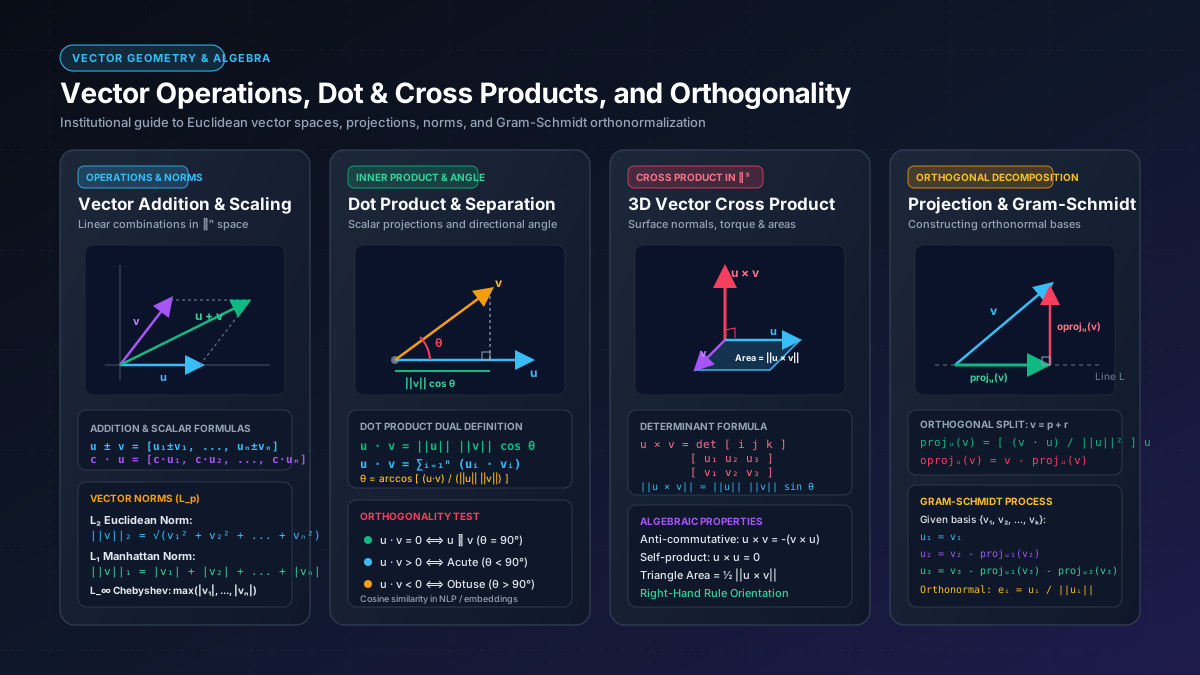
1. Theoretical Foundations of Vector Geometry in Euclidean Spaces
In linear algebra and mathematical physics, a vector is an element of a vector space over a field (typically the real numbers ℝ). In Euclidean space ℝⁿ, an ordered n-tuple \(v = [v_1, v_2, \dots, v_n]\) represents a directed line segment characterized by both magnitude (Euclidean length) and direction. The algebraic operations of vector addition and scalar multiplication obey the eight core axioms of linear vector spaces: commutativity, associativity, additive identity (the zero vector 0), additive inverse, distributivity over scalar and vector addition, and scalar multiplicative identity.
Geometrically, vector addition corresponds to the parallelogram law and the tip-to-tail triangle rule. When two force vectors act simultaneously on a mechanical joint, or two velocity components influence an aircraft relative to crosswinds, the total resultant displacement is precisely the vector sum \(u + v\).
2. Vector Norms: Euclidean L₂, Manhattan L₁, and Chebyshev L_∞
A norm is a mathematical function ||·||: V → ℝ assigning a strictly positive length to each non-zero vector. Different norm metrics provide critical structural advantages across data science, machine learning regularization, and robotics kinematics:
Euclidean Norm (L₂)
||v||₂ = √(∑ v_i²). Represents standard spatial straight-line distance. Invariance under orthogonal rotations.
Manhattan Norm (L₁)
||v||₁ = ∑ |v_i|. Sum of grid-based coordinate distances. Used in Lasso regression to induce parameter sparsity.
Chebyshev Norm (L_∞)
||v||_∞ = max |v_i|. Measures the maximum single component deviation. Crucial in CNC milling and uniform error bounding.
3. The Dot Product and Angular Orthogonality in ℝⁿ
The dot product (or scalar inner product) of two vectors u, v ∈ ℝⁿ is defined algebraically as the sum of coordinate-wise products:
u · v = ∑ (u_i · v_i) = u_1 v_1 + u_2 v_2 + ... + u_n v_n
Geometrically, by the law of cosines, the inner product equates to \(u \cdot v = \|u\| \|v\| \cos\theta\), where \(\theta\) is the convex angle between the two vectors. This fundamental relationship yields the standard definition of orthogonality:
- Orthogonal: \(u \cdot v = 0 \iff \theta = 90^\circ\) (\(\pi/2\) radians).
- Acute: \(u \cdot v > 0 \iff 0 \le \theta < 90^\circ\).
- Obtuse: \(u \cdot v < 0 \iff 90^\circ < \theta \le 180^\circ\).
4. The 3D Vector Cross Product & Right-Hand Rule
Unlike the dot product which yields a scalar, the cross product \(u \times v\) is a binary vector operation defined strictly in three dimensions (and seven dimensions via octonions). The cross product produces a vector orthogonal to both \(u\) and \(v\), with its orientation determined by the right-hand rule.
The magnitude \(\|u \times v\| = \|u\| \|v\| \sin\theta\) exactly equals the surface area of the parallelogram spanned by \(u\) and \(v\). In classical mechanics, cross products model angular momentum \(L = r \times p\), magnetic Lorentz force \(F = q(v \times B)\), and torque \(\tau = r \times F\).
5. Orthogonal Projection and Vector Rejection
Any vector \(v\) can be uniquely decomposed into two mutually orthogonal components relative to a reference vector \(u\):
v = proj_u(v) + oproj_u(v)
The orthogonal projection proj_u(v) = [(v · u) / ||u||²] u represents the shadow or parallel component of \(v\) lying along the line spanned by \(u\). The vector rejection oproj_u(v) = v - proj_u(v) represents the perpendicular component. This decomposition forms the mathematical backbone of linear regression (ordinary least squares), computer graphics shadow casting, and radar signal filtering.
6. The Gram-Schmidt Orthonormalization Algorithm
In linear algebra, non-orthogonal bases often cause severe numerical instability, ill-conditioned matrices, and roundoff error propagation. The Gram-Schmidt process iteratively converts any linearly independent basis (v₁, v₂, ..., v_k) into an orthonormal basis (e₁, e₂, ..., e_k) satisfying e_i · e_j = δ_ij (the Kronecker delta):
- u₁ = v₁; e₁ = u₁ / ||u₁||
- u₂ = v₂ - proj_u₁(v₂); e₂ = u₂ / ||u₂||
- u₃ = v₃ - proj_u₁(v₃) - proj_u₂(v₃); e₃ = u₃ / ||u₃||
Orthonormal bases guarantee that coordinate representation is as simple as computing inner products: \(x = \sum (x \cdot e_i) e_i\), eliminating the need for expensive matrix inversions.