Math Calculator
Advanced Mathematics
ODE Differential Solver
First-order separable and linear differential equations
Linear ODE: y' + P·y = Q with y(0) = y₀
Analytical Solution
Exact / NumericAnalytical Solution y(x)
y(x) = 3.000 + (-2.000) · e^(-2x)
Steady State Limit (x → ∞) = 3
Exact analytical solution using integrating factor μ(x) = e^(2x). Initial condition y(0) = 1 satisfied.
Academic Reference & Real Analysis
Single-Variable Calculus: Limits, Derivatives, Integrals & Error Bounds
Comprehensive foundations of differential and integral calculus, L'Hôpital's rule, the Fundamental Theorem of Calculus, and Taylor remainder estimation.
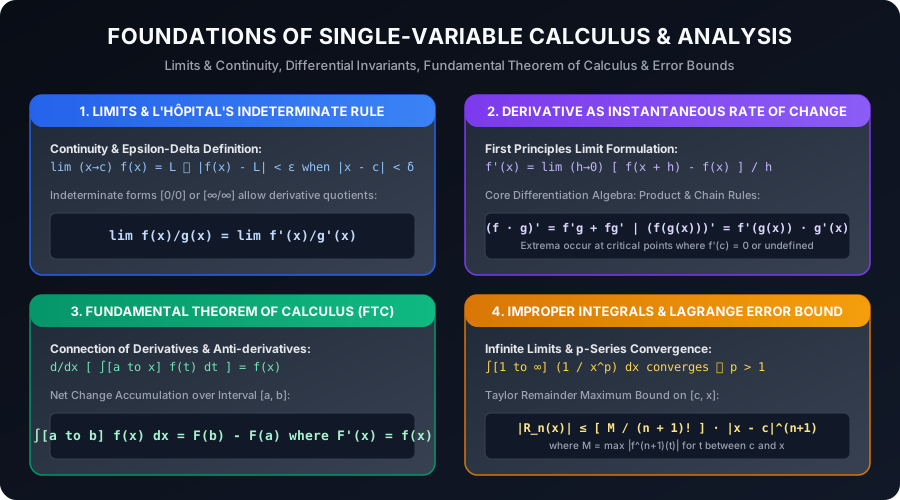
1. Limits, Continuity & L'Hôpital's Indeterminate Quotients
The formal Cauchy definition of a limit establishes that lim (x→c) f(x) = L if for every ε > 0, there exists a δ > 0 such that 0 < |x - c| < δ implies |f(x) - L| < ε. When evaluating rational limits that yield indeterminate forms [0/0] or [±∞/±∞], L'Hôpital's Rule permits replacing the ratio of functions with the ratio of their derivatives:
lim (x→c) [ f(x) / g(x) ] = lim (x→c) [ f'(x) / g'(x) ]
This theorem requires both f and g to be differentiable near c, with g'(x) ≠ 0. If the derivative ratio remains indeterminate, the rule can be applied repeatedly until a finite or infinite limit is determined.
2. The Fundamental Theorem of Calculus (FTC)
The Fundamental Theorem of Calculus bridges the two distinct branches of analysis: differential calculus (slopes) and integral calculus (accumulated areas):
- FTC Part 1 (Derivative of Accumulation): If f is continuous on [a, b], then g(x) = ∫[a to x] f(t) dt is continuous on [a, b], differentiable on (a, b), and g'(x) = f(x).
- FTC Part 2 (Evaluation Theorem): If f is continuous on [a, b] and F is any anti-derivative of f (meaning F'(x) = f(x)), then:∫[a to b] f(x) dx = F(b) - F(a)
3. Taylor Polynomial Remainder & Lagrange Error Bound
When approximating a smooth function f(x) by its degree-n Taylor polynomial centered at c, the error is given by the remainder term R_n(x) = f(x) - P_n(x). The Lagrange Error Bound establishes a strict upper limit on this truncation error:
|R_n(x)| ≤ [ M / (n + 1)! ] · |x - c|^(n + 1)
Here M is the maximum absolute value of the (n + 1)-th derivative |f^(n+1)(t)| for all t in the closed interval between c and x. This bound is essential in numerical analysis for determining the minimum polynomial degree needed to guarantee a specified precision tolerance.
Frequently Asked Questions (FAQ)
About Differential Equation Solver
Institutional calculus workstation for limits, symbolic and numerical derivatives, definite and improper integrals, differential equation solvers, Lagrange error bounds, and scientific computation with rigorous step-by-step derivations.
Why this page helps
- Rigorous step-by-step mathematical proofs conforming to AB/BC AP Calculus and university analysis standards
- Adaptive precision engine detects removable discontinuities, vertical asymptotes, and divergent improper integrals
- Integrated action header with instant PDF report generation and raw calculation history export
How to use it well
- Select your calculus analysis mode (Limits, Derivatives, Integrals, ODE Solver, Lagrange Error, or Scientific Calc).
- Input the function expression f(x), target evaluation point x_0, and interval bounds [a, b] if applicable.
- Configure computation parameters such as differentiation order, integration intervals, or differential equation initial values y(x_0).