Math Calculator
Advanced Mathematics
Taylor Series Polynomial
Degree-n Taylor approximation centered at c
Analytic Target Function f(x):
Transformed / Series Output
Analytic Closed-FormPolynomial Expansion
P_4(x) = 1.0000 + 1.0000(x - 0)^1 + 0.5000(x - 0)^2 + 0.1667(x - 0)^3 + 0.0417(x - 0)^4
P(1) = 2.708333
Exact = 2.718282
Truncation Error |f - P_n| = 9.9485e-3
Approximation of exp(x) centered at c = 0 evaluated at x = 1.
Academic Reference & Complex Analysis
Integral Transforms, Complex Analysis & Power Series Expansions
Laplace s-domain transfer functions, Fourier harmonic series, complex Euler geometry in the Argand plane, and analytic convergence tests.
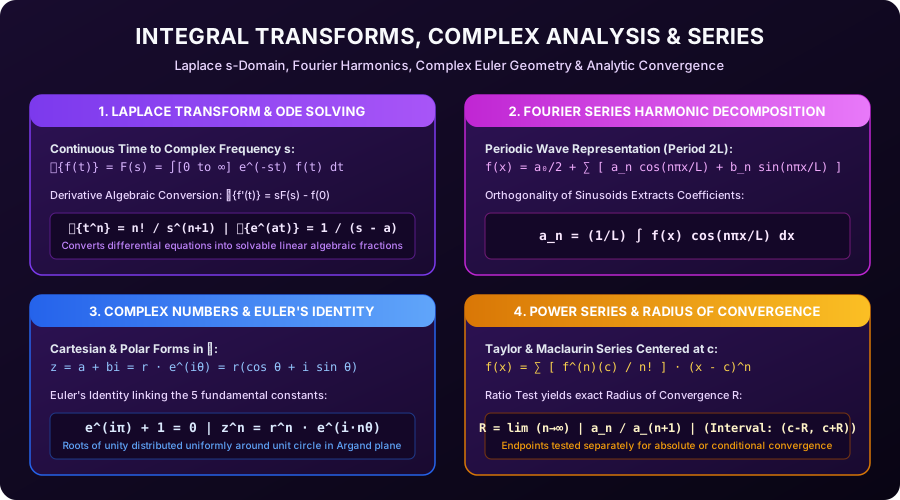
1. The Laplace Transform & Differential Equation Invariants
The unilateral Laplace transform maps a continuous real-time signal f(t) into the complex frequency domain s = σ + jω:
ℒ{f(t)} = F(s) = ∫[0 to ∞] e^(-st) f(t) dt
Its paramount strength in engineering lies in turning differentiation into multiplication: ℒ{f'(t)} = sF(s) - f(0). High-order linear differential equations are instantaneously transformed into algebraic rational polynomials, allowing circuits, robotics control systems, and mechanical dampers to be analyzed via poles and zeros.
2. Complex Geometry, Argand Planes & Euler's Identity
Every complex number z = a + bi corresponds to a point (a, b) in the 2D Argand plane, expressible in polar form via Euler's formula:
z = r · e^(iθ) = r(cos θ + i sin θ) where r = √(a² + b²), θ = arctan(b/a)
Setting θ = π yields the renowned Euler identity: e^(iπ) + 1 = 0, connecting arithmetic 0 and 1, geometry π, analysis e, and algebra i. Multiplication of complex numbers corresponds to multiplying their moduli and adding their arguments: z₁z₂ = r₁r₂ e^(i(θ₁ + θ₂)).
3. Radius of Convergence & D'Alembert's Ratio Test
A power series centered at c has the form ∑ aₙ (x - c)ⁿ. By Abel's Theorem, every power series converges either only at x = c, for all real x, or inside an open interval (c - R, c + R) of radius R:
R = lim (n→∞) | a_n / a_(n + 1) |
Inside the radius of convergence |x - c| < R, the series converges absolutely and uniformly, allowing term-by-term differentiation and integration to produce new analytic functions.
Frequently Asked Questions (FAQ)
About Taylor Series Calculator
Institutional integral transforms, complex analysis, and series expansion workstation. Compute Laplace transforms, Fourier series harmonic decompositions, complex numbers in rectangular/polar forms, Taylor series, and radius/interval of convergence.
Why this page helps
- Essential for electrical circuit analysis, signal processing, acoustic harmonics, and control systems engineering
- Immediate polar-to-rectangular complex coordinate conversions with de Moivre's formula
- Seamless integration with history sidebar, 1-click PDF export, and CSV harmonic spectral tables
How to use it well
- Choose your transformation or series tool (Laplace Transform, Fourier Series, Complex Numbers, Taylor/Maclaurin Series, or Convergence Tests).
- Enter function f(t), periodic waveform parameters, complex values (a + bi or r e^(iθ)), or series coefficients a_n.
- Select expansion order n, expansion center point c, or transformation domain parameters.
- Review the analytical transform, harmonic frequency spectrum, polar/Euler complex forms, or convergence interval.