ISO Calendar Date Input
ISO 8601 Designation
Week 42of 52
Standard Code: 2024-W42-4 (Thursday, Day 4)
Year Progress
0%
10 weeks leftWeek 1 (Starts Mon )Week 52 (Ends Sun )
Current QuarterQ413-week standard
7-Day SpanMon – Sun to
Leap Week Status52-Week Normal YearThursday Rule applied
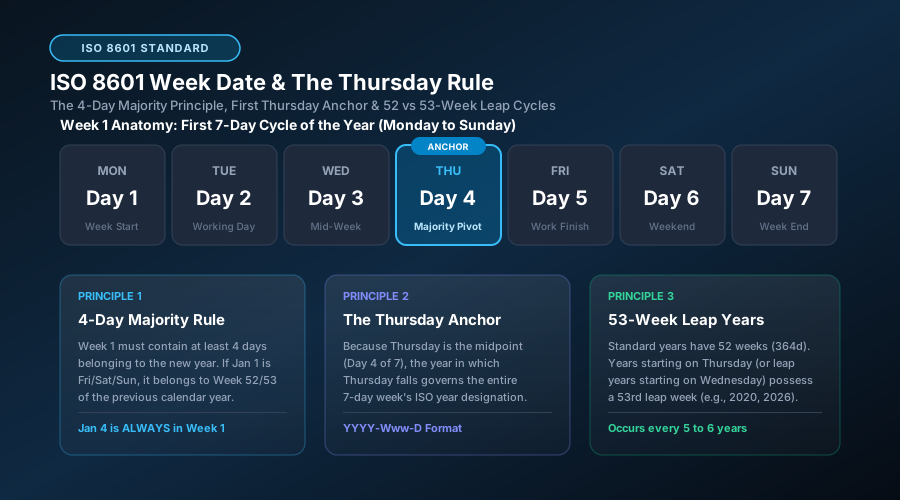
ISO 8601 Week Date & The Thursday Rule
Visualizing the 4-day majority rule, Monday–Sunday weekly cycle, and the mathematical conditions governing 53-week leap years.
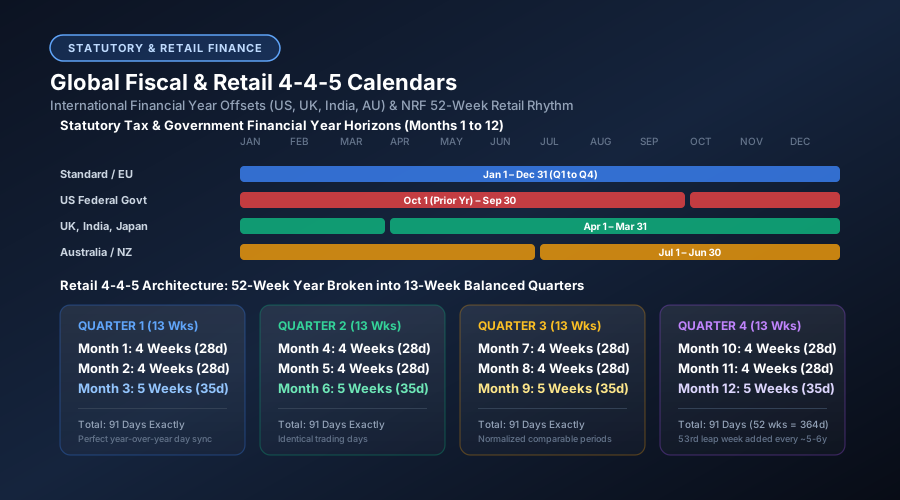
Statutory Fiscal Years & Retail 4-4-5 Quarters
Comparison of international financial years (US Federal Oct-Sep, UK/India Apr-Mar) and the National Retail Federation (NRF) 52-week 4-4-5 architecture.
Structural Chronometry: ISO Week Numbering, Fiscal Horizons & Higher Education Pacing
While civil life functions on Gregorian day-month combinations, institutional governance across international supply chains, capital markets, and universities relies on specialized structural chronometries. Standardizing week numbers and fiscal quarters prevents costly timing discrepancies in enterprise resource planning (ERP) systems and academic curricula.
1. ISO 8601 Week Date Architecture & The Thursday Rule
Formulated by the International Organization for Standardization, ISO 8601 defines an unambiguous week-based calendar widely utilized in European commerce, logistics, and software engineering. Its foundational rules mandate:
- Monday Start: Weeks consistently start on Monday (Day 1) and conclude on Sunday (Day 7).
- The 4-Day Majority Principle: Week 1 of any year is defined as the first week containing at least 4 days in the new calendar year.
- The Thursday Equivalence: Because Thursday is Day 4 (the exact median of a 7-day week), Week 1 is equivalently the week containing the first Thursday of the year, or the week that includes January 4th.
- 53-Week Leap Years: Standard ISO years contain 52 weeks (364 days). Years that begin on a Thursday (or leap years starting on Wednesday) conclude with 53 weeks, inserting an extra week every 5 to 6 years to absorb the 1.2425 days accumulated annually beyond 52 complete weeks.
2. Global Fiscal Year Standards & Retail 4-4-5 Accounting
Different national governments align their statutory fiscal years with historical agricultural tax collection cycles and legislative budget sessions:
- US Federal Government (Oct 1 – Sep 30): The fiscal year is designated by the calendar year in which it concludes (e.g., FY2025 concludes September 30, 2025).
- United Kingdom & India (Apr 1 – Mar 31): Inherited from the historical British Lady Day (March 25) tax cycle, adjusted during the 1752 calendar reform. In India, Financial Year (FY) 2024–25 corresponds to Assessment Year (AY) 2025–26.
- Retail 4-4-5 System: Retailers face distortions when comparing months with varying weekend counts. The National Retail Federation (NRF) 4-4-5 calendar structures each quarter into two 4-week months (28 days) and one 5-week month (35 days), yielding exactly 13 weeks (91 days) per quarter and ensuring every month begins and ends on the exact same day of the week year over year.
3. Academic Credit Load & Pacing Dynamics
In university administration, the standard Carnegie Unit equates 1 collegiate credit hour to 1 hour of direct classroom instruction plus 2 to 3 hours of outside academic preparation per week. A full-time 15-credit undergraduate schedule therefore necessitates 45 to 60 total weekly hours of academic engagement. Mapping syllabus completion curves against midterm and final exam blackout windows enables students to avoid end-of-term burnout.
Frequently Asked Questions
Why does an ISO week year sometimes differ from the Gregorian year?
If January 1 falls on a Friday, Saturday, or Sunday, those days belong to Week 52 or 53 of the previous year under ISO 8601. Conversely, if December 31 falls on a Monday, Tuesday, or Wednesday, those days belong to Week 1 of the following year.
What is the advantage of a 4-4-5 retail accounting calendar?
A 4-4-5 calendar ensures that each quarter has exactly 13 weeks and 91 days, with an identical distribution of shopping Saturdays and Sundays. This eliminates artificial revenue swings caused by calendar month shifts.
What is the difference between Semester and Quarter academic systems?
A semester system divides the academic year into two 15–16 week terms (Fall and Spring). A quarter system divides the year into four 10–11 week terms (Fall, Winter, Spring, and Summer), requiring accelerated syllabus pacing.