Date & Time Calculator
Calendar & Year Tools
Date & Celestial Coordinates
Julian Day (JD):2461346.00
Synodic Lunar Age:20.96 days
Earth-Moon Distance:377,746 km
Local Sidereal Time:09:49:06
Current Moon Phase
🌖
Waning Gibbous
Illumination begins diminishing from western right limb
Illuminated Fraction62.5%Phase Angle: 255.5°
Next Full Moon:In 23.3 Days
Next New Moon:In 8.6 Days
Lunisolar Metonic Cycle & Folklore Milestone
Metonic Golden NumberYear #13 of 19
Epact (moon age on Jan 1): 12 days.
Traditional Full Moon NameBeaver Moon
Historical North American Algonquin / Old Farmer folklore naming.
Algorithmic Step Derivation (Meeus Ephemeris)
// 1. Julian Day (JD) at 2026-11-01 12:00 UTC
JD = 2461346.00 (Julian centuries T = 0.26834)
// 2. Synodic Lunar Age & Phase Angle
Delta Days from Epoch = (2461346.00 - 2460321.0) = 1025.00 d
Lunar Age = 20.96 days (of 29.53059d cycle)
Phase Angle φ = (20.96 / 29.53059) × 360° = 255.5°
Illumination k = [1 - cos(255.5°)] / 2 = 62.5% (Waning Gibbous)
// 3. Local Sidereal Time (LST) Alignment
LST = GMST (14:45:07) + (-74.01° / 15) = 09:49:06
Figure 1: The 8 Canonical Moon Phases & Synodic Month
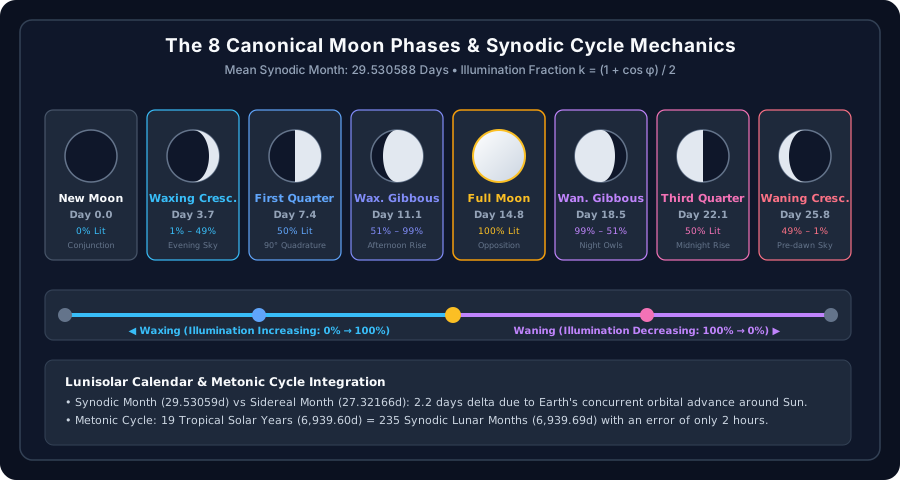
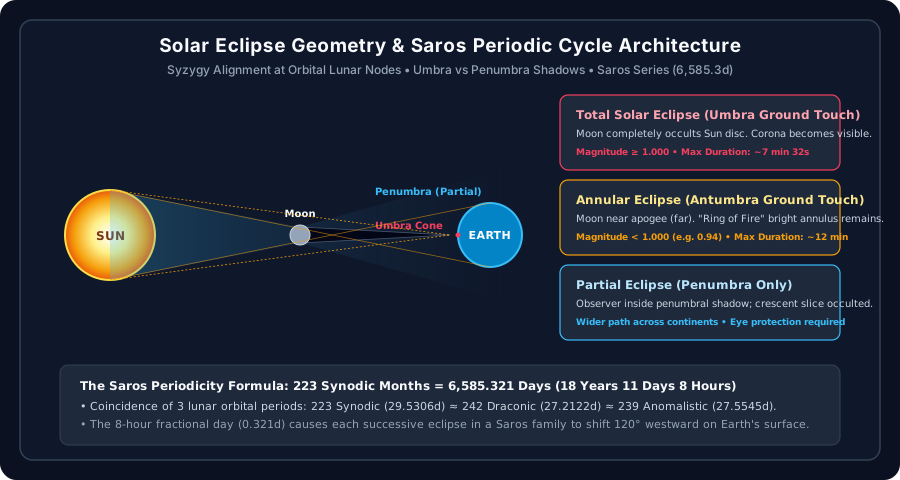
Figure 2: Solar Eclipse Geometry & The Saros Periodicity Formula
Institutional Reference: Celestial Mechanics, Lunar Ephemerides, and Saros Periodicity
Authoritative documentation conforming to the International Astronomical Union (IAU) 2000 Resolutions, NASA Eclipse Web Central, and the Astronomical Almanac.
1. The Synodic Month vs. Sidereal Month: Orbital Physics & Illumination Geometry
The Moon does not orbit a static Earth. As the Moon travels around the Earth, the Earth simultaneously advances approximately $1^\circ$ per day along its heliocentric orbit around the Sun. This concurrent motion creates two distinct lunar orbital periods:
- The Sidereal Month (27.321661 days): The true orbital period of the Moon relative to the fixed background stars. After 27.32 days, the Moon returns to the identical celestial longitude on the celestial sphere.
- The Synodic Month (29.530588 days): The period required for the Moon to complete one full cycle of illumination phases (from one New Moon to the next). Because Earth has traveled forward by roughly 27° along its orbit during the sidereal month, the Moon must travel an additional 2.2 days to realign with the Sun and return to syzygy (conjunction).
The illuminated fraction of the lunar disc k observable from Earth is calculated using the phase angle φ (the selenocentric angle between the Earth and the Sun):
Illumination Fraction k = (1 + cos φ) / 2 or (1 - cos(θ_age)) / 2
2. The Saros Series & Eclipse Periodicity (223 Synodic Months = 6,585.3 Days)
Solar and lunar eclipses do not occur haphazardly; they follow a strict mathematical periodicity discovered by ancient Babylonian astronomers known as the Saros Cycle. An eclipse can only occur when the Moon is simultaneously at syzygy (New or Full) and crossing the plane of the ecliptic at one of its orbital nodes (ascending or descending node).
The Saros cycle represents the harmonic resonance among three distinct lunar orbital frequencies:
- 223 Synodic Months = 223 × 29.530589 d = 6,585.3213 days (Phase repetition)
- 242 Draconic Months = 242 × 27.212221 d = 6,585.3575 days (Node crossing repetition)
- 239 Anomalistic Months = 239 × 27.554550 d = 6,585.5375 days (Perigee/apogee distance repetition)
Because these three periods coincide within fractions of a day after 6,585.32 days (18 years, 11 days, 8 hours), an eclipse with nearly identical geometry, magnitude, and totality duration recurs in the same Saros family. The remaining 8 hours (0.321 days) causes the Earth to rotate 120° west, shifting the eclipse path one-third of the globe westward on every successive cycle. After three Saros cycles (54 years and 34 days, known as an Exeligmos), the eclipse returns to approximately the same geographic longitude.
3. The Lunisolar Calendar, Epact, and the 19-Year Metonic Cycle
A pure solar year (tropical year) contains 365.2422 days, while a pure lunar year of 12 synodic months contains only 12 × 29.53059 = 354.3671 days. This fundamental discrepancy of 10.875 days per year (known as the annual epact) causes lunar calendars (such as the Islamic Hijri calendar) to drift backward through the solar seasons by roughly 11 days each year.
Lunisolar calendars (such as the Hebrew, traditional Chinese, and Hindu calendars) reconcile this drift using the Metonic Cycle, documented by Meton of Athens in 432 BCE:
19 Tropical Solar Years = 19 × 365.2422 = 6,939.60 Days
235 Synodic Lunar Months = 235 × 29.53059 = 6,939.69 Days
235 Synodic Lunar Months = 235 × 29.53059 = 6,939.69 Days
The two cycles align with an astonishing precision of just 2 hours over 19 years! To maintain synchronization, lunisolar calendars insert seven intercalary leap months (embolisms) across each 19-year cycle (specifically in years 3, 6, 8, 11, 14, 17, and 19).
4. Local Sidereal Time (LST) and Telescope Meridian Alignment
While civil clocks follow the Sun, observational astronomers and telescope mounts operate on Sidereal Time. A sidereal day is the time required for Earth to rotate 360° on its axis relative to the vernal equinox (23h 56m 4.091s of mean solar time).
Local Sidereal Time (LST) is fundamentally equal to the Right Ascension (RA) of any celestial object currently crossing the observer's local meridian. By setting a telescope's equatorial setting circles or computerized GoTo drive to the current LST, objects at transit can be targeted with zero hour angle (HA = LST - RA = 0).
Frequently Asked Questions
What is the difference between a Supermoon and a Micromoon?
Because the Moon's orbit is elliptical (e = 0.0549), its distance from Earth ranges from perigee (363,300 km) to apogee (405,500 km). A Full Moon occurring within 90% of closest perigee is colloquially known as a Supermoon; it appears approximately 14% larger in apparent diameter and 30% brighter in luminous flux than an apogee Micromoon.
Why don't solar and lunar eclipses happen every month?
The Moon's orbital plane is inclined by 5.14° relative to the plane of the Earth's orbit around the Sun (the ecliptic). At most New and Full Moons, the Moon passes safely above or below the Sun, casting its shadow harmlessly into empty space. Eclipses can only transpire during eclipse seasons, when the Sun is near one of the Moon's orbital nodes.
Why does the Moon keep the same face toward Earth?
The Moon is in 1:1 spin-orbit tidal resonance (tidal locking) with Earth. Over billions of years, Earth's gravitational tidal torque slowed the Moon's rotational period until it matched its orbital period (27.32 days). Observers see slight edge wobbles (up to 59% of the total lunar surface over time) due to lunar optical librations.
About Solar Eclipse Calculator
Calculate next solar eclipse dates. Designed for fast, accurate calculation with clear outputs, explanation, and device-friendly usability.
Why this page helps
- Fast answers without manual formula rearrangement
- Cleaner comparison of multiple scenarios
- Works on mobile, tablet, and desktop
- Useful for study, planning, and quick verification
How to use it well
- Open the Solar Eclipse Calculator and enter the known input values.
- Select the correct units for each field before calculating.
- Review the main result, formula, and conversions shown on the page.
- Use the step-by-step breakdown to verify the logic and download or share the result if needed.
Expert tips
- Check that all inputs use the correct unit system before comparing values.
- Use the worked steps to confirm whether you entered the right known variables.