Date & Time Calculator
Calendar & Year Tools
Gregorian to Hijri Parameters
Fine-tune for local hilal moon sighting variations
Islamic Lunar Epoch (AH)
1 Ramadan 1446 AH
Corresponds to Wednesday (2026-11-01)
Status of MonthHoly Month (Fasting)
Leap CycleStandard Year (354d)11 of 30y cycle
Days in Month30 Days
Upcoming Major Observance:Eid al-Fitr (1 Shawwal 1446)
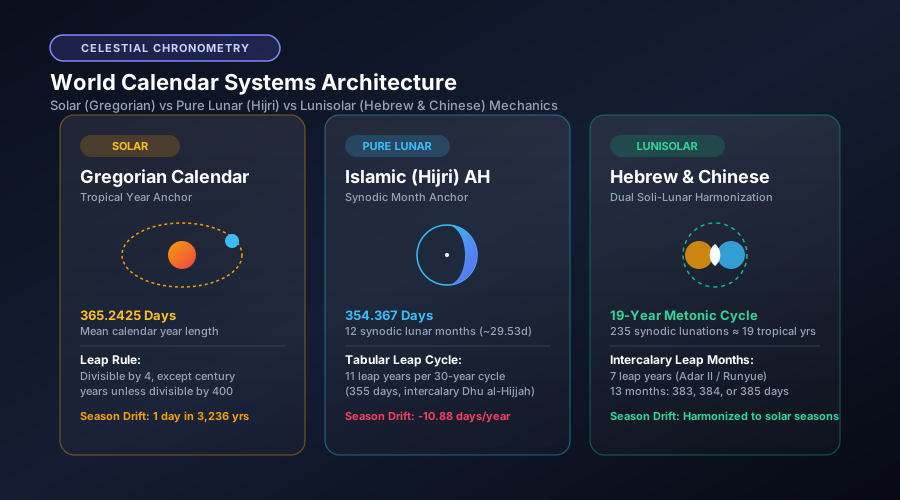
Solar vs Pure Lunar vs Lunisolar Mechanics
Structural comparison of Gregorian (solar 365.2425d), Islamic (pure lunar 354.36d), and Hebrew/Chinese 19-year Metonic lunisolar synchronization.
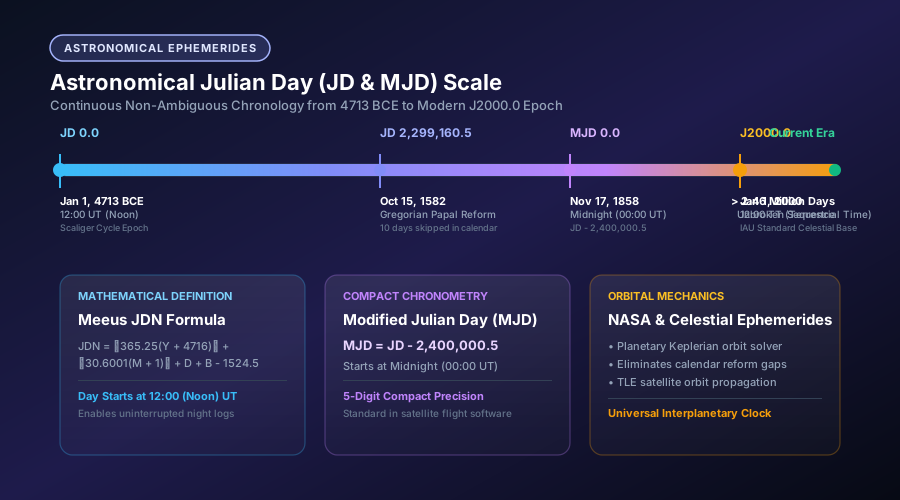
Astronomical Julian Day (JD & MJD) Continuous Scale
Joseph Scaliger's uninterrupted day count from 4713 BCE through the Gregorian 1582 reform, MJD 1858 baseline, and IAU J2000.0 standard.
The Mathematics of Celestial Time: Solar, Lunar & Lunisolar Chronological Epochs
Throughout human civilization, calendar systems have addressed the fundamental astronomical incommensurability between the day (axial rotation), the synodic month (lunar orbit: 29.530589 days), and the tropical year (solar orbit: 365.24219 days). Because none of these periods divide evenly into one another, societies engineered distinct calendrical paradigms:
1. The Islamic (Hijri) Pure Lunar Calendar
Established in 622 CE by the second Caliph Umar ibn al-Khattab, the Hijri calendar (Anno Hegirae, AH) is strictly lunar, comprising 12 synodic months totaling approximately 354.367 days per year. Because it contains no intercalary leap months to reconcile with the solar year, the Islamic calendar drifts backward through the Gregorian solar seasons by approximately 10.875 days every year (completing a full 33-year solar cycle).
In the arithmetical tabular Kuwārizmī system, a 30-year cycle incorporates 11 leap years (years 2, 5, 7, 10, 13, 16, 18, 21, 24, 26, 29) where the 12th month (Dhu al-Hijjah) receives an extra day (30 days total), maintaining alignment with true lunar phases to within one day over 2,500 years.
2. Hebrew Lunisolar Calendar & The 19-Year Metonic Cycle
The traditional Hebrew calendar harmonizes lunar months with solar agricultural festivals (such as Passover in the spring) via the 19-year Metonic cycle, which exploits the mathematical coincidence that 235 synodic lunar months (approx. 6,939.69 days) closely aligns with 19 tropical solar years (approx. 6,939.60 days).
To bridge the 11-day annual disparity, an intercalary 13th month (Adar II) is inserted 7 times within every 19-year cycle (in years 3, 6, 8, 11, 14, 17, and 19). Furthermore, four postponement rules (Deḥiyyot) ensure that Yom Kippur never falls adjacent to the Sabbath (preventing consecutive days of solemn labor prohibition) and Hoshana Rabbah never falls on the Sabbath.
3. Astronomical Julian Day (JD) & Modified Julian Day (MJD)
In orbital mechanics, astrophysics, and satellite tracking, civil calendar leap years and historical calendar reforms (such as the 10 days omitted during the Gregorian papal transition in October 1582) introduce unacceptable discontinuities. In 1583, Joseph Justus Scaliger formulated the Julian Day (JD): an unbroken count of solar days elapsed since 12:00 UT on January 1, 4713 BCE (the convergence point of the 28-year solar cycle, 19-year Metonic cycle, and 15-year Roman indiction).
Julian Days begin at noon (12:00 UT) so that nighttime astronomical observations remain on the same Julian date. The modern standard ephemeris epoch, J2000.0, corresponds precisely to JD 2,451,545.0 (January 1, 2000, 12:00 Terrestrial Time).
Frequently Asked Questions
Why does Ramadan change dates each Gregorian year?
Because the Islamic calendar is strictly lunar (354 days per year) without leap months, it is approximately 11 days shorter than the 365-day Gregorian solar year. Ramadan therefore arrives roughly 10 to 11 days earlier each solar year.
What is Modified Julian Day (MJD)?
Modified Julian Day is defined as MJD = JD - 2,400,000.5. It was introduced by the Smithsonian Astrophysical Observatory in 1957 to reduce the number of digits needed for computer memory and shifts the day start to midnight (00:00 UT) to match civil day boundaries.
What is the Chinese 60-year Ganzhi cycle?
The Ganzhi (干支) system pairs 10 Heavenly Stems with 12 Earthly Branches (represented by 12 zodiac animals). Because 10 and 12 have a least common multiple of 60, the combinations repeat every 60 years.
About Hijri Calendar Converter
Convert to Islamic/Hijri calendar. Designed for fast, accurate calculation with clear outputs, explanation, and device-friendly usability.
Why this page helps
- Fast answers without manual formula rearrangement
- Cleaner comparison of multiple scenarios
- Works on mobile, tablet, and desktop
- Useful for study, planning, and quick verification
How to use it well
- Open the Hijri Calendar Converter and enter the known input values.
- Select the correct units for each field before calculating.
- Review the main result, formula, and conversions shown on the page.
- Use the step-by-step breakdown to verify the logic and download or share the result if needed.
Expert tips
- Check that all inputs use the correct unit system before comparing values.
- Use the worked steps to confirm whether you entered the right known variables.