Academic Major Career ROI & Payback
Actuarial NPV$
$
$
Degree Net Present Value (NPV)ELEVATED DEBT RATIO
+$827,228
Discounted lifetime wage premium over high school baseline (6% hurdle rate)
Payback Horizon
3 years
Years to recover degree cost
Debt / Starting Salary
1.13x
Benchmark: Keep ≤ 1.0x
Higher-Ed Career Principles
The 20-Hour Work-Study Rule: Research by the National Center for Education Statistics (NCES) indicates that working 10 to 15 hours per week during term time actually correlates with higher GPAs due to disciplined time management. However, working beyond 20 hours per week introduces severe fatigue, lower completion rates, and extended time-to-degree.
Career Earnings Crossover & International Matrix Schematics
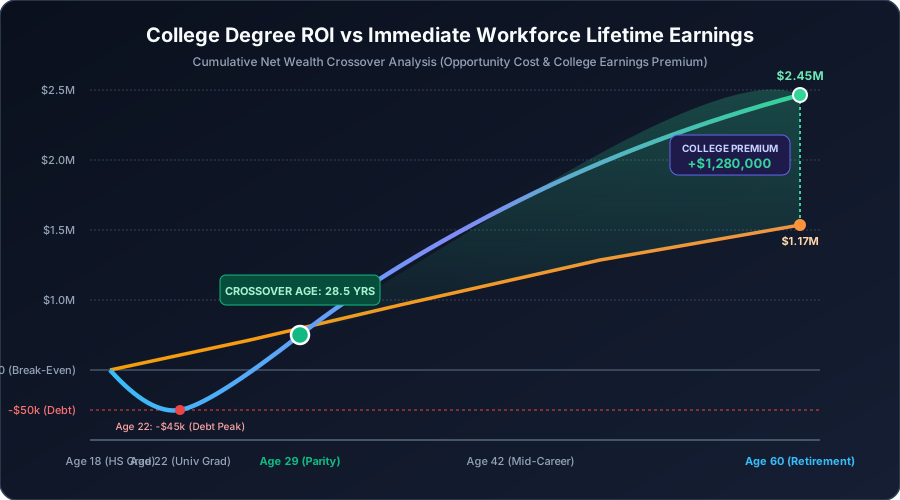
College vs Immediate Workforce Crossover Trajectory
Lifetime wealth inflection crossing at Age 28–30 to yield +$1.2M+ career premium.
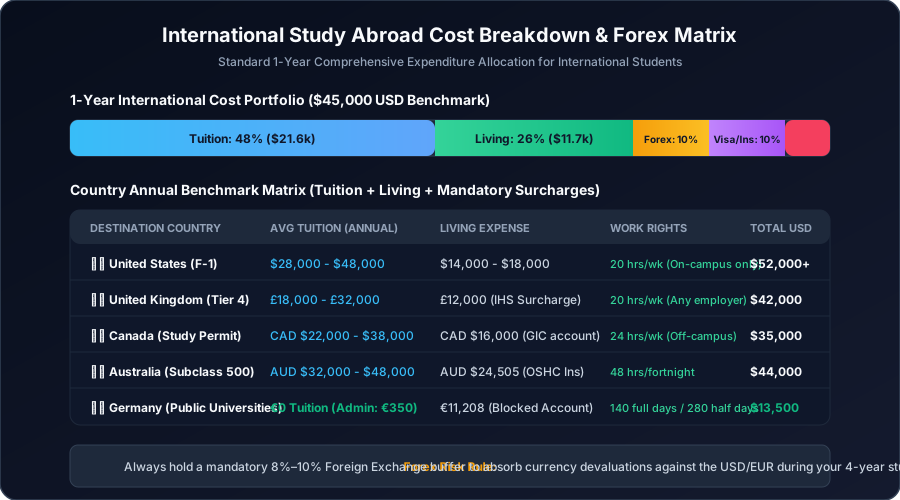
International Student Expenditure & Forex Matrix
Country-by-country breakdown of tuition, living expenses, visa and currency safety buffer.
Academic Return on Investment & Actuarial Equations
1. Net Present Value (NPV)
NPV = Σ [CF_t / (1 + r)^t] - Cost_0
Where CF_t is annual college earnings premium over high school baseline, and r is discount rate (6%).
2. Payback Horizon Equation
T_pb = min t: Σ [W_college - W_hs] ≥ Cost_0
Identifies exact post-graduation year where accumulated surplus income fully covers initial college tuition and interest debt.
3. Net Textbook Optimization
Net = (B_gross + Code_mand) - Resell_ret
Calculates true net out-of-pocket course literature expenditure after factoring mandatory online access portal codes and buyback recovery.
Academic Career & Mobility Case Studies
Case 1: The Germany Tuition-Free Tradeoff
Scenario: An engineering graduate student considers US private school ($52,000/yr) vs Germany public university (€0 tuition with €11,208 mandatory living blocked account). Over a 2-year master’s, studying in Germany saves over $65,000 in debt, accelerating financial independence by 6 years despite language adaptation.
Case 2: Digital Textbook Rental vs Campus Bookstore
Scenario: A pre-med student taking 5 classes faces $725 for new print textbooks. By securing 3 digital rentals ($45 each), 1 library reserve loan, and 1 mandatory online chemistry code ($85), the net semester outlay drops to $220—a 70% direct savings of $505 per semester.