Education Calculator
College & Career Planning
Part-Time Wages & Academic Balance
Campus Work-Study$
$
Semester Take-Home WagesMODERATE ACADEMIC LOAD
$3,274
$819 / month net income after 12% tax
Living Offset
72.8%
Of $ 4,500 target living cost
Weekly Hours
15 hrs
Legal limit: 20 hrs/week
Higher-Ed Career Principles
The 20-Hour Work-Study Rule: Research by the National Center for Education Statistics (NCES) indicates that working 10 to 15 hours per week during term time actually correlates with higher GPAs due to disciplined time management. However, working beyond 20 hours per week introduces severe fatigue, lower completion rates, and extended time-to-degree.
Career Earnings Crossover & International Matrix Schematics
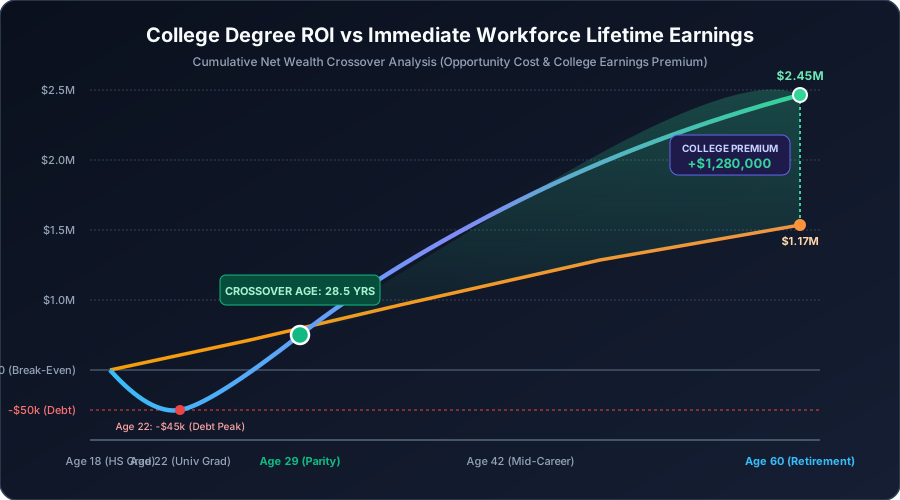
College vs Immediate Workforce Crossover Trajectory
Lifetime wealth inflection crossing at Age 28–30 to yield +$1.2M+ career premium.
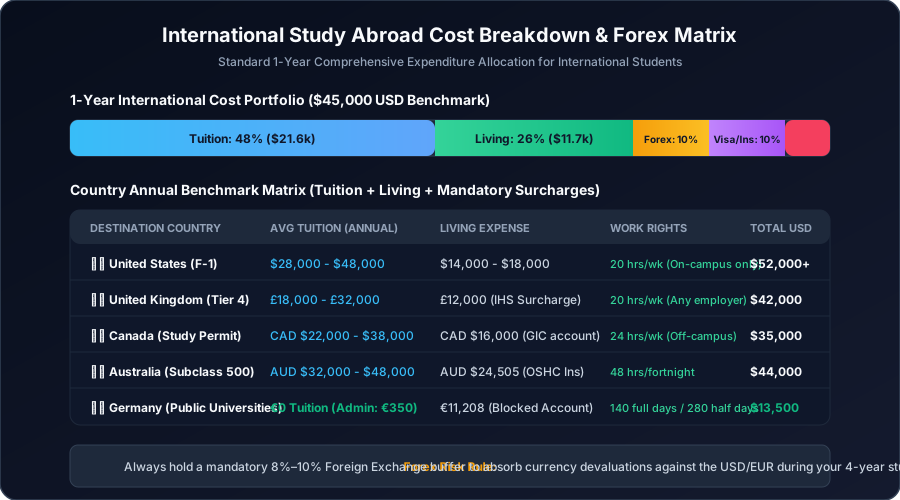
International Student Expenditure & Forex Matrix
Country-by-country breakdown of tuition, living expenses, visa and currency safety buffer.
Academic Return on Investment & Actuarial Equations
1. Net Present Value (NPV)
NPV = Σ [CF_t / (1 + r)^t] - Cost_0
Where CF_t is annual college earnings premium over high school baseline, and r is discount rate (6%).
2. Payback Horizon Equation
T_pb = min t: Σ [W_college - W_hs] ≥ Cost_0
Identifies exact post-graduation year where accumulated surplus income fully covers initial college tuition and interest debt.
3. Net Textbook Optimization
Net = (B_gross + Code_mand) - Resell_ret
Calculates true net out-of-pocket course literature expenditure after factoring mandatory online access portal codes and buyback recovery.
Academic Career & Mobility Case Studies
Case 1: The Germany Tuition-Free Tradeoff
Scenario: An engineering graduate student considers US private school ($52,000/yr) vs Germany public university (€0 tuition with €11,208 mandatory living blocked account). Over a 2-year master’s, studying in Germany saves over $65,000 in debt, accelerating financial independence by 6 years despite language adaptation.
Case 2: Digital Textbook Rental vs Campus Bookstore
Scenario: A pre-med student taking 5 classes faces $725 for new print textbooks. By securing 3 digital rentals ($45 each), 1 library reserve loan, and 1 mandatory online chemistry code ($85), the net semester outlay drops to $220—a 70% direct savings of $505 per semester.
Frequently Asked Questions
About Part-time Job Planner
Balance study time with part-time work earnings. Designed for fast, accurate calculation with clear outputs, explanation, and device-friendly usability.
Why this page helps
- Fast answers without manual formula rearrangement
- Cleaner comparison of multiple scenarios
- Works on mobile, tablet, and desktop
- Useful for study, planning, and quick verification
How to use it well
- Open the Part-time Job Planner and enter the known input values.
- Select the correct units for each field before calculating.
- Review the main result, formula, and conversions shown on the page.
- Use the step-by-step breakdown to verify the logic and download or share the result if needed.
Expert tips
- Check that all inputs use the correct unit system before comparing values.
- Use the worked steps to confirm whether you entered the right known variables.