Curl Vorticity (∇ × F)
Vector rotation, circulation, and Stokes' theorem
Vector Field F = ⟨P(x,y), Q(y,z), R(x,z)⟩ Partial Derivatives:
Vector Field & Tensor Solution
Multivariable MetricVorticity Vector ∇ × F
⟨-2.000, -1.000, 1.000⟩
Angular Speed = 2.449 rad/s
Rotational Field: Vorticity magnitude = 2.449. Paddle wheel placed in field will spin about axis ∇ × F.
Academic Reference & Vector Fields
Multivariable Calculus: Gradients, Divergence, Curl & Hessian Optimization
Vector differential operators, flux surface integrals, Stokes' and Gauss's divergence theorems, and multivariable critical point classifications.
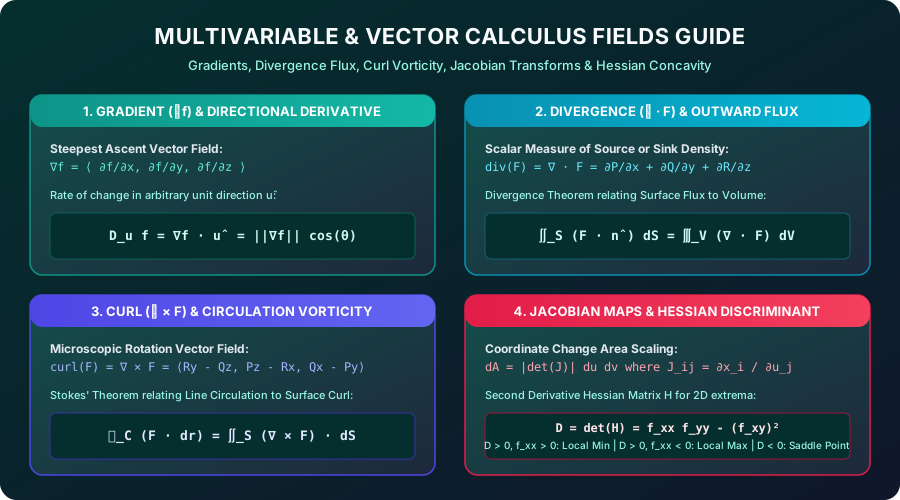
1. The Gradient Vector Field (∇f) & Steepest Ascent
For a scalar field f(x, y, z), the gradient ∇f (pronounced "del f") is a vector field formed by the first partial derivatives:
∇f = ⟨ ∂f/∂x, ∂f/∂y, ∂f/∂z ⟩
The gradient points in the exact direction along which f increases most rapidly. Its magnitude ||∇f|| equals that maximum rate of increase. Furthermore, the gradient vector at any point is strictly perpendicular (normal) to the level surface f(x, y, z) = k passing through that point, forming the mathematical foundation for gradient descent optimization algorithms in modern machine learning.
2. Divergence (∇ · F) and Gauss's Divergence Theorem
The divergence of a vector field F = ⟨P, Q, R⟩ measures the net outward flux per unit volume around an infinitesimal point:
div(F) = ∇ · F = ∂P/∂x + ∂Q/∂y + ∂R/∂z
Gauss's Divergence Theorem establishes that the total outward flux of F across a closed boundary surface S equals the triple volume integral of the divergence over the enclosed region V:
∬_S (F · n̂) dS = ∭_V (∇ · F) dV
3. Hessian Matrix & Multivariable Second Derivative Test
To classify a critical point (x₀, y₀) where ∇f = 0 on a 2D surface, the Hessian matrix of second-order partial derivatives is evaluated:
H = [ [ f_xx, f_xy ], [ f_yx, f_yy ] ] | D = det(H) = f_xx · f_yy - (f_xy)²
- If D > 0 and f_xx > 0: strictly concave upward, local minimum.
- If D > 0 and f_xx < 0: strictly concave downward, local maximum.
- If D < 0: the eigenvalues of H have opposite signs, producing a saddle point.
- If D = 0: the test is inconclusive, requiring higher-order polynomial analysis.