Euler's Gamma Function
Γ(z) = ∫[0 to ∞] t^(z-1) e^(-t) dt continuous factorial
Computed Solution
Exact / NumericalEuler Gamma Value
24
Factorial Equivalent: (5 - 1)! = 4!
Γ(z) satisfies the fundamental functional equation Γ(z + 1) = z Γ(z). For positive integers, Γ(n) = (n - 1)!.
Academic Reference & Special Functions
Special Functions, Multidimensional Integrals & Orthogonal Polynomials
Triple and volume integrals, line circulation, Euler's continuous gamma factorial, Bessel acoustic harmonics, and Legendre spherical polynomials.
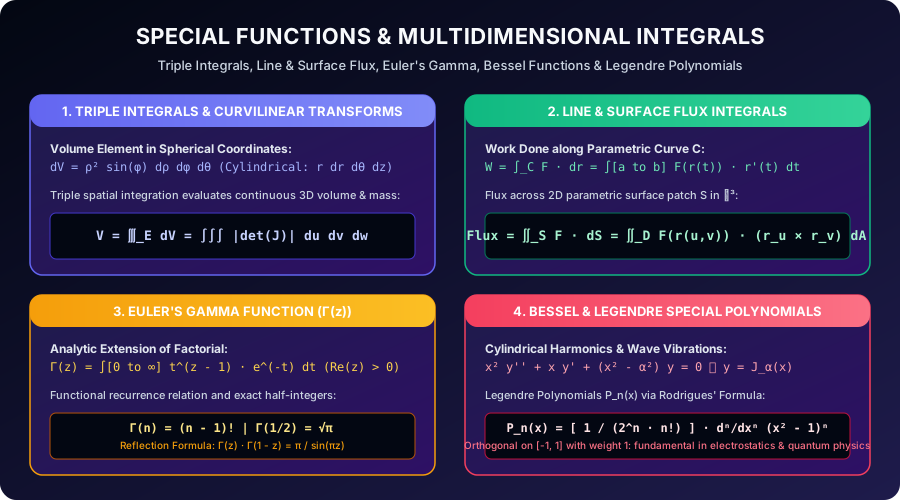
1. Euler's Gamma Function & The Analytic Factorial Extension
The Gamma function Γ(z) provides a smooth, analytic continuation of the factorial function to all complex numbers with positive real parts:
Γ(z) = ∫[0 to ∞] t^(z - 1) · e^(-t) dt (Re(z) > 0)
Integrating by parts yields the fundamental recurrence relation Γ(z + 1) = z Γ(z). For positive integers n, Γ(n) = (n - 1)!. One of its most famous values is the half-integer value Γ(1/2) = √π, directly derived from the Gaussian probability integral ∫ e^(-x²) dx = √π.
2. Bessel Functions of the First Kind (J_α(x))
Bessel functions arise as canonical solutions to Bessel's second-order differential equation:
x² y'' + x y' + (x² - α²) y = 0
These functions represent the radial modes of vibrating circular drumheads, optical diffraction patterns through circular apertures (Airy disks), and electromagnetic wave propagation inside cylindrical waveguides.
3. Legendre Polynomials P_n(x) & Spherical Harmonics
The Legendre polynomials P_n(x) are solutions to Legendre's differential equation (1 - x²)y'' - 2xy' + n(n + 1)y = 0. They can be generated compactly using Rodrigues' formula:
P_n(x) = [ 1 / (2ⁿ · n!) ] · dⁿ/dxⁿ [ (x² - 1)ⁿ ]
They are mutually orthogonal on the interval [-1, 1] with weight function w(x) = 1. In physics and astronomy, Legendre polynomials form the angular component of spherical harmonics, governing gravitational fields of planets and electronic orbitals of hydrogen atoms in quantum mechanics.