Improper Integrals
Infinite limits of integration ∫[a to ∞] and vertical poles
Function Definition: f(x) = a·xⁿ + b·xᵐ + c·x + d
Analytical Solution
Exact / NumericInfinite Area Integral
0.5
Convergent Finite Limit
Converges by p-integral test (p = 3 > 1). Value = 1 / (3 - 1) = 0.5000.
Academic Reference & Real Analysis
Single-Variable Calculus: Limits, Derivatives, Integrals & Error Bounds
Comprehensive foundations of differential and integral calculus, L'Hôpital's rule, the Fundamental Theorem of Calculus, and Taylor remainder estimation.
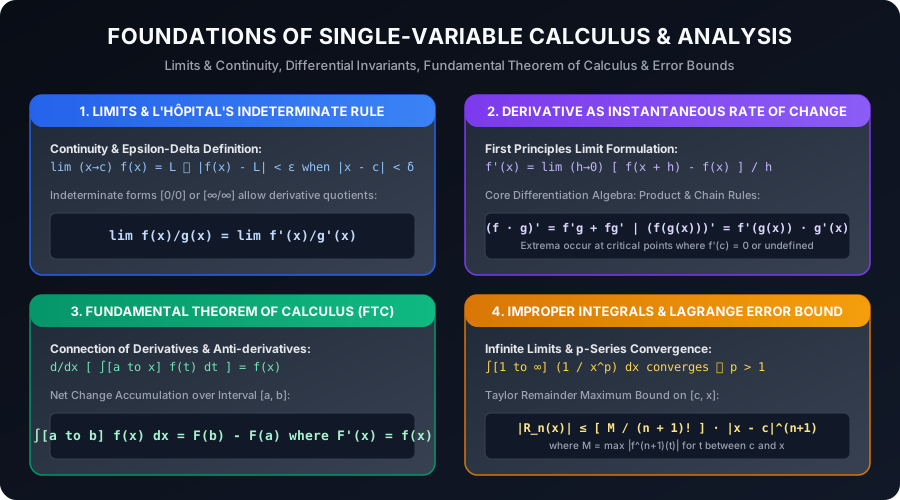
1. Limits, Continuity & L'Hôpital's Indeterminate Quotients
The formal Cauchy definition of a limit establishes that lim (x→c) f(x) = L if for every ε > 0, there exists a δ > 0 such that 0 < |x - c| < δ implies |f(x) - L| < ε. When evaluating rational limits that yield indeterminate forms [0/0] or [±∞/±∞], L'Hôpital's Rule permits replacing the ratio of functions with the ratio of their derivatives:
lim (x→c) [ f(x) / g(x) ] = lim (x→c) [ f'(x) / g'(x) ]
This theorem requires both f and g to be differentiable near c, with g'(x) ≠ 0. If the derivative ratio remains indeterminate, the rule can be applied repeatedly until a finite or infinite limit is determined.
2. The Fundamental Theorem of Calculus (FTC)
The Fundamental Theorem of Calculus bridges the two distinct branches of analysis: differential calculus (slopes) and integral calculus (accumulated areas):
- FTC Part 1 (Derivative of Accumulation): If f is continuous on [a, b], then g(x) = ∫[a to x] f(t) dt is continuous on [a, b], differentiable on (a, b), and g'(x) = f(x).
- FTC Part 2 (Evaluation Theorem): If f is continuous on [a, b] and F is any anti-derivative of f (meaning F'(x) = f(x)), then:∫[a to b] f(x) dx = F(b) - F(a)
3. Taylor Polynomial Remainder & Lagrange Error Bound
When approximating a smooth function f(x) by its degree-n Taylor polynomial centered at c, the error is given by the remainder term R_n(x) = f(x) - P_n(x). The Lagrange Error Bound establishes a strict upper limit on this truncation error:
|R_n(x)| ≤ [ M / (n + 1)! ] · |x - c|^(n + 1)
Here M is the maximum absolute value of the (n + 1)-th derivative |f^(n+1)(t)| for all t in the closed interval between c and x. This bound is essential in numerical analysis for determining the minimum polynomial degree needed to guarantee a specified precision tolerance.