Authoritative reference charts illustrating Cartesian distance triangles, slope rise/run, and line equation models.
Distance Triangle & Midpoint Geometry
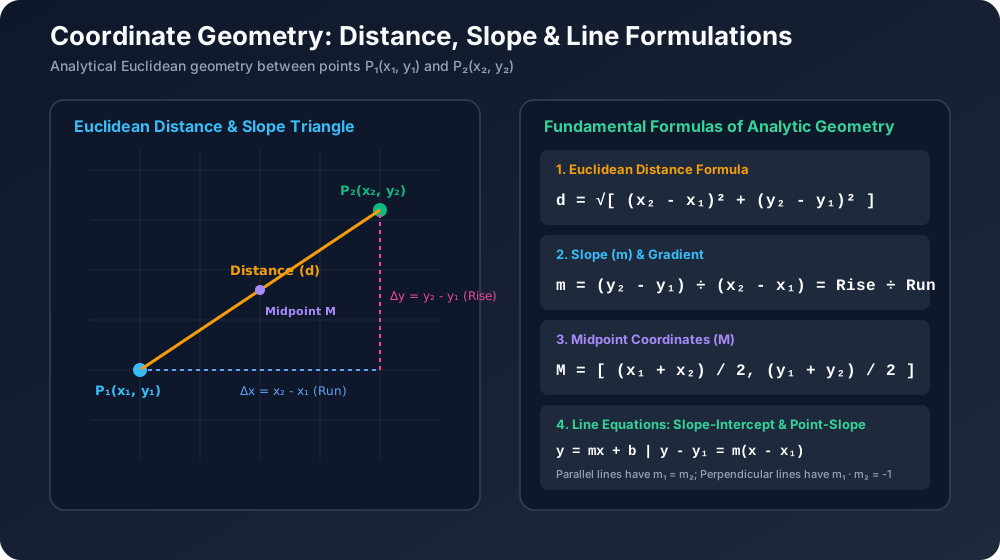
Euclidean distance derivation via Pythagorean hypotenuse, horizontal run (Δx), and vertical rise (Δy).
Lines & Simultaneous Intersections
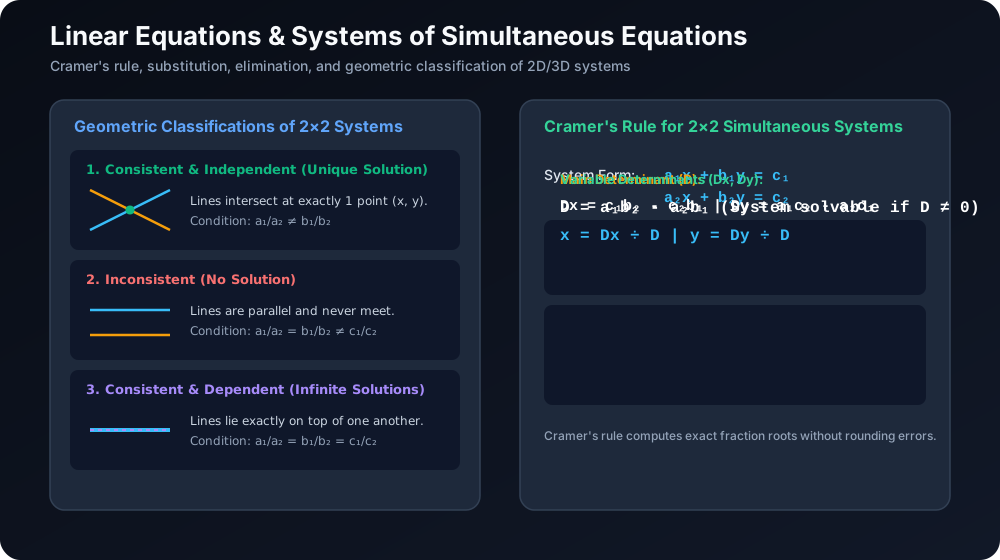
Geometric intersection classifications: unique solution, parallel non-intersecting, and coincident lines.
Comprehensive Reference: Analytic Coordinate Geometry and Linear Formulations
Analytic geometry fuses algebra with Euclidean geometry, representing points as coordinate ordered pairs $(x, y)$ and equations as curves on a Cartesian plane.
1. Derivation of the Distance Formula from the Pythagorean Theorem
Connecting any two points $P_1(x_1, y_1)$ and $P_2(x_2, y_2)$ forms a right-angled triangle with legs of length $|x_2 - x_1|$ and $|y_2 - y_1|$. By the Pythagorean Theorem:
d² = (Δx)² + (Δy)² = (x₂ - x₁)² + (y₂ - y₁)²
Taking the principal non-negative square root yields the celebrated Euclidean distance formula d = √((x₂ - x₁)² + (y₂ - y₁)²).
Frequently Asked Questions (FAQ)
Analytic Coordinate Geometry Suite
Euclidean Plane & Slope Intercept
Distance Formula Calculator
Calculate distance between points.
Euclidean Distance Calculator
Calculate the exact straight-line geometric distance between two coordinate points P₁(x₁, y₁) and P₂(x₂, y₂).
Authoritative reference charts illustrating Cartesian distance triangles, slope rise/run, and line equation models.
Distance Triangle & Midpoint Geometry
Euclidean distance derivation via Pythagorean hypotenuse, horizontal run (Δx), and vertical rise (Δy).
Lines & Simultaneous Intersections
Geometric intersection classifications: unique solution, parallel non-intersecting, and coincident lines.
Comprehensive Reference: Analytic Coordinate Geometry and Linear Formulations
Analytic geometry fuses algebra with Euclidean geometry, representing points as coordinate ordered pairs $(x, y)$ and equations as curves on a Cartesian plane.
1. Derivation of the Distance Formula from the Pythagorean Theorem
Connecting any two points $P_1(x_1, y_1)$ and $P_2(x_2, y_2)$ forms a right-angled triangle with legs of length $|x_2 - x_1|$ and $|y_2 - y_1|$. By the Pythagorean Theorem:
d² = (Δx)² + (Δy)² = (x₂ - x₁)² + (y₂ - y₁)²
Taking the principal non-negative square root yields the celebrated Euclidean distance formula d = √((x₂ - x₁)² + (y₂ - y₁)²).