Solve linear equations, 2×2 simultaneous systems using Cramer's rule, and linear inequalities with complete step-by-step solutions and classifications.
Why this page helps
Rapidly solves systems of equations for algebra, physics, and economics problems
Distinguishes instantly between no solution and infinitely many solutions
Step-by-step intermediate steps for easy verification
How to use it well
Select your calculation tab: Linear Equation (ax + b = c), 2×2 System of Equations, or Linear Inequality.
Enter numeric coefficients into the input fields.
Review the calculated solution, determinant evaluation, and step-by-step algebraic breakdown.
Save calculation to persistent history or export a 1-click PDF summary.
Expert tips
When solving inequalities, always check if your divisor is negative so you know whether to reverse the inequality symbol.
Frequently Asked Questions (FAQ)
About Simultaneous Equations Solver
Solve linear equations, 2×2 simultaneous systems using Cramer's rule, and linear inequalities with complete step-by-step solutions and classifications.
Why this page helps
Rapidly solves systems of equations for algebra, physics, and economics problems
Distinguishes instantly between no solution and infinitely many solutions
Step-by-step intermediate steps for easy verification
How to use it well
Select your calculation tab: Linear Equation (ax + b = c), 2×2 System of Equations, or Linear Inequality.
Enter numeric coefficients into the input fields.
Review the calculated solution, determinant evaluation, and step-by-step algebraic breakdown.
Save calculation to persistent history or export a 1-click PDF summary.
Expert tips
When solving inequalities, always check if your divisor is negative so you know whether to reverse the inequality symbol.
Authoritative reference charts illustrating geometric intersections of 2D lines, Cramer’s rule determinants, and coordinate geometry.
Simultaneous Systems & Cramer's Rule
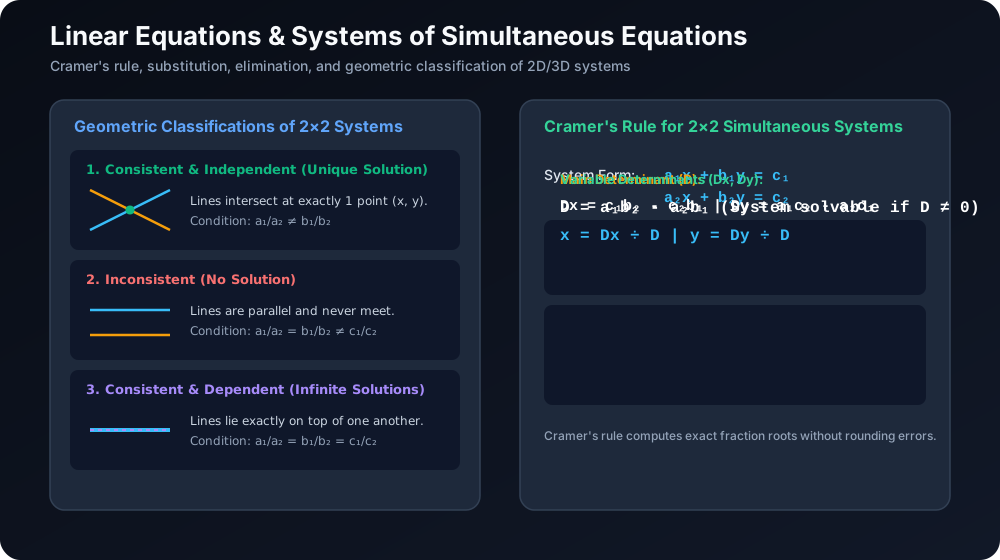
Geometric classifications of consistent (unique or infinite) and inconsistent (parallel) linear systems.
Coordinate Lines & Euclidean Geometry
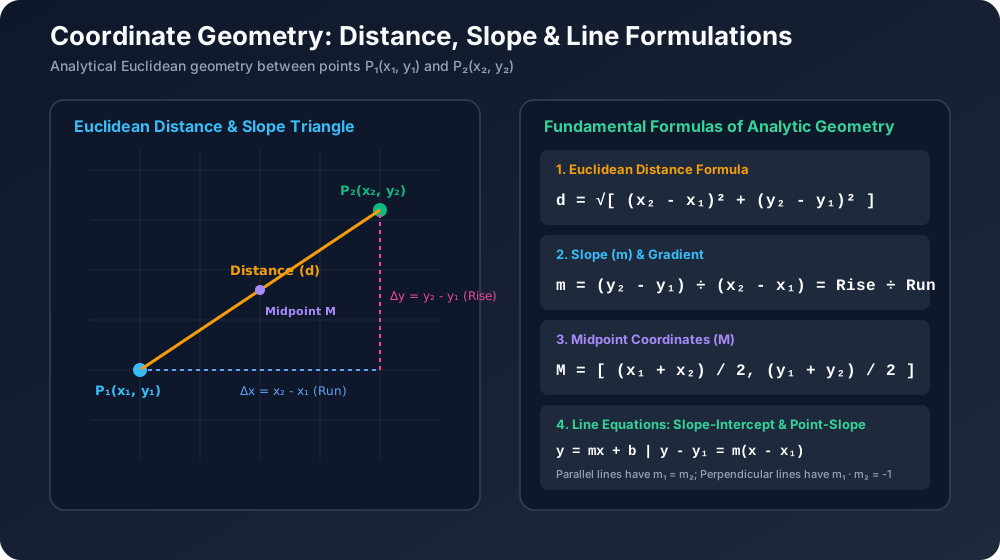
Slope-intercept form (y = mx + b), Euclidean distance hypotenuse, and midpoint calculations.
Comprehensive Reference: Linear Equations, Systems of Equations, and Inequalities
Linear relationships govern proportional scaling across engineering, economics, physics, and computer graphics. Understanding how lines intersect and how constraints bound solution intervals is essential.
1. Solving 2×2 Simultaneous Systems with Cramer's Rule
Consider a system of two linear equations in two variables:
a₁x + b₁y = c₁ a₂x + b₂y = c₂
Cramer's Rule states that if the coefficient determinant $D \ne 0$, the system possesses a unique solution:
Coefficient Determinant:D = a₁b₂ - a₂b₁
x Determinant:Dx = c₁b₂ - c₂b₁
y Determinant:Dy = a₁c₂ - a₂c₁
The variables are computed as $x = D_x / D$ and $y = D_y / D$.
Frequently Asked Questions (FAQ)
Linear Algebra & Systems Suite
Cramer's Rule & Interval Notation
Simultaneous Equations Solver
Solve systems of equations.
Visual Guides & Systems Architecture
Authoritative reference charts illustrating geometric intersections of 2D lines, Cramer’s rule determinants, and coordinate geometry.
Simultaneous Systems & Cramer's Rule
Geometric classifications of consistent (unique or infinite) and inconsistent (parallel) linear systems.
Coordinate Lines & Euclidean Geometry
Slope-intercept form (y = mx + b), Euclidean distance hypotenuse, and midpoint calculations.
Comprehensive Reference: Linear Equations, Systems of Equations, and Inequalities
Linear relationships govern proportional scaling across engineering, economics, physics, and computer graphics. Understanding how lines intersect and how constraints bound solution intervals is essential.
1. Solving 2×2 Simultaneous Systems with Cramer's Rule
Consider a system of two linear equations in two variables:
a₁x + b₁y = c₁ a₂x + b₂y = c₂
Cramer's Rule states that if the coefficient determinant $D \ne 0$, the system possesses a unique solution:
Coefficient Determinant:D = a₁b₂ - a₂b₁
x Determinant:Dx = c₁b₂ - c₂b₁
y Determinant:Dy = a₁c₂ - a₂c₁
The variables are computed as $x = D_x / D$ and $y = D_y / D$.