Linear Algebra Master Suite
Matrices, Determinants, Inverses, Eigenvalues & Vectors
Eigenvalue Calculator
Calculate eigenvalues and eigenvectors.
Eigenvalue & Characteristic Polynomial (2×2)
Solve the characteristic equation det(A - λI) = 0 to extract scalar invariant eigenvalues and trace.
First Eigenvalue (λ₁)
5.0000
Second Eigenvalue (λ₂)
2.0000
Invariants Breakdown:
Trace tr(A) = a + d = 7
Determinant det(A) = ad - bc = 10
Characteristic Equation: λ² - (7)λ + (10) = 0
Recent Calculations
Rigorous Mathematical Field Manual
Comprehensive Guide to Linear Algebra, Matrices & 3D Vector Spaces
Explore algebraic mechanics, geometric transformations, matrix invertibility, characteristic spectra, and spatial physics.
Figure 1: Matrix Inverses, Determinants & Complex Transforms
Visualizing geometric scaling factor, 2×2 determinant diagonals, and vector cross products.
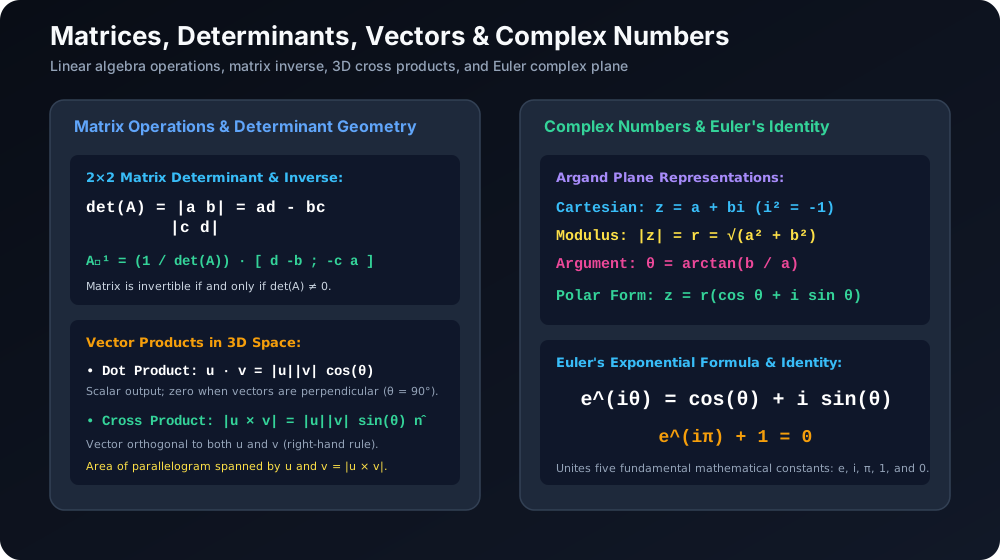
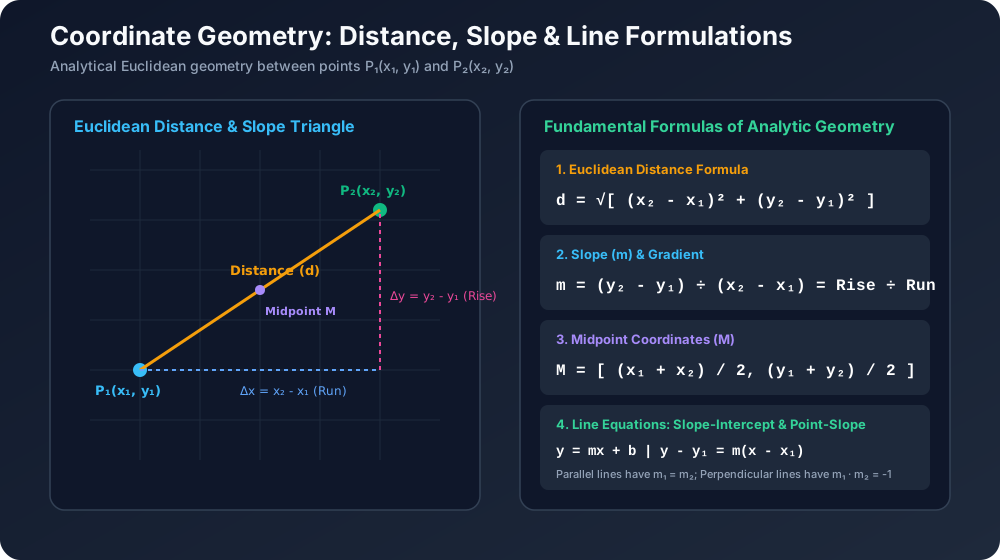
Figure 2: Coordinate Geometry, Distance & Vector Projections
Orthogonal decomposition, dot product angle projections, and Euclidean coordinates.
1. Foundations of Matrix Algebra & Arithmetic Operations
A matrix is a rectangular array of numbers, symbols, or expressions arranged in rows and columns. In linear algebra, matrices serve as compact representations of linear systems of equations, coordinate transformations, and linear mappings between vector spaces. For two matrices to be added or subtracted, they must possess identical dimensions (conformability for addition). If Matrix A is of order m × n and Matrix B is of order m × n, the sum C = A + B is computed entry-by-entry: C[i, j] = A[i, j] + B[i, j].
Unlike addition, matrix multiplication is governed by an inner-product constraint: Matrix A of size m × k can multiply Matrix B of size k × n only if the number of columns in A equals the number of rows in B. The resultant matrix C is of size m × n, where each element is defined by the dot product of the i-th row of A and the j-th column of B: C[i, j] = Σ (A[i, p] × B[p, j]) for p = 1 to k. Crucially, matrix multiplication is non-commutative in general: A × B ≠ B × A.
2. The Geometric & Algebraic Determinant: det(A)
The determinant of a square matrix is a singular scalar value that encapsulates profound geometric and algebraic properties of the linear transformation described by the matrix. Geometrically, for a 2×2 matrix, |det(A)| represents the area of the parallelogram formed by the column vectors; for a 3×3 matrix, |det(A)| represents the volume of the parallelopiped spanned by the three column vectors.
The sign of the determinant indicates orientation: a positive determinant preserves the spatial orientation (right-handed coordinate system remains right-handed), whereas a negative determinant indicates that space has been flipped or inverted (reflection). If det(A) = 0, the matrix is classified as singular: the transformation collapses n-dimensional space into a lower dimension (e.g. 3D space into a 2D plane or line), rendering the matrix irreversibly non-invertible.
3. Matrix Inverses & Adjugate Cofactor Expansion
The inverse of a square matrix A, denoted A⁻¹, is the unique matrix such that A · A⁻¹ = A⁻¹ · A = I, where I is the identity matrix with ones along the main diagonal and zeros elsewhere. An inverse exists if and only if det(A) ≠ 0. The classical analytical formula for the inverse utilizes the adjugate matrix:
A⁻¹ = (1 / det(A)) · adj(A) = (1 / det(A)) · [C]ᵀ
Here, [C] is the cofactor matrix, and [C]ᵀ is its transpose (the adjugate). For a 2×2 matrix with entries [[a, b], [c, d]], the adjugate is formed simply by swapping diagonal elements (a and d) and negating off-diagonal elements (-b and -c), yielding A⁻¹ = (1 / (ad - bc)) · [[d, -b], [-c, a]].
4. Characteristic Equations & Eigenvalues (Spectral Theory)
An eigenvector of a square matrix A is a non-zero vector v that, when transformed by A, changes only in magnitude by a scalar factor λ (the eigenvalue), without altering its directional span: A · v = λ · v. Rearranging into the homogeneous matrix equation (A - λI) · v = 0, non-trivial solutions exist if and only if the characteristic determinant vanishes:
det(A - λI) = 0 ⟹ λ² - tr(A)λ + det(A) = 0 (for 2×2 matrices)
Here, tr(A) is the trace (sum of the diagonal elements: a + d). Solving this quadratic equation yields the eigenvalues λ₁ and λ₂. Eigenvalues and eigenvectors form the cornerstone of Google’s PageRank algorithm, quantum mechanics (wavefunctions and observables), vibration analysis in structural civil engineering, and Principal Component Analysis (PCA) in machine learning.
5. 3D Euclidean Vectors: Dot Product & Cross Product
In three-dimensional space, vectors u = (u_x, u_y, u_z) and v = (v_x, v_y, v_z) possess both magnitude and directional orientation. Two distinct products govern vector mechanics:
- Dot Product (Scalar Product): u · v = u_x · v_x + u_y · v_y + u_z · v_z = |u| |v| cos(θ). The dot product produces a scalar. If u · v = 0 for non-zero vectors, the vectors are perpendicular (orthogonal).
- Cross Product (Vector Product): u × v produces a vector strictly orthogonal to both u and v, whose magnitude |u × v| = |u| |v| sin(θ) equals the surface area of the parallelogram formed by the two vectors. The directional orientation obeys the Right-Hand Rule.