Comprehensive Reference: Quadratic Equations, Polynomial Algebra, and Binomial Theorem
Polynomial equations are the foundational pillars of algebra, describing curves, physical trajectories (such as ballistic projectile motion), financial profit optimization, and wave mechanics.
1. The Quadratic Formula and the Discriminant Test
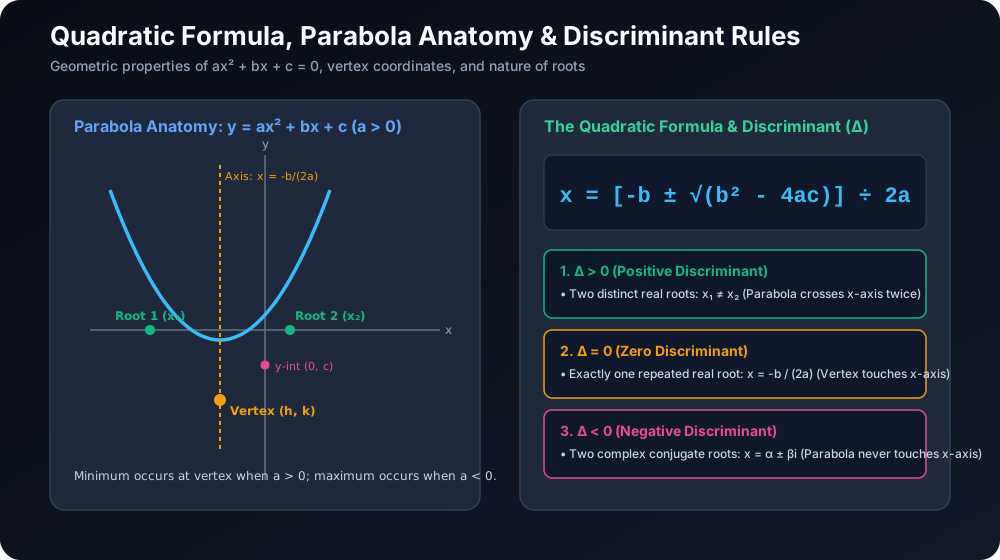
For any second-degree polynomial equation $ax^2 + bx + c = 0$ with $a \ne 0$, the roots are given by the Quadratic Formula:
x = [-b ± √(b² - 4ac)] ÷ 2a
The quantity under the radical symbol, $\Delta = b^2 - 4ac$, is called the Discriminant. It completely determines the nature and quantity of the roots:
- $\Delta > 0$: The equation has two distinct real roots. The parabola intersects the x-axis at two distinct points.
- $\Delta = 0$: The equation has exactly one repeated real root ($x = -b / (2a)$). The parabola's vertex touches the x-axis tangentially.
- $\Delta < 0$: The equation has two complex conjugate roots ($x = \alpha \pm \beta i$). The parabola does not touch or cross the x-axis.
2. Parabola Vertex and Axis of Symmetry
The vertex of the parabola $y = ax^2 + bx + c$ represents the absolute extreme point of the quadratic function. The coordinates $(h, k)$ are calculated as:
Horizontal Coordinate:h = -b / (2a)
Vertical Extreme Value:k = c - b² / (4a)