Physics Calculator
Energy & Power
Power Engineering & Energetics•Rate of Work & Unit Equivalence
Calories to Joules
Multi-domain computational engineering suite calculating instantaneous power across mechanical, electrical, and hydraulic systems, converting all global standards of horsepower, solving multilateral Joules matrices, and analyzing HVAC thermal BTU capacities.
N
90.0 km/h
m/s
Power & Energy Transfer Rates
P = F · vKilowatts (kW)
60
60,000 Watts
Imperial Horsepower
80.46
hp (745.7 W/hp)
Metric Horsepower
81.58
PS / CV (735.5 W/PS)
Thermal Rate (BTU/h)
204,728
1 W = 3.412 BTU/h
Per-Second Work
60,000 J/s
Joules each second
1-Hour Energy Use
60 kWh
Kilowatt-hours per hour
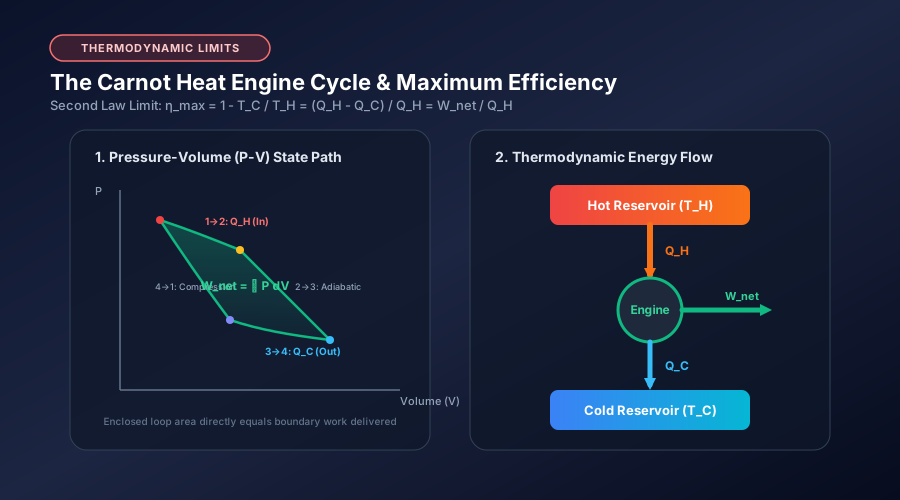
Thermodynamic P-V Indicator & Carnot Maximum Efficiency
Reversible work integral: Boundary work W = ∮ P dV bounded by isothermal and adiabatic expansions, establishing the theoretical efficiency limit.
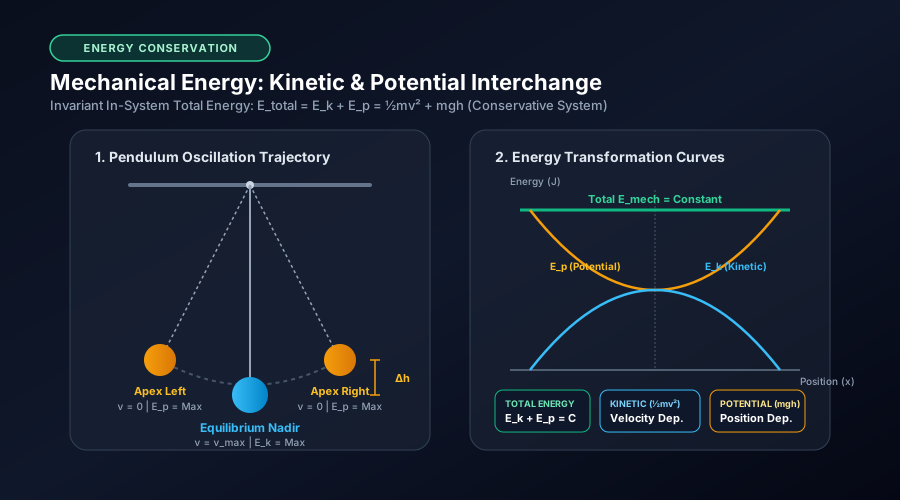
Conservation of Mechanical Energy: Kinetic & Potential Exchange
Conservative energy conversion: Continuous reciprocal transfer between kinetic energy ½mv² and gravitational potential energy mgh.
Power Dynamics, Horsepower Standards & Multilateral Energy Equivalencies
Power measures the time rate at which work is performed or energy is transferred across physical boundaries: P = dW/dt. While the SI unit of power is the Watt (1 W = 1 Joule/second), engineering across automotive, aerospace, marine, and HVAC domains employs legacy imperial, metric, and thermal standards that require rigorous mathematical reconciliation.
1. Defining Horsepower Across International Standards
Formulated by Scottish engineer James Watt in 1782 to market steam engines to mine owners comparing them against draft horses, the definition of horsepower varies significantly by international regulatory jurisdiction:
- Mechanical / Imperial Horsepower (hp): Defined in British and American standards as the power required to lift 550 pounds at a speed of 1 foot per second: 1 hp = 550 ft·lbf/s = 745.699872 Watts.
- Metric Horsepower (PS, CV, ch, pk): Standardized in Germany (DIN 66036) and Continental Europe as the power to lift 75 kilograms by 1 meter in 1 second under standard Earth gravity: 1 PS = 75 kgf·m/s = 735.49875 Watts (1.39% less power than Imperial hp).
- Electrical Horsepower: Adopted by the U.S. National Electrical Code (NEC) for electric motor ratings, defined cleanly as exactly 1 hp = 746.00 Watts.
- Boiler Horsepower (BHP): Used in industrial steam plants, defined as the power required to evaporate 34.5 pounds of water per hour from and at 212°F (100°C): 1 BHP = 33,471.4 BTU/h = 9,809.5 Watts.
2. The Multilateral Joules Matrix
The Joule (J) is the foundational coherent derived unit of energy in the International System of Units (SI). One Joule is defined as the work done by a force of one Newton acting over a displacement of one meter (1 J = 1 N·m = 1 kg·m²/s²):
- Kilowatt-hour (kWh): 1 kWh = 1,000 Watts × 3,600 seconds = 3,600,000 Joules (3.60 MJ).
- British Thermal Unit (BTU): The heat required to raise the temperature of 1 pound of water by 1°F: 1 BTU ≈ 1,055.056 Joules.
- Thermochemical Calorie (cal_th): 1 cal_th = 4.184 Joules.
- Dietary Calorie (Food Calorie / kcal): 1 kcal = 1,000 cal = 4,184 Joules (4.184 kJ).
- Electronvolt (eV): The kinetic energy gained by an electron accelerating across an electric potential of 1 Volt: 1 eV ≈ 1.602176634 × 10⁻¹⁹ Joules.
3. HVAC Thermal Sizing, SEER & Coefficient of Performance
In refrigeration and air conditioning engineering, cooling capacity is expressed in British Thermal Units per hour (BTU/hr) or Tons of Refrigeration. One Ton of Refrigeration is defined as the heat absorption rate required to freeze or melt 2,000 pounds (1 short ton) of pure ice at 0°C in 24 hours:
1 Ton of Refrigeration = 12,000 BTU/h = 3,516.85 Watts thermal (~3.517 kW)
The Seasonal Energy Efficiency Ratio (SEER) measures the total cooling output in BTUs divided by the total electric energy consumed in Watt-hours over a representative cooling season. The dimensionless thermodynamic Coefficient of Performance (COP) relates directly to SEER via:
COP = (BTU/h / Watts) / 3.412142 = SEER / 3.412142
A high-efficiency heat pump with a SEER rating of 18 achieves a seasonal COP of ~5.27, transferring 5.27 Joules of heat energy for every 1 Joule of electrical energy drawn from the grid.
Frequently Asked Questions
Why are European and American car horsepower ratings slightly different?
European automakers historically publish engine output in Metric Horsepower (PS in Germany, CV in France/Italy), defined as 735.5 Watts. American manufacturers publish in Imperial Mechanical Horsepower (hp), defined as 745.7 Watts. A German sports car rated at 300 PS produces approximately 296 American SAE horsepower.
Why does a heat pump have an efficiency greater than 100%?
Electric resistance heaters generate heat by dissipating electric work into thermal energy, which has a maximum physical limit of 100% (1 Joule of electricity = 1 Joule of heat). A heat pump does not create heat; it uses a vapor compression cycle to pump existing heat from outdoor air into the building. With a COP of 4.0, 1 kW of electrical power moves 4 kW of thermal heat, yielding an apparent efficiency of 400%.
What is the difference between a calorie and a Calorie with a capital C?
In scientific chemistry, a small calorie (cal) is the energy needed to warm 1 gram of water by 1°C (4.184 J). In nutrition and food labeling, a Calorie (with a capital C) is actually a kilocalorie (kcal = 1,000 small calories = 4,184 J). A 250-Calorie candy bar contains 250,000 scientific calories or roughly 1,046,000 Joules of chemical energy.
About Calories to Joules
Convert energy units. Built for fast physics problem solving with step-by-step explanations, unit conversions, and practical help content.
Why this page helps
- Better than a plain formula page because it explains the result as well as calculates it
- Useful for school, college, exam practice, and quick engineering checks
- Helps reduce common unit-conversion mistakes
- Makes scenario testing faster with presets and instant recalculation
How to use it well
- Choose the Calories to Joules and identify which motion values are already known.
- Enter the values carefully and set the matching units for distance, time, velocity, angle, or acceleration.
- Read the main answer first, then confirm the formula and the step-by-step derivation.
- Use the conversion output, graph, related tools, or download options if you need a report or comparison.