Physics Calculator
Energy & Power
Renewable Energetics•Solar, Wind, Hydro & Battery Storage
Wind Power Calculator
Multi-source renewable generation engine calculating solar photovoltaic array yields, Betz-limit aerodynamic wind turbine power curves, hydroelectric gravitational head generation, and electrochemical battery storage runtimes.
PV Array & Insolation Inputs
kWp
4.8 hrs
2.5 (UK / Germany)4.5 (USA Midwest)6.5 (Arizona / Desert)
%
Accounts for temperature derating, soiling, and cabling
$/kWh
Photovoltaic Energy Generation
E = P_dc × PSH × PRDaily Production
25.58
kWh / day average
Annual Production
9.34
MWh (9,338.2 kWh)
Annual Financial Value
$1,307.34
$3.58/day
Monthly Harvest
767.5 kWh
Average 30-day billing
CO2 Offset Avoidance
6.54 t
Metric tonnes / year
Specific Yield
1437
kWh / kWp / year
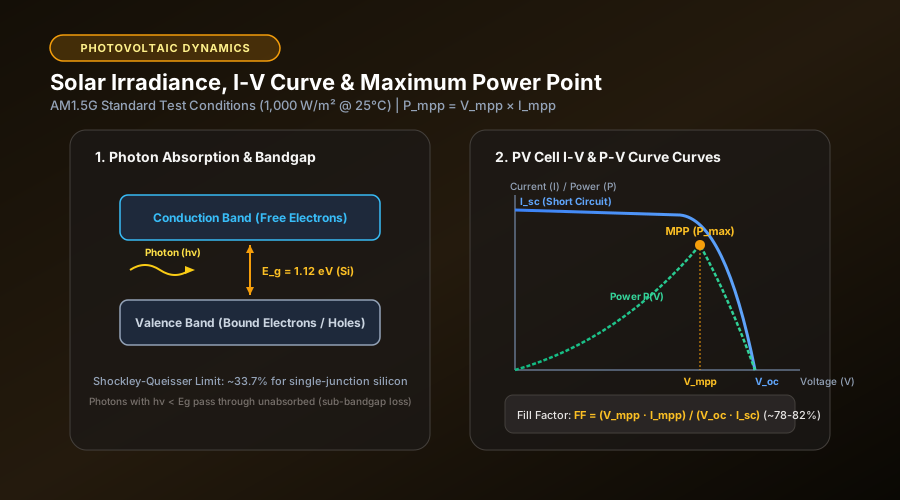
Photovoltaic Semiconductor Energetics & MPP
Bandgap photon absorption: Maximum Power Point (MPP) tracking at V_mpp and I_mpp, bounded by Shockley-Queisser thermodynamic limits.
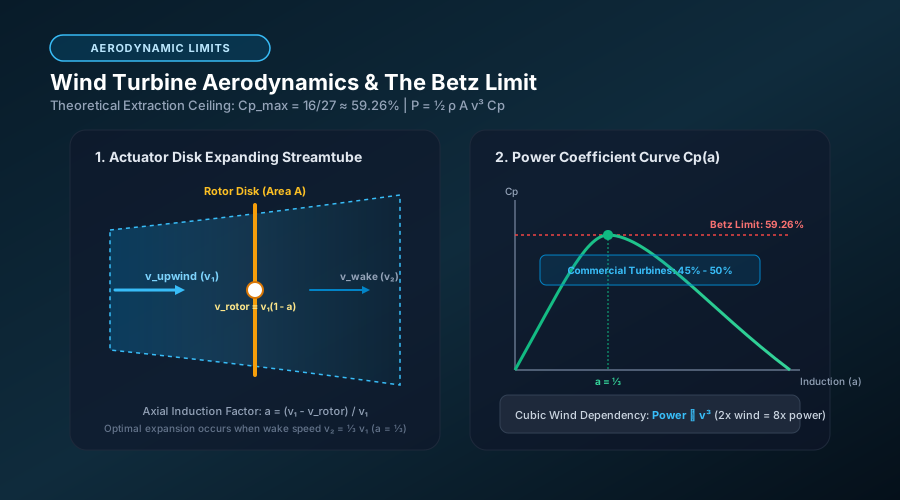
Wind Turbine Aerodynamics & The Betz Limit
Actuator disk streamtube expansion: Maximum theoretical kinetic extraction coefficient Cp_max = 16/27 ≈ 59.26% under cubic wind velocity v³.
Renewable Energy Generation, Aerodynamic Betz Limits & Electrochemical Storage
Decarbonizing global energy grids requires engineering systems that capture variable environmental kinetic and radiant energy fluxes—sunlight, wind velocity, and falling water—and synchronizing them with electrochemical battery storage systems. Each generation modality operates according to fundamental physical laws and thermodynamic limits.
1. Photovoltaic Conversion & The Shockley-Queisser Limit
Solar photovoltaic cells exploit the photoelectric effect in semiconductor p-n junctions. When incident photons possess energy greater than or equal to the semiconductor's bandgap energy (Eg = 1.12 eV for standard crystalline silicon), valence electrons are excited into the conduction band, generating electron-hole pairs that are separated by the internal electric field.
In 1961, William Shockley and Hans-Joachim Queisser calculated the ultimate thermodynamic efficiency limit for a single-junction solar cell under standard Air Mass 1.5 solar spectrum. The limit (~33.7% for silicon) arises from two unalterable physical mechanisms:
- Sub-Bandgap Loss: Photons with energy less than Eg lack the energy to excite electrons and pass directly through the silicon without producing electricity.
- Thermal Relaxation / Thermalization: Photons with energy substantially higher than Eg excite electrons high into the conduction band, but this excess energy (hν - Eg) is rapidly dissipated within picoseconds as lattice heat vibrations (phonons).
2. The Betz Limit & Cubic Wind Scaling
Published in 1919 by German physicist Albert Betz, Betz's Law proves that no wind turbine can capture more than 16/27 (59.26%) of the kinetic energy in a moving airstream. If a turbine were 100% efficient, it would extract all kinetic energy from the wind, bringing downwind air velocity to zero (v₂ = 0), which would block incoming wind from flowing through the rotor blades.
Furthermore, wind turbine power output scales with the cube of wind velocity:
P_wind = ½ · ρ · A · v³ · Cp
Because of this cubic power law (v³), doubling the wind speed from 5 m/s to 10 m/s increases the available kinetic energy flux by an astonishing factor of eight (2³ = 8x).
3. Hydroelectric Head Potential
Hydroelectricity represents the most established and flexible utility-scale renewable generation technology. Water stored in elevated reservoirs possesses gravitational potential energy Ep = m·g·H. When discharged through a penstock at volumetric flow rate Q (m³/s), continuous power generation is:
P_hydro = η · ρ · g · Q · H
With modern hydro turbines achieving mechanical efficiencies exceeding 90% to 94%, hydroelectricity exhibits the highest conversion efficiency of any utility-scale power generation asset in the world.
Frequently Asked Questions
Why should a battery not be discharged to 0%?
Deep discharging damages battery electrodes. Traditional lead-acid batteries degrade rapidly if discharged beyond 50% Depth of Discharge (DoD). Modern Lithium Iron Phosphate (LiFePO4) chemistry can safely discharge to 80%–90% DoD, but reserving 10%–20% capacity prevents dendritic short-circuits and extends cycle longevity from 2,000 to over 5,000 charge cycles.
What are Peak Sun Hours (PSH)?
Peak Sun Hours does not measure the total hours of daylight. It represents the equivalent number of hours per day when solar irradiance equals standard test conditions of exactly 1,000 Watts per square meter (1 kW/m²). A sunny 12-hour day in summer typically yields between 4.5 and 6.0 Peak Sun Hours.
Why can't a wind turbine operate during extreme hurricane winds?
At wind speeds above ~25 m/s (~90 km/h or 55 mph), aerodynamic drag forces threaten to overwhelm the turbine tower's structural integrity and gearboxes. Modern turbines engage aerodynamic pitch furling to feather the blades into the wind, applying mechanical brakes to stop rotation and protect the generator.
About Wind Power Calculator
Estimate wind turbine output. Built for fast physics problem solving with step-by-step explanations, unit conversions, and practical help content.
Why this page helps
- Better than a plain formula page because it explains the result as well as calculates it
- Useful for school, college, exam practice, and quick engineering checks
- Helps reduce common unit-conversion mistakes
- Makes scenario testing faster with presets and instant recalculation
How to use it well
- Choose the Wind Power Calculator and identify which motion values are already known.
- Enter the values carefully and set the matching units for distance, time, velocity, angle, or acceleration.
- Read the main answer first, then confirm the formula and the step-by-step derivation.
- Use the conversion output, graph, related tools, or download options if you need a report or comparison.