Classical Mechanics & Thermodynamics•Energy, Work & Power Dynamics
Mechanical Energy Calculator
Multi-mode computational physics engine simulating classical & relativistic kinetic energy (½mv²), gravitational & elastic spring potential energy (mgh, ½kx²), mechanical work vectors (F·d·cos θ), closed-system energy conservation, and Carnot thermodynamic cycle limits.
Motion & Mass Parameters
kg
100.0 km/h
m/s
62.1 mphMach 0.08
Kinetic Energy & Momentum
Ek = ½ m v²Kinetic Energy (J)
463
kJ (0.463 MJ)
Electrical Unit (kWh)
0.1286
Kilowatt-hours
Imperial Work (ft·lb)
341,490
Foot-pounds
Linear Momentum (p)
33,336
kg·m/s (p = m·v)
Lorentz Factor (γ)
1.005
γ = 1/√(1 - v²/c²)
Thermochemical (cal)
110,660
Calories (4.184 J/cal)
The Quadratic Velocity Relationship (v²):
Because kinetic energy scales quadratically with velocity, doubling an automobile's speed from 50 km/h to 100 km/h does not double its kinetic energy—it quadruples it (4x). Braking distance, structural crash impact forces, and stopping work all increase by 400%, which forms the fundamental physical basis for highway speed regulations.
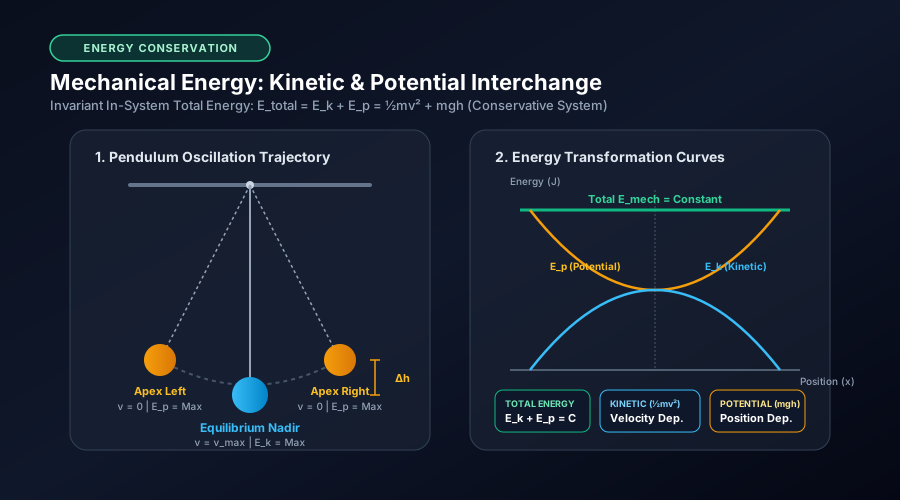
Conservation of Mechanical Energy: Kinetic & Potential Exchange
Conservative vector field interchange: Potential energy mgh trades off with kinetic energy ½mv², keeping total mechanical energy rigorously invariant.
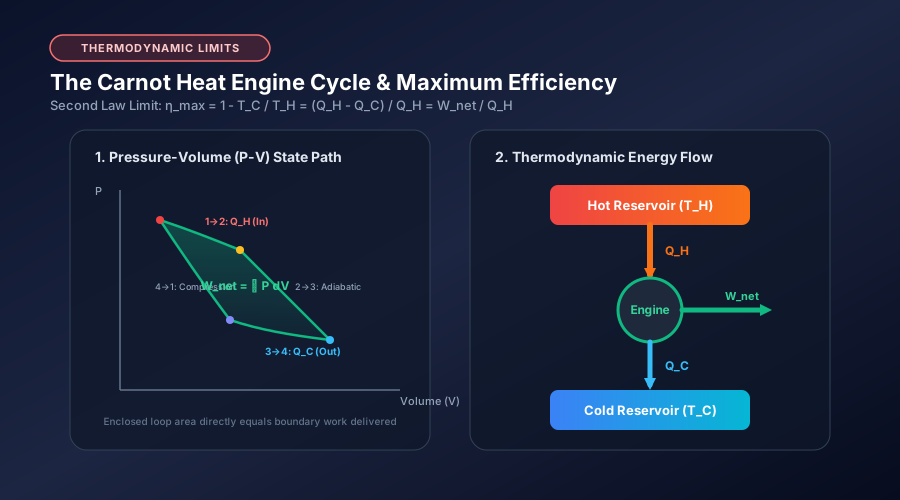
Thermodynamic P-V Indicator & Carnot Maximum Efficiency
Second Law boundary: Isothermal and adiabatic reversible paths establish theoretical maximum thermal conversion η_max = 1 - T_C / T_H.
Mechanical Work, Energy Conservation & Thermodynamic Efficiency
Energy is the fundamental currency of physical reality. Under Emmy Noether's celebrated theorem, the conservation of energy is the direct mathematical consequence of time-translation symmetry—the invariant law that the fundamental rules of physics do not change from one moment to the next. From macroscopic planetary motion and roller coaster dynamics to atomic electron transitions, energy manifests in various interchangeable states while remaining rigorously conserved in total quantity.
1. Classical vs Relativistic Kinetic Energy
In classical Newtonian mechanics, an object of invariant mass m accelerated by a force over displacement d acquires translational kinetic energy directly proportional to the square of its speed:
Ek = ½ · m · v²
However, as velocities approach significant fractions of the speed of light c (v > 0.1c), Albert Einstein's special theory of relativity demonstrates that the classical formulation underestimates the required energy. The exact relativistic kinetic energy requires accounting for the Lorentz factor γ = 1 / √(1 - v²/c²):
Ek_relativistic = (γ - 1) · m · c²
When v << c, the Taylor expansion of γ yields γ ≈ 1 + ½(v²/c²), simplifying the relativistic formula precisely back into the classical ½mv².
2. Potential Energy Fields & Conservative Forces
Potential energy represents the energy stored within a physical system by virtue of the relative position or configuration of its parts:
- Uniform Gravitational Fields: For elevations near the Earth's surface, gravitational potential energy is given by Ep = m·g·h, representing the work done against constant gravity g to lift an object to height h.
- Elastic Hookean Springs: When a spring with spring constant k is compressed or stretched by distance x, Hooke's restoring force F = -kx increases linearly. Integrating this force over displacement yields the elastic potential energy: Ep = ½·k·x².
3. The Work-Energy Theorem & Dissipative Losses
The Work-Energy Theorem states that the net work performed by all forces acting upon a particle equals the instantaneous change in its kinetic energy:
W_net = ΔEk = Ek_final - Ek_initial
When non-conservative forces like tribological friction or aerodynamic air drag act upon the body, mechanical energy is converted into disorganized microscopic thermal vibrations (heat):
E_initial = E_final + W_friction ⟹ (mgh₁ + ½mv₁²) = (mgh₂ + ½mv₂²) + F_friction · d
4. Thermodynamic Heat Engine Limits: The Carnot Ceiling
While mechanical energy can theoretically be converted into thermal energy with 100% efficiency (e.g., brake pads stopping a speeding vehicle), the reverse process—converting random thermal energy into ordered mechanical work—is strictly constrained by the Second Law of Thermodynamics.
In 1824, Sadi Carnot proved that any heat engine operating between a hot thermal source at temperature T_H and a cold sink at temperature T_C has an upper theoretical efficiency bound:
η_Carnot = 1 - (T_C / T_H)
where temperatures must be expressed in absolute thermodynamic degrees Kelvin (K = °C + 273.15). For example, a modern coal or nuclear power plant operating with steam at 550°C (823 K) and cooling river water at 25°C (298 K) has a theoretical Carnot maximum of 63.8%. Real-world mechanical and turbine losses limit practical plant efficiency to 38%–42%.
Frequently Asked Questions
Why does an automobile need more distance to stop at higher speeds?
Braking friction does work to dissipate the car's kinetic energy: F_brake · d = ½mv². Because kinetic energy scales with the square of velocity, increasing speed from 60 km/h to 120 km/h quadruples the kinetic energy (4x), demanding four times the stopping distance under identical tire traction.
Can a machine ever achieve 100% mechanical efficiency?
No macroscopic machine can achieve 100% efficiency. Microscopic friction in bearings, aerodynamic drag, acoustic sound waves, and electrical resistance inevitably dissipate a portion of the input energy as waste heat. In heat engines, achieving 100% Carnot efficiency would require a cold sink at absolute zero (0 Kelvin), which is physically impossible under the Third Law of Thermodynamics.
What is the difference between energy and power?
Energy is the total capacity or amount of work performed (measured in Joules or kWh). Power is the rate at which energy is transferred or consumed per unit of time (measured in Watts = Joules/second or horsepower). A 1,000-Watt microwave consumes 1,000 Joules of energy every single second.