Enter Real Number x
Greatest Integer vs Least Integer:
Floor ⌊x⌋ always rounds down toward negative infinity. Ceiling ⌈x⌉ rounds up toward positive infinity.
Step Function Evaluations
Floor: ⌊x⌋
3
Ceiling: ⌈x⌉
4
Fractional: {x}
0.7
Truncate: trunc(x)
3
Heaviside: H(x)
1
Sign: sgn(x)
1
Polar Curves, Parametric Trajectories & Step Functions Guide
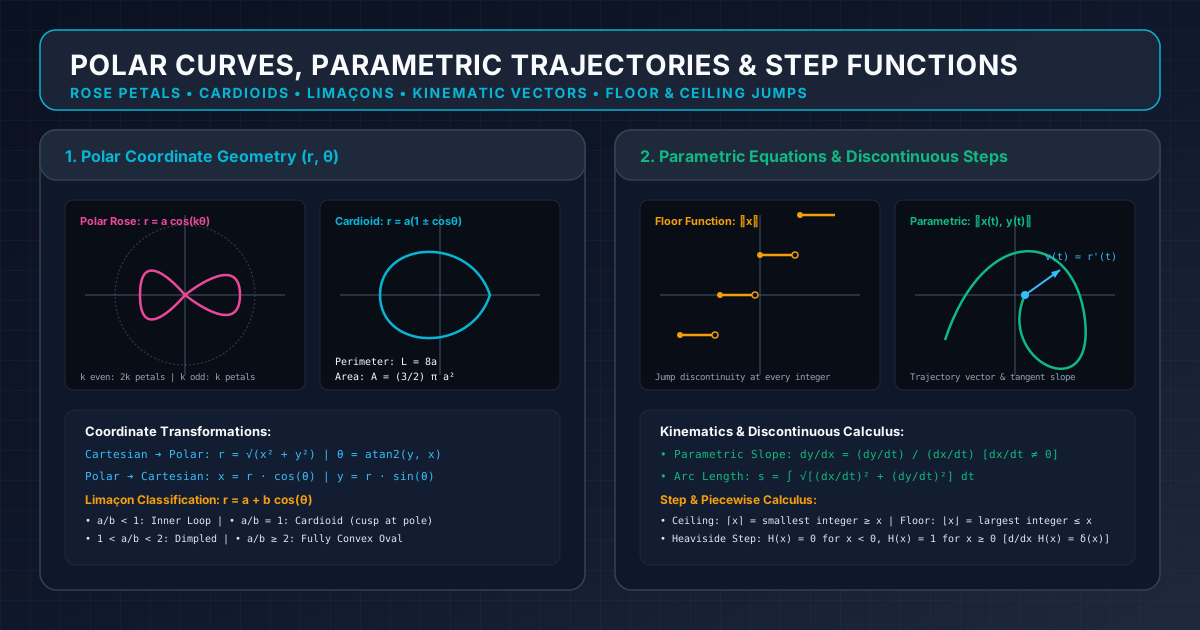
Visual reference covering polar rhodonea rose petal counts, cardioid arc lengths, parametric velocity vectors, and discrete jump discontinuities.
1. Polar Coordinate Geometry and Harmonic Angular Traces
In two-dimensional polar coordinate systems $(r, \theta)$, points are located by their radial distance $r$ from a central pole and their counterclockwise angle $\theta$ from a positive polar axis. Polar coordinates simplify curves exhibiting rotational or harmonic symmetry that are otherwise intractable in Cartesian $y = f(x)$ forms:
- Rhodonea (Polar Rose) Curves: Described by $r = a \cos(k\theta)$ or $r = a \sin(k\theta)$, named by Italian mathematician Luigi Guido Grandi in 1728. When $k$ is an odd integer, the curve closes after one period $\pi$, producing exactly $k$ petals. When $k$ is an even integer, the curve requires $2\pi$ to close, generating $2k$ symmetric petals.
- Cardioids and Limaçons of Pascal: Étienne Pascal studied the family $r = a + b \cos\theta$. When $a = b$, the inner loop collapses to a sharp cusp at the origin, forming a cardioid whose perimeter is exactly $8a$ and whose area is $\frac32\pi a^2$.
2. Parametric Equations and Dynamic Kinematic Trajectories
In physics and kinematics, spatial position is parameterized by time t: r(t) = ⟨x(t), y(t)⟩. The velocity vector is given by the derivative v(t) = ⟨x'(t), y'(t)⟩, with speed defined as the Euclidean magnitude |v(t)| = √[(x')² + (y')²].
The slope of the tangent line to a parametric curve in the Cartesian plane is the ratio of their instantaneous time rates of change:
dy / dx = (dy/dt) / (dx/dt) [dx/dt ≠ 0]
3. Step Functions, Jump Discontinuities, and Distribution Theory
Discrete and piecewise functions bridge continuous calculus with digital computation:
- Floor Function ⌊x⌋: Maps a real number to the greatest integer less than or equal to x. At every integer n, the function exhibits a jump discontinuity of magnitude 1, with left-hand limit equal to n - 1 and right-hand limit equal to n.
- Heaviside Step Function $H(x)$: Used extensively in electrical engineering and control systems to represent instantaneous switch activations. In Schwartz distribution theory, the weak derivative of the Heaviside step function is the Dirac delta distribution $\delta(x)$, representing an instantaneous unit impulse.