Curve Parameters
Curve Properties & Critical Points
Equation
y = 1x³ - 3x² + 0x + 2
Inflection Point:(1.000, 0.000)
Critical Extrema Points:x₁ = 2.000, x₂ = 0.000
Asymptote:No asymptotes (Polynomial of degree 3)
Function Analysis, Sequences & Transcendental Curves Guide
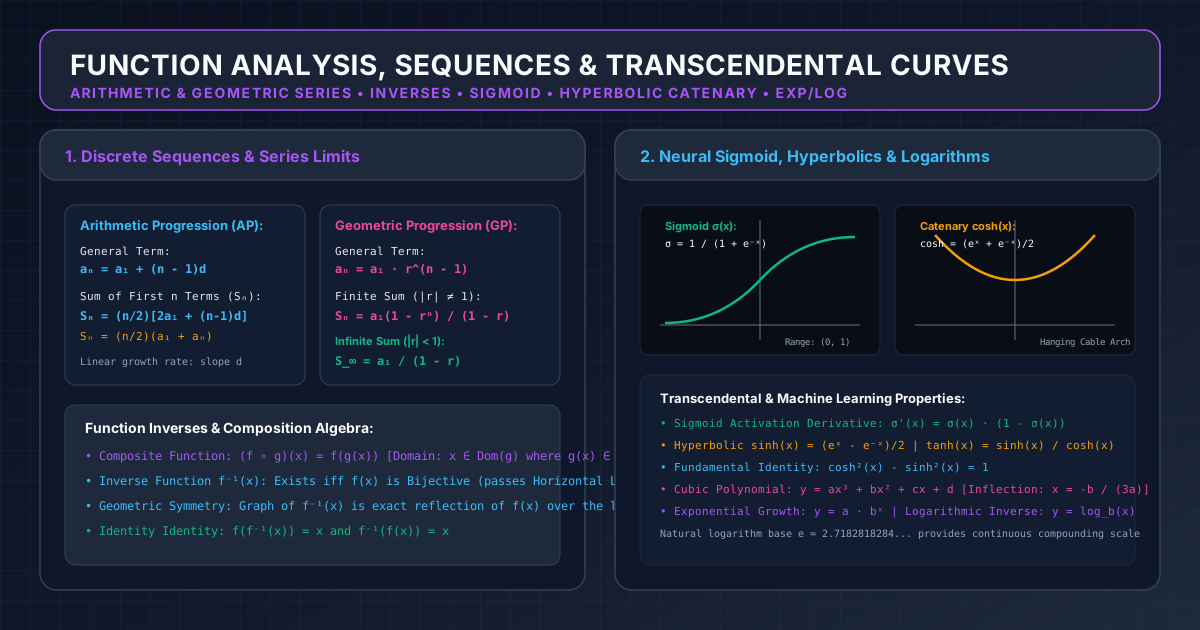
Visual reference mapping discrete arithmetic/geometric progressions, neural network sigmoid activations, hyperbolic catenary curves, and inverse function reflections.
1. Mathematical Mapping, Inverses, and Functional Composition
A mathematical function $f: X \to Y$ is a relation assigning to each element $x$ in a domain $X$ exactly one element $y = f(x)$ in a codomain $Y$. In functional algebra, composition $(f \circ g)(x) = f(g(x))$ chains operations in series.
An inverse function $f^-1(x)$ undoes the operation of $f(x)$, satisfying $f(f^-1(x)) = x$ and $f^-1(f(x)) = x$. Geometrically, the graph of $f^-1(x)$ is the mirror reflection of $f(x)$ across the diagonal identity line $y = x$. A function possesses a well-defined two-sided inverse if and only if it is strictly bijective (one-to-one and onto), verified visually by the Horizontal Line Test.
2. Discrete Sequences, Convergence, and Infinite Series Limits
While continuous functions model smooth processes, sequences a_n model discrete time steps, compound interest periods, and numerical algorithm iterations:
- Arithmetic Progression (AP): Features a constant difference d. The n-th term is aₙ = a₁ + (n - 1)d, and the partial sum of n terms is Sₙ = (n / 2)(a₁ + aₙ). Because d ≠ 0 produces unbounded terms, infinite arithmetic series always diverge.
- Geometric Progression (GP): Features a constant multiplier ratio r. The n-th term is aₙ = a₁ · r^(n - 1). If and only if the absolute common ratio is strictly less than 1 (|r| < 1), the infinite geometric series converges to a finite limit:S_∞ = a₁ / (1 - r)
3. Transcendental, Machine Learning & Hyperbolic Curves
Functions that cannot be expressed as finite combinations of algebraic operations are termed transcendental:
- Sigmoid Function: Defined as σ(x) = 1 / (1 + e⁻ˣ), the sigmoid squashes the entire real line (-∞, ∞) into a normalized probability interval (0, 1). Its symmetric derivative σ'(x) = σ(x)(1 - σ(x)) makes it a foundational activation function in logistic regression and artificial neural network backpropagation.
- Hyperbolic Catenary ($\cosh$): A uniform flexible cable or electrical transmission line hanging under its own weight between two supports forms a catenary curve $y = a \cosh(x/a)$, rather than a parabola as Galileo originally conjectured.