Math Calculator
Graphs & Formulas
Sequence Configuration
Sequence Terms & Series Sum
n-th Term (a_10)
48
aₙ = 3 + (n - 1)(5)
Partial Sum (S_10)
255
First Terms Sequence:
a_1 = 3
a_2 = 8
a_3 = 13
a_4 = 18
a_5 = 23
a_6 = 28
a_7 = 33
a_8 = 38
a_9 = 43
a_10 = 48
Function Analysis, Sequences & Transcendental Curves Guide
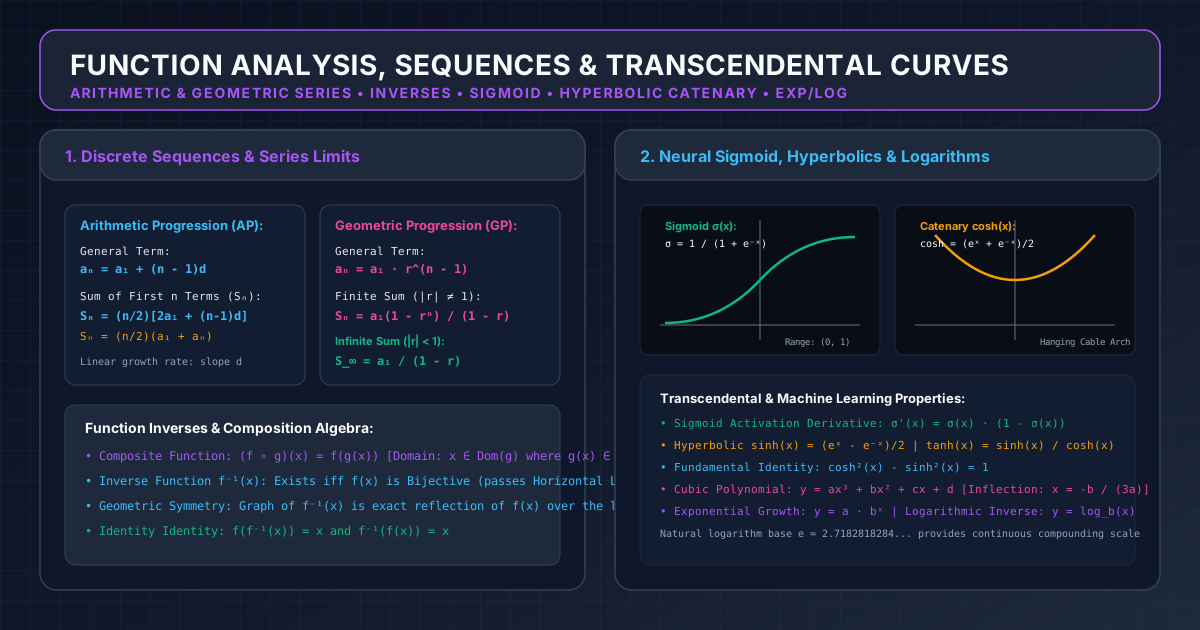
Visual reference mapping discrete arithmetic/geometric progressions, neural network sigmoid activations, hyperbolic catenary curves, and inverse function reflections.
1. Mathematical Mapping, Inverses, and Functional Composition
A mathematical function $f: X \to Y$ is a relation assigning to each element $x$ in a domain $X$ exactly one element $y = f(x)$ in a codomain $Y$. In functional algebra, composition $(f \circ g)(x) = f(g(x))$ chains operations in series.
An inverse function $f^-1(x)$ undoes the operation of $f(x)$, satisfying $f(f^-1(x)) = x$ and $f^-1(f(x)) = x$. Geometrically, the graph of $f^-1(x)$ is the mirror reflection of $f(x)$ across the diagonal identity line $y = x$. A function possesses a well-defined two-sided inverse if and only if it is strictly bijective (one-to-one and onto), verified visually by the Horizontal Line Test.
2. Discrete Sequences, Convergence, and Infinite Series Limits
While continuous functions model smooth processes, sequences a_n model discrete time steps, compound interest periods, and numerical algorithm iterations:
- Arithmetic Progression (AP): Features a constant difference d. The n-th term is aₙ = a₁ + (n - 1)d, and the partial sum of n terms is Sₙ = (n / 2)(a₁ + aₙ). Because d ≠ 0 produces unbounded terms, infinite arithmetic series always diverge.
- Geometric Progression (GP): Features a constant multiplier ratio r. The n-th term is aₙ = a₁ · r^(n - 1). If and only if the absolute common ratio is strictly less than 1 (|r| < 1), the infinite geometric series converges to a finite limit:S_∞ = a₁ / (1 - r)
3. Transcendental, Machine Learning & Hyperbolic Curves
Functions that cannot be expressed as finite combinations of algebraic operations are termed transcendental:
- Sigmoid Function: Defined as σ(x) = 1 / (1 + e⁻ˣ), the sigmoid squashes the entire real line (-∞, ∞) into a normalized probability interval (0, 1). Its symmetric derivative σ'(x) = σ(x)(1 - σ(x)) makes it a foundational activation function in logistic regression and artificial neural network backpropagation.
- Hyperbolic Catenary ($\cosh$): A uniform flexible cable or electrical transmission line hanging under its own weight between two supports forms a catenary curve $y = a \cosh(x/a)$, rather than a parabola as Galileo originally conjectured.
Frequently Asked Questions (FAQ)
About Series Calculator
Institutional function analysis, discrete progression, and transcendental curve suite. Evaluate composite and inverse functions, solve arithmetic and geometric sequences with finite/infinite series sums, compute cubic inflection points, analyze exponential growth and natural logarithms, and simulate machine learning sigmoid activations and hyperbolic catenary curves.
Why this page helps
- Crucial for data scientists, financial analysts, machine learning engineers, and calculus students
- Accurately models compound growth, discrete algorithms, and continuous physical systems
- Zero-blur vector SVG diagram maps functional behaviors and series convergence
How to use it well
- Select your functional category: Composition & Inverses, AP/GP Sequences, Polynomial/Transcendental, or Sigmoid/Hyperbolics.
- Input function coefficients, sequence initial terms, or evaluation points.
- Inspect the composite results, n-th terms, partial sums, or inflection points.
- Review calculus derivatives, asymptotes, and functional symmetries.
- Save your calculation to history or download the full sequence array.