Circle ParametersEccentricity e = 0
Equations & Metrics
Standard Form
(x - 0)² + (y - 0)² = 25
General Form
x² + y² + 0x + 0y - 25 = 0
Area
78.5398
Circumference
31.4159
Diameter
10
Conic Sections & 3D Quadric Surfaces Guide
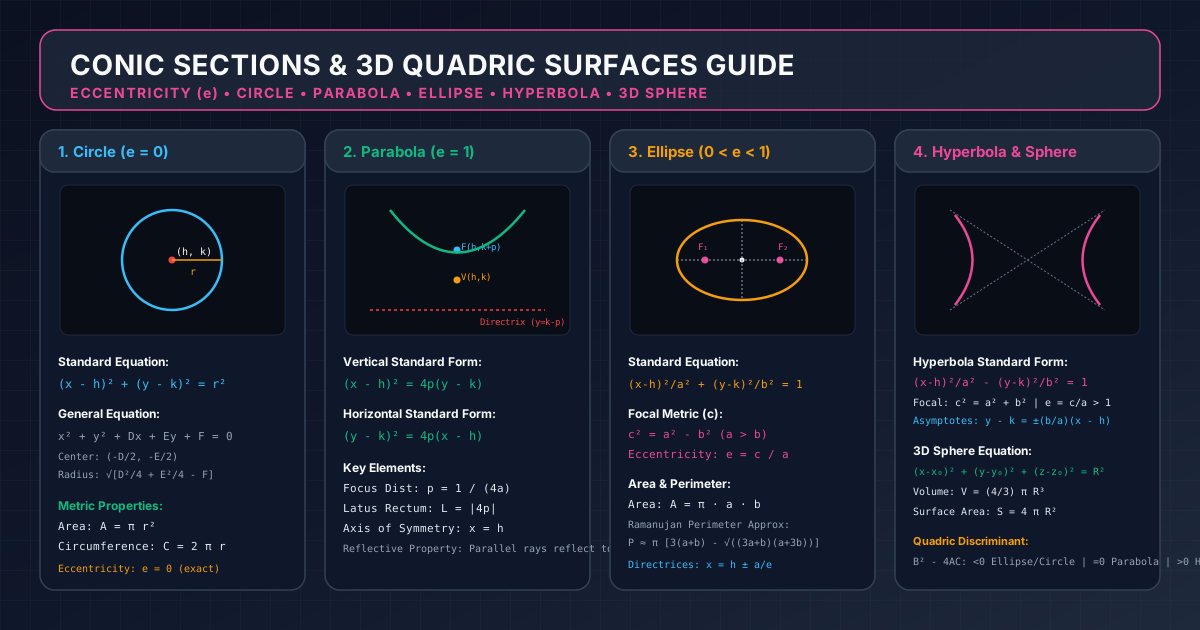
Visual reference mapping conic classifications by eccentricity (e = 0, e = 1, e < 1, e > 1), focal properties, directrices, and 3D spherical volumes.
1. The Classical Theory of Conic Sections: Apollonius to Kepler
Conic sections were first systematically investigated by Apollonius of Perga around 200 BC in his eight-volume work Conics. A conic section is defined geometrically as the intersection of a plane with a double right circular cone. Depending on the angle between the cutting plane and the cone's central axis, four fundamental curves emerge: the circle, the ellipse, the parabola, and the hyperbola.
In 1609, Johannes Kepler revolutionized celestial mechanics by showing in Astronomia Nova that planetary orbits are not perfect circles as Ptolemy and Copernicus assumed, but ellipses with the Sun at one focus (Kepler’s First Law). Sir Isaac Newton later proved from the inverse-square law of universal gravitation that all two-body orbital trajectories under central gravity must trace out a conic section: bound orbits are circles ($e = 0$) or ellipses ($0 < e < 1$), parabolic trajectories ($e = 1$) represent escape velocity, and hyperbolic paths ($e > 1$) represent unbounded flybys.
2. The Unified Focus-Directrix-Eccentricity Definition
In modern analytic geometry, every non-degenerate conic section can be unified under a single geometric definition: the locus of all points $P$ in a plane whose distance to a fixed point (the focus $F$) is proportional to its perpendicular distance to a fixed line (the directrix $L$):
e = Dist(P, F) / Dist(P, L)
- Circle: $e = 0$ (directrix is at infinity).
- Ellipse: $0 < e < 1$ (bounded closed curve).
- Parabola: $e = 1$ (distance to focus equals distance to directrix).
- Hyperbola: $e > 1$ (open, two-branched curve with asymptotes).
3. 3D Quadric Surfaces and the General Second-Degree Equation
The general second-degree equation in two variables is $Ax^2 + Bxy + Cy^2 + Dx + Ey + F = 0$. The nature of the curve is determined by its discriminant $\Delta = B^2 - 4AC$:
- If $B^2 - 4AC < 0$, the curve is an ellipse or circle (or empty set).
- If $B^2 - 4AC = 0$, the curve is a parabola.
- If $B^2 - 4AC > 0$, the curve is a hyperbola.
Extending to three dimensions yields quadric surfaces such as spheres, ellipsoids, paraboloids, and hyperboloids. A sphere of radius $R$ centered at $(x_0, y_0, z_0)$ has volume $V = \frac43\pi R^3$ and surface area $S = 4\pi R^2$, representing the shape that minimizes surface area for any given volume.