Enter Point Coordinates2D Cartesian
Point 1: P₁(x₁, y₁)
Point 2: P₂(x₂, y₂)
Slope (Gradient) Formula:
m = Δy / Δx = (y₂ - y₁) / (x₂ - x₁). Angle of inclination is derived via θ = arctan(m).
Line Forms & Metrics
Slope-Intercept Form (y = mx + b)
y = 2x - 1
Slope (m)
2
Inclination θ
63.43°
Perpendicular Slope
-0.5
Standard Form (Ax + By = C):
8x - 4y = 4
Cartesian Coordinates, Linear Systems & Asymptotes Guide
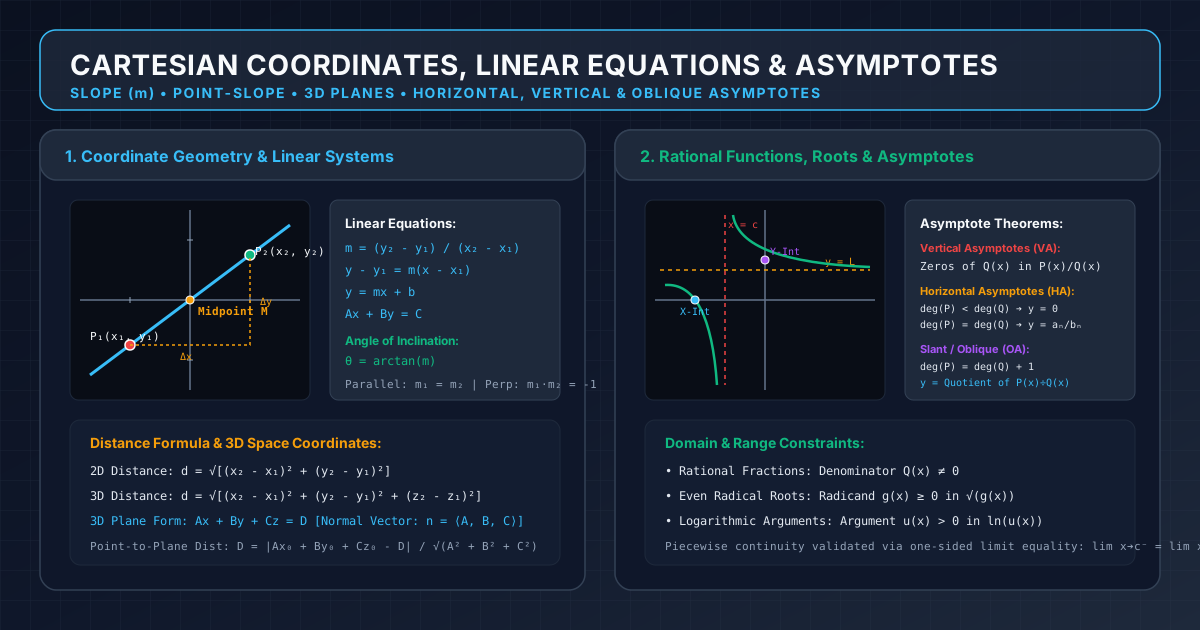
Visual reference mapping coordinate lines, slope geometry, 3D Euclidean distances, normal vectors, and polynomial rational asymptote limits.
1. The Foundations of Analytic Geometry and Cartesian Coordinates
Introduced by René Descartes in his 1637 landmark treatise La Géométrie, the Cartesian coordinate system established the bridge between classical synthetic Euclidean geometry and algebraic analysis. By assigning ordered real number pairs (x, y) in 2D space or triplets (x, y, z) in 3D space to geometric points, geometric curves and spatial relationships can be expressed as algebraic equations.
A straight line in two dimensions represents the set of all points satisfying a first-degree polynomial equation $Ax + By = C$. The fundamental invariant of a non-vertical line is its slope or gradient $m$, defined as the ratio of vertical change (rise) to horizontal change (run):
m = Δy / Δx = (y₂ - y₁) / (x₂ - x₁) = tan(θ)
2. Euclidean Distance and 3D Vector Geometry
The distance between two points in n-dimensional Euclidean space is directly derived from the generalized Pythagorean Theorem:
d = √[(x₂ - x₁)² + (y₂ - y₁)² + (z₂ - z₁)²]
In three-dimensional space, a flat plane is uniquely determined by a point (x₀, y₀, z₀) and a normal vector n = ⟨A, B, C⟩ perpendicular to the plane. The scalar equation of the plane is A(x - x₀) + B(y - y₀) + C(z - z₀) = 0, expanding into standard form Ax + By + Cz = D.
3. Asymptotic Behavior and Limits at Infinity
An asymptote of a curve is a line such that the distance between the curve and the line approaches zero as one or both of the coordinates tend to infinity:
- Vertical Asymptotes: Occur at x = c where the function approaches positive or negative infinity. In rational functions P(x)/Q(x), these correspond to non-removable zeros of the denominator Q(x).
- Horizontal Asymptotes: Occur at y = L where the function approaches a finite limit L as x tends to positive or negative infinity.
- Slant (Oblique) Asymptotes: Occur when the degree of the numerator is strictly one greater than the degree of the denominator. Polynomial long division yields f(x) = (mx + b) + R(x)/Q(x), where y = mx + b is the slant asymptote because the remainder R(x)/Q(x) approaches zero as x approaches infinity.